

Archive position — measured, not model output
0 likes on Devpost
2,263 of the 7,850 archived projects have more likes, and 5,587 share exactly 0 — so this project's #5,679 place in the like-ranked listing is a tie-break inside that group, not a ranking.
Projects (log scale)
Likes on Devpost. ▲ marks this project's group.
Show the figures
| Likes | Projects | Share of archive |
|---|---|---|
| 0 | 5,587 | 71.2% |
| 1 | 1,758 | 22.4% |
| 2 | 284 | 3.6% |
| 3–4 | 132 | 1.7% |
| 5–9 | 75 | 1.0% |
| 10+ | 14 | 0.2% |
 User Stories BotA demo video on every pull request
Get a demo video on every new feature
GitHub App that watches your pull requests and records a narrated, captioned demo.
Save time on demo prep and make informed decisions faster with a video walkthrough of every new feature.
Executive Summary
What the company appears to be: OneRun is a tool that allows users to convert successful AI workflows into portable Codex Skills using a structured pipeline of extraction, testing, repair, and export. It is built as a web application using Next.js, TypeScript, and Tailwind CSS, with GPT-5.6 as its core AI engine.
What changed: The author describes building OneRun as an experiment in treating AI workflows like code compilation, applying software engineering discipline to prompt engineering. The project was submitted to the OpenAI 2026 hackathon.
Single most important open question: Is there a market need for converting AI workflows into portable, testable skills, or is this primarily a proof-of-concept?
What The Product Actually Is
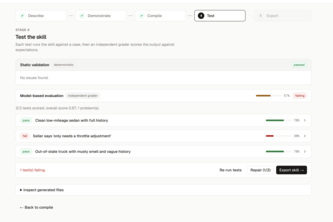
The description states that OneRun takes a workflow description and examples, then packages it into a portable Codex Skill. It compiles the skill into real files (SKILL.md, examples, tests, README), runs automated tests, grades output, and repairs broken skills before exporting as ZIP.
- Evidenced: Yes
- Inferred: No
Positioning & Claim Evolution
The author positions OneRun as a tool that turns “great chat sessions” into real software by applying standard software engineering practices to AI workflows. It claims to bring structure and reliability to prompt engineering through a five-stage pipeline (Extract → Test → Repair → Export).
- Evidenced: Yes
- Inferred: No
Target Customer & ICP
The description does not state who the target customer is or what their specific needs are.
- Evidenced: No
- Inferred: No
Business Model & Pricing Evidence
There is no evidence in the description of a business model or pricing structure.
- Evidenced: No
- Inferred: No
Technical & Delivery Signals
OneRun is built with Next.js, TypeScript, Tailwind CSS, and uses GPT-5.6 via OpenAI’s Responses API with Zod schemas for validation. It includes:
- 57 unit tests
- 1 Playwright end-to-end test
- Mock mode for demos without API keys
- Structured handling of AI calls behind a single module
- Timeout handling for latency issues
- Evidenced: Yes
- Inferred: No
Traction & Maturity Signals
There is no evidence of revenue, customers, or adoption beyond the author’s own development and demo.
- Evidenced: No
- Inferred: No
Competitive Context
The description does not mention any competitors or how OneRun fits into existing AI workflow tools or Codex ecosystems.
- Evidenced: No
- Inferred: No
Open Questions & Risks
- The project is described as a hackathon submission, suggesting it may be experimental or incomplete.
- There is no evidence of market traction, user feedback, or commercial viability.
- The tool relies heavily on GPT-5.6 and OpenAI APIs, which could pose dependency risks.
- No mention of scalability, persistence, or long-term sustainability.
- Evidenced: Yes
- Inferred: Yes
Questions the description leaves open
- What specific problem are you solving for users beyond the hackathon demo?
- How do you plan to monetize this tool if it's not just a prototype?
- Have you validated demand from potential users or customers?
- What is your roadmap for moving from a demo to a production-ready product?
- Are there any technical dependencies that could limit scalability or performance?
- Evidenced: No
- Inferred: Yes
Overall Assessment
There is no evidence of traction, revenue, or customer validation. The project appears to be an experimental hackathon submission with limited commercial potential at this stage.
- Evidenced: No
- Inferred: Yes
User Stories BotA demo video on every pull request
Get a demo video on every new feature
GitHub App that watches your pull requests and records a narrated, captioned demo.
Save time on demo prep and make informed decisions faster with a video walkthrough of every new feature.
Source
Submitted to the OpenAI 2026 hackathon on Devpost. Project home on Devpost. Back to the full gallery on Devpost.
This competitive analysis was produced by top-founders.com (opens in a new tab)
Generated by a language model from this project's public Devpost page — its tagline, the author's own write-up and any built-with tags listed there — as captured in August 2026. Short quotations are the author's words. It is an opinion on the idea as a business, not on the people behind it, and it reflects the description as published then. If the project has moved on, request a correction below. The analysis is not independent research and contains no verified traction, revenue or customer data.
An independent guide by KFG International LLC — not affiliated with, endorsed by, or connected to Devpost or OpenAI.