

Archive position — measured, not model output
0 likes on Devpost
2,263 of the 7,850 archived projects have more likes, and 5,587 share exactly 0 — so this project's #7,640 place in the like-ranked listing is a tie-break inside that group, not a ranking.
Projects (log scale)
Likes on Devpost. ▲ marks this project's group.
Show the figures
| Likes | Projects | Share of archive |
|---|---|---|
| 0 | 5,587 | 71.2% |
| 1 | 1,758 | 22.4% |
| 2 | 284 | 3.6% |
| 3–4 | 132 | 1.7% |
| 5–9 | 75 | 1.0% |
| 10+ | 14 | 0.2% |
 User Stories BotA demo video on every pull request
Get a demo video on every new feature
GitHub App that watches your pull requests and records a narrated, captioned demo.
Save time on demo prep and make informed decisions faster with a video walkthrough of every new feature.
Executive Summary
What the company appears to be
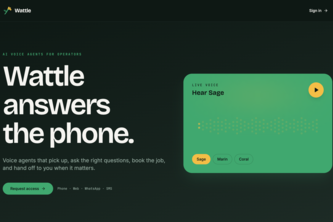
Wattle is a self-reported voice AI agent platform designed for small businesses to manage inbound inquiries via phone calls and web forms. The product integrates with Twilio for phone numbers and Google Sheets for data storage, and includes a unified inbox and CRM-like functionality.
What changed
The author states that Wattle was built as a hackathon project in one week, using AI tools like Codex and GPT 5.6, and deployed using NextJS + Supabase + Google Cloud stack. It is described as a working prototype with core features implemented but not fully fleshed out due to time constraints.
The single most important open question
Is there any evidence of traction, revenue or customer adoption beyond the author’s own account? The description does not indicate any actual users or monetization.
Note: This analysis is based entirely on the self-reported, unverified project description provided by the author. No third-party verification or historical data was used.
What The Product Actually Is
- The description states that Wattle is a "voice AI agent" for managing inbound inquiries.
- It integrates with Twilio to receive phone calls and Google Sheets to store customer details.
- A web widget or inline form can be embedded on websites to collect queries.
- It includes a unified inbox and CRM-like functionality to track customer interactions.
- The UI has a setup wizard to help users quickly get started.
- The author reports that it was built using Codex, GPT 5.6, NextJS, Supabase, and Google Cloud.
Inference: Based on the description, Wattle appears to be an AI-powered customer service automation tool for small businesses, focused on handling phone calls and web-based inquiries through a simple interface.
Positioning & Claim Evolution
- The tagline states: “Wattle is a Voice AI agent for every task that helps with managing inbound inquiries from customers and leads.”
- The author's write-up claims Wattle was built to solve the problem of small businesses lacking funds to hire receptionists.
- It positions itself as an affordable, automated solution for handling customer interactions.
- The product is described as having a “setup agent” to allow quick deployment.
Inference: The positioning appears to be that Wattle targets small businesses looking for low-cost AI-driven support tools. It evolved from a hackathon idea into a prototype with limited features but clear intent to scale toward monetization.
Target Customer & ICP
- The author states that the inspiration came from a friend who runs a restaurant and cannot afford a receptionist.
- This implies a target customer segment of small businesses (e.g., restaurants, local shops) with limited budgets.
- The product is designed for users who want to automate inbound inquiries via phone or web.
Not evidenced: No explicit identification of ICP beyond the single example. No data on other potential verticals or personas.
Business Model & Pricing Evidence
- The description does not mention pricing, payment models, or monetization strategy.
- It states that the author aims to “get some paying customers afterwards,” suggesting a future intent to sell.
- There is no indication of whether Wattle will charge per call, per user, or via subscription.
Inference: The business model remains undefined. The author implies eventual monetization but provides no evidence of pricing structure or revenue streams.
Technical & Delivery Signals
- Built using Codex and GPT 5.6.
- Tech stack includes NextJS, Supabase, Google Cloud.
- Uses Twilio for phone number integration and Google Sheets for data storage.
- The author mentions node editor functionality to make the voice agent deterministic.
- The app was developed in a week, with features implemented using AI-assisted development.
Inference: The technical approach is AI-driven and uses modern SaaS stack components. However, no evidence of scalability or production-grade architecture is provided.
Traction & Maturity Signals
- The product is described as a working prototype built in one week.
- The author notes that “the majority of the app works,” but also mentions challenges with time and incomplete integrations.
- There is no mention of actual users, customers, or usage metrics.
- No evidence of revenue, customer acquisition, or retention.
Not evidenced: No traction data, user base, or adoption metrics are available.
Competitive Context
- The author does not reference competitors or market positioning in relation to existing tools.
- Wattle appears to aim at small business automation, potentially competing with tools like Twilio's voice APIs, Zapier, or CRMs such as HubSpot or Pipedrive.
- No mention of how it differentiates from these platforms.
Not evidenced: No competitive analysis or differentiation strategy is provided.
Open Questions & Risks
- The project is a single-person hackathon effort with no team or funding.
- No evidence of traction, revenue, or customer validation.
- The author states that not all integrations were completed due to time constraints.
- The product is described as a prototype, not a production-ready solution.
- Lack of pricing or monetization strategy raises questions about commercial viability.
Inference: High risk due to lack of evidence for commercial viability, user traction, or sustainable business model.
Questions the description leaves open
- What is the current status of the prototype? Is it being used by any customers?
- How does Wattle plan to monetize its service?
- What are the specific use cases beyond the restaurant example?
- Are there any plans to expand beyond Twilio and Google Sheets integrations?
- What is the roadmap for completing the remaining features that were not implemented due to time constraints?
Overall Assessment
- The author states Wattle was built in a week as a hackathon project.
- No evidence of revenue, customers, or traction exists.
- The product has a clear idea and basic functionality but lacks commercial validation.
- It is positioned for small businesses, but no pricing or monetization model is evident.
Assessment: Not ready for investment or partnership. The project shows potential in concept and execution speed, but lacks any demonstrated traction or business model. A follow-up with the founder to assess progress, user feedback, and monetization strategy would be required before considering further due diligence.
User Stories BotA demo video on every pull request
Get a demo video on every new feature
GitHub App that watches your pull requests and records a narrated, captioned demo.
Save time on demo prep and make informed decisions faster with a video walkthrough of every new feature.
Source
Submitted to the OpenAI 2026 hackathon on Devpost. Project home on Devpost. Back to the full gallery on Devpost.
This competitive analysis was produced by top-founders.com (opens in a new tab)
Generated by a language model from this project's public Devpost page — its tagline, the author's own write-up and any built-with tags listed there — as captured in August 2026. Short quotations are the author's words. It is an opinion on the idea as a business, not on the people behind it, and it reflects the description as published then. If the project has moved on, request a correction below. The analysis is not independent research and contains no verified traction, revenue or customer data.
An independent guide by KFG International LLC — not affiliated with, endorsed by, or connected to Devpost or OpenAI.