

Archive position — measured, not model output
0 likes on Devpost
2,263 of the 7,850 archived projects have more likes, and 5,587 share exactly 0 — so this project's #7,641 place in the like-ranked listing is a tie-break inside that group, not a ranking.
Projects (log scale)
Likes on Devpost. ▲ marks this project's group.
Show the figures
| Likes | Projects | Share of archive |
|---|---|---|
| 0 | 5,587 | 71.2% |
| 1 | 1,758 | 22.4% |
| 2 | 284 | 3.6% |
| 3–4 | 132 | 1.7% |
| 5–9 | 75 | 1.0% |
| 10+ | 14 | 0.2% |
 User Stories BotA demo video on every pull request
Get a demo video on every new feature
GitHub App that watches your pull requests and records a narrated, captioned demo.
Save time on demo prep and make informed decisions faster with a video walkthrough of every new feature.
Executive Summary
What the company appears to be
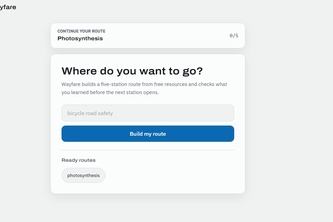
Wayfare is a self-reported educational platform that turns any topic into a structured, transit-map-based learning route using free resources. The system uses AI to generate learning paths with locked stations that unlock only after comprehension checks. It is built as a single-person project and does not require user accounts.
What changed
The author describes Wayfare as a solution to the problem of unstructured educational content online, aiming to bridge the gap between free resources and verified progress. The product was built for the OpenAI 2026 hackathon and includes features like server-verified quizzes, misconception diagnosis, and anonymous progress tracking.
Single most important open question
Is there evidence that Wayfare has traction or adoption beyond its author’s own testing and development?
What The Product Actually Is
The description states that Wayfare:
- Turns a topic into a structured learning route made from free resources.
- Displays the route as a transit map with locked, active, and completed stations.
- Requires learners to pass comprehension quizzes before unlocking the next station.
- Uses AI for route generation, quiz creation, safety classification, and remediation.
- Operates without requiring user accounts or personal data.
The system is built using Laravel 12, Livewire 4, Alpine.js, Tailwind CSS, SQLite, and Groq-compatible language models. It supports parallel resource discovery and server-side quiz verification to prevent cheating.
Inference Wayfare appears to be a proof-of-concept prototype for an AI-powered learning platform that emphasizes structured progression over passive consumption of content.
Positioning & Claim Evolution
The author claims:
- Free educational content is abundant, but verified progress is not.
- Wayfare bridges the gap between unstructured resources and traditional platforms that manually create courses.
- It provides a transit-map metaphor for learning progression.
- The system verifies knowledge rather than attendance.
Inference Wayfare positions itself as an alternative to both open-content repositories and structured course platforms, focusing on learner verification and autonomy in learning paths.
Target Customer & ICP
The description states:
- Wayfare is designed for learners who want to study topics like photosynthesis, linear algebra, bicycle safety, sourdough bread, or Ohm’s law.
- It supports a wide range of academic, technical, creative, and practical topics.
- No specific customer segment is identified beyond general learners.
Inference The target audience seems to be self-directed learners interested in structured exploration of topics without formal instruction. The lack of segmentation suggests a broad, non-specific ICP.
Business Model & Pricing Evidence
There is no evidence provided about:
- Revenue streams
- Pricing models
- Monetization strategy
- Paid features or subscriptions
Inference The business model remains unspecified in the self-reported description.
Technical & Delivery Signals
The description states:
- Built with Laravel 12, Livewire 4, Alpine.js, Tailwind CSS, SQLite.
- Uses Groq-compatible language models for route generation and safety checks.
- Implements a provider-adapter architecture to support fallbacks.
- Quiz answers are verified server-side.
- Progress is stored anonymously via signed cookies.
- Includes automated integrity scans and deterministic fixtures for testing.
Inference Wayfare demonstrates technical maturity in its backend design, including security measures, error handling, and offline capability. However, it lacks evidence of production deployment or scaling beyond a prototype.
Traction & Maturity Signals
The description states:
- The project was built for a hackathon.
- It includes 226 passing tests with 693 assertions.
- A smoke command drives the full learning loop from topic entry to route completion.
- The system supports offline fixtures and rollback functionality.
Inference There is no evidence of real-world usage, user adoption, or customer engagement beyond internal testing. The project appears to be a prototype or MVP with limited external validation.
Competitive Context
The description does not mention:
- Competitors
- Market positioning relative to existing platforms (e.g., Coursera, Khan Academy, Duolingo)
- Differentiation from similar tools
Inference No competitive analysis is provided. The author does not reference or compare Wayfare to other learning platforms.
Open Questions & Risks
The description states:
- The system relies heavily on AI-generated content and external APIs.
- It uses a provider-adapter architecture, but there is no mention of how it handles API failures or rate limits in production.
- The project is built by one person (team size: 1).
- No evidence of monetization or business model.
Inference
Key risks include:
- Dependency on AI and external services without clear fallbacks for scale.
- Lack of team capacity to iterate or scale beyond prototype.
- Unclear path to commercial viability or user retention.
Questions the description leaves open
- What is the source of the AI-generated learning content? Is it fully reliable, or does it require human curation?
- How does Wayfare plan to handle scaling beyond a single developer’s capacity?
- Are there any plans for monetization or revenue models?
- Has the system been tested with real users outside of internal testing?
- What are the long-term goals for content expansion and platform growth?
Overall Assessment
The description states:
- Wayfare is a single-person project built for a hackathon.
- It includes a functional prototype with tests and offline fixtures.
- There is no evidence of revenue, customers, or traction.
Inference Wayfare shows early-stage technical capability but lacks commercial viability indicators. It may be an interesting concept for further development, but it does not yet demonstrate a scalable or monetizable business model. Investment or partnership interest would depend on future traction and team expansion.
User Stories BotA demo video on every pull request
Get a demo video on every new feature
GitHub App that watches your pull requests and records a narrated, captioned demo.
Save time on demo prep and make informed decisions faster with a video walkthrough of every new feature.
Source
Submitted to the OpenAI 2026 hackathon on Devpost. Project home on Devpost. Back to the full gallery on Devpost.
This competitive analysis was produced by top-founders.com (opens in a new tab)
Generated by a language model from this project's public Devpost page — its tagline, the author's own write-up and any built-with tags listed there — as captured in August 2026. Short quotations are the author's words. It is an opinion on the idea as a business, not on the people behind it, and it reflects the description as published then. If the project has moved on, request a correction below. The analysis is not independent research and contains no verified traction, revenue or customer data.
An independent guide by KFG International LLC — not affiliated with, endorsed by, or connected to Devpost or OpenAI.