

Archive position — measured, not model output
0 likes on Devpost
2,263 of the 7,850 archived projects have more likes, and 5,587 share exactly 0 — so this project's #3,716 place in the like-ranked listing is a tie-break inside that group, not a ranking.
Projects (log scale)
Likes on Devpost. ▲ marks this project's group.
Show the figures
| Likes | Projects | Share of archive |
|---|---|---|
| 0 | 5,587 | 71.2% |
| 1 | 1,758 | 22.4% |
| 2 | 284 | 3.6% |
| 3–4 | 132 | 1.7% |
| 5–9 | 75 | 1.0% |
| 10+ | 14 | 0.2% |
 User Stories BotA demo video on every pull request
Get a demo video on every new feature
GitHub App that watches your pull requests and records a narrated, captioned demo.
Save time on demo prep and make informed decisions faster with a video walkthrough of every new feature.
Executive Summary
What the company appears to be
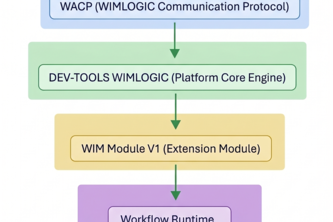
DEV-TOOLS WIMLOGIC is described as an enterprise AI workflow orchestration platform that separates business applications from AI execution through a standardized communication protocol (WACP) and intelligent routing module (WIM Module V1). The author states it aims to treat AI workflows as reusable, versioned assets that can serve multiple business apps.
What changed
The project was built during the OpenAI 2026 hackathon. It focuses on implementing WIM Module V1, which routes requests based on business intent rather than requiring client applications to know which workflow to execute. The author used GPT-5.6 and Codex for development.
Single most important open question
Is there evidence of real-world usage or traction beyond the hackathon demo? The description lacks any data about revenue, customers, adoption, or product-market fit beyond a prototype.
What The Product Actually Is
The description states that DEV-TOOLS WIMLOGIC is an enterprise AI workflow orchestration platform. It includes:
- A standardized communication protocol called WIMLOGIC Application Communication Protocol (WACP)
- WIM Module V1 — an intelligent routing module
- Workflow templates and versioning capabilities
- A workflow runtime engine
- Integration with business applications through WACP SDK
The author describes the current implementation as a demonstration using AIHOME.WIMLOGIC, a home design business application. The platform receives standardized requests via WACP, routes them using WIM Module V1, executes workflows, and returns structured results.
This architecture allows multiple business apps to share the same AI execution platform.
Evidence
- The author states: "DEV-TOOLS WIMLOGIC separates business applications from AI execution."
- The system uses FastAPI, React + TypeScript, MySQL, and integrates with OpenAI's GPT-5.6 and Codex.
- It includes a WACP SDK for integration between business apps and the platform.
Inference The system is designed to be modular and extensible, with plans to add more modules like connectors, monitoring, and knowledge management.
Positioning & Claim Evolution
The author positions DEV-TOOLS WIMLOGIC as an alternative to standalone AI applications where business logic is tightly coupled with AI providers and prompts. The goal is to treat AI workflows as reusable enterprise assets that can be shared across multiple business applications.
Key claims from the description:
- "Instead of embedding AI logic into every application, business applications communicate with the platform through the WIMLOGIC Application Communication Protocol (WACP)."
- "The platform is responsible for workflow selection, execution, monitoring, and returning structured results."
- "I wanted to explore a different approach: treating AI workflows as reusable enterprise assets that can serve multiple business applications."
Evidence
- The author explicitly states the intent to decouple AI logic from business apps.
- WIM Module V1 is described as enabling intelligent routing based on business intent.
Inference The positioning suggests a shift toward platform-based AI infrastructure, but no evidence of market traction or adoption exists.
Target Customer & ICP
The description states that DEV-TOOLS WIMLOGIC targets enterprise customers who want to reuse AI workflows across multiple business applications. It is built for developers and engineering teams working in enterprise environments.
Evidence
- The platform is described as an "enterprise AI workflow orchestration platform."
- The use of WACP SDK implies integration with business apps.
- The author mentions “enterprise job pipeline” and “enterprise integrations.”
Inference The target ICP appears to be internal enterprise developers or engineering teams looking for scalable, reusable AI workflows. No specific customer segments or personas are named.
Business Model & Pricing Evidence
There is no evidence in the description of a business model or pricing structure. The author does not mention monetization strategies, subscription tiers, or any commercial arrangements.
Evidence
- No revenue streams, pricing plans, or sales processes are described.
- The project was built for a hackathon and lacks any indication of commercial viability.
Inference The platform may be intended for internal enterprise use or as a prototype for future monetization, but no details are provided.
Technical & Delivery Signals
The system is built using:
- FastAPI
- React + TypeScript
- MySQL
- Workflow templates and versioning
- WACP (WIMLOGIC Application Communication Protocol)
- Integration with OpenAI Codex and GPT-5.6 for development
The author used AI-assisted tools to inspect and extend an existing codebase, implementing WIM Module V1 in a way that preserved the architecture.
Evidence
- The platform uses FastAPI, React + TypeScript, MySQL.
- WIM Module V1 was implemented using GPT-5.6 and Codex.
- The system includes workflow templates, versioning, runtime engine, and monitoring capabilities.
Inference The technical stack suggests a modern, scalable architecture suitable for enterprise use. However, the lack of production data or performance metrics limits confidence in its maturity.
Traction & Maturity Signals
There is no evidence of traction or product-market fit beyond the hackathon demo. No customers, users, revenue, or usage data are mentioned.
Evidence
- The project was built during a single hackathon event.
- No mention of real-world deployment or adoption.
- No data on user engagement, retention, or performance metrics.
Inference The system is at an early prototype stage. It has not yet demonstrated real-world utility or scalability beyond a demonstration.
Competitive Context
No competitive analysis or market positioning relative to existing players is provided in the description. The author does not reference competitors or similar platforms.
Evidence
- No mention of competing products, platforms, or services.
- No indication of how this compares to other AI orchestration tools or workflow engines.
Inference The competitive landscape remains unknown. The project may be positioned within a niche market for enterprise AI workflow orchestration, but no evidence supports this claim.
Open Questions & Risks
Several key risks and open questions emerge from the description:
- No commercial traction or validation: The platform is only demonstrated in a hackathon setting.
- Unproven scalability: No evidence of how it handles large-scale enterprise workloads.
- Limited team size: Only one member (Tim Gian) is listed, raising questions about execution capacity.
- Self-reported architecture: All claims are from the author’s own account; no independent verification or third-party validation.
- Unclear monetization path: No business model or pricing strategy is described.
Evidence
- The project was built for a hackathon.
- Only one team member is listed.
- No revenue, customers, or product-market fit data are available.
Questions the description leaves open
- What specific enterprise use cases does the platform aim to solve?
- How does WIM Module V1 determine business intent? Is there a formalized process or algorithm?
- Has the platform been tested with real enterprise clients or internal teams beyond the hackathon?
- What are the plans for expanding beyond WIM Module V1 and adding additional system modules?
- Are there any existing partnerships or integrations with enterprise software vendors?
- How does the platform ensure security, governance, and compliance in enterprise settings?
- What is the roadmap for monetization and go-to-market strategy?
Overall Assessment
At this stage, DEV-TOOLS WIMLOGIC appears to be a conceptual prototype built during a hackathon. There is no evidence of commercial traction, revenue, or customer adoption.
Confidence Level Low The description is entirely self-reported and unverified, with no data on performance, usage, or market validation.
Assessment Not ready for investment or partnership consideration without further demonstration of product-market fit, traction, or scalability. The idea shows potential but lacks evidence of execution or commercial viability.
User Stories BotA demo video on every pull request
Get a demo video on every new feature
GitHub App that watches your pull requests and records a narrated, captioned demo.
Save time on demo prep and make informed decisions faster with a video walkthrough of every new feature.
Source
Submitted to the OpenAI 2026 hackathon on Devpost. Project home on Devpost. Back to the full gallery on Devpost.
This competitive analysis was produced by top-founders.com (opens in a new tab)
Generated by a language model from this project's public Devpost page — its tagline, the author's own write-up and any built-with tags listed there — as captured in August 2026. Short quotations are the author's words. It is an opinion on the idea as a business, not on the people behind it, and it reflects the description as published then. If the project has moved on, request a correction below. The analysis is not independent research and contains no verified traction, revenue or customer data.
An independent guide by KFG International LLC — not affiliated with, endorsed by, or connected to Devpost or OpenAI.