

Archive position — measured, not model output
1 like on Devpost
505 of the 7,850 archived projects have more likes, and 1,758 share exactly 1 — so this project's #1,535 place in the like-ranked listing is a tie-break inside that group, not a ranking.
Projects (log scale)
Likes on Devpost. ▲ marks this project's group.
Show the figures
| Likes | Projects | Share of archive |
|---|---|---|
| 0 | 5,587 | 71.2% |
| 1 | 1,758 | 22.4% |
| 2 | 284 | 3.6% |
| 3–4 | 132 | 1.7% |
| 5–9 | 75 | 1.0% |
| 10+ | 14 | 0.2% |
 User Stories BotA demo video on every pull request
Get a demo video on every new feature
GitHub App that watches your pull requests and records a narrated, captioned demo.
Save time on demo prep and make informed decisions faster with a video walkthrough of every new feature.
Executive Summary
What the company appears to be
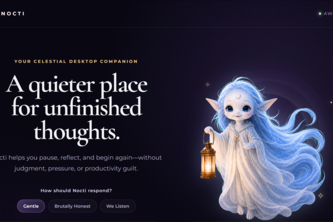
Nocti is a character-driven AI companion built as a prototype for the OpenAI 2026 hackathon. The product aims to help overwhelmed creatives turn unfinished ideas into clear, manageable next steps through three distinct personality modes. It uses GPT-5.6 and is implemented using React, Vite, JavaScript, and serverless functions hosted on Vercel.
What changed
The project evolved from an idea about emotional support in productivity tools to a functional prototype with multiple personality modes, secure API integration, and a celestial visual interface. It was built by a single developer (MLeigh Yang) over the course of a hackathon, incorporating feedback loops and iterative improvements.
Single most important open question
Is there evidence that Nocti has traction or user engagement beyond its initial prototype, or any indication of commercial viability or monetization strategy?
What The Product Actually Is
The description states that Nocti is an AI companion designed to help creatives manage unfinished ideas and creative blocks. It uses GPT-5.6 via the OpenAI API and presents responses through a character-driven interface with three distinct personality modes.
It includes:
- A frontend built in React, Vite, and JavaScript
- A serverless function hosted on Vercel that communicates with the OpenAI API
- Custom prompts tailored to each personality mode
- An immersive celestial visual experience featuring floating stars, glowing aura, and animations
The author notes that it was built using Codex with GPT-5.6 for planning, component building, prompt design, debugging, and UI refinement.
Inference The product is a prototype application, not yet a commercial offering. It lacks any evidence of revenue, customers, or deployment beyond the hackathon submission.
Positioning & Claim Evolution
The author claims that Nocti addresses the problem of feeling overwhelmed by too many ideas and unfinished projects. Traditional productivity tools are said to make this worse, while AI assistants often feel impersonal. The positioning is that Nocti combines practicality with emotional connection through a memorable character.
Key claims:
- Nocti helps users find clarity and return to neglected ideas.
- It offers three distinct personality modes for different interaction styles.
- The experience feels more like meeting a companion than using a chatbot.
- The product was designed to preserve the character experience over AI-generated content.
Inference This positioning reflects an attempt to differentiate from generic AI tools by emphasizing emotional resonance and usability. However, there is no evidence of market validation or user feedback beyond the developer's own account.
Target Customer & ICP
The description states that Nocti targets "overwhelmed creatives" who have many ideas but struggle to decide what to do next. It also mentions users dealing with creative blocks, unfinished projects, and new ideas weighing on them.
Inference The target customer segment is defined by emotional and cognitive state rather than specific demographics or job roles. There is no evidence of segmentation beyond this broad category.
Business Model & Pricing Evidence
There is no mention of pricing, monetization strategy, or business model in the description. The project is described as a hackathon submission with no indication of commercial intent or revenue streams.
Not evidenced
Technical & Delivery Signals
The author reports:
- Built using React, Vite, JavaScript, CSS3
- Integrated with OpenAI API via serverless function on Vercel
- Used Codex for development assistance
- Implemented secure handling of API keys through serverless functions
- Designed responsive UI with fixed card dimensions and internal scrolling
- Developed multiple personality modes with mode-specific prompts
Inference The technical implementation shows some sophistication in frontend/backend separation, security practices (API key protection), and UI/UX design. However, the project remains a prototype without evidence of scalability or production deployment.
Traction & Maturity Signals
The description indicates that Nocti is a first version built during a hackathon. It includes:
- A functional prototype with live GPT-5.6 responses
- Multiple personality modes
- Secure API connection
- Loading and error states
- Responsive interface
- Custom character-driven prompt design
There is no evidence of user adoption, retention metrics, or usage data beyond the developer’s own account.
Not evidenced
Competitive Context
The author does not reference competitors or existing solutions in the market. The project is positioned as a novel approach to AI productivity tools that combines emotional support with practical guidance.
Inference While Nocti may be unique in its character-driven interface, there is no evidence of competitive analysis or awareness of similar products. The lack of references suggests either limited market research or no prior knowledge of comparable offerings.
Open Questions & Risks
- Single-person development: The entire project was built by one individual (MLeigh Yang), raising questions about scalability and long-term maintenance.
- Prototype-only status: No evidence of commercial viability, user feedback, or product-market fit beyond the hackathon submission.
- No revenue or monetization strategy: There is no indication of how the product would generate value or income.
- Limited technical depth: The use of Codex for development implies reliance on AI assistance rather than deep technical expertise.
- Unproven market demand: No evidence of user testing, surveys, or real-world usage.
Questions the description leaves open
- What specific creative challenges did you observe among your target users?
- Have you conducted any user interviews or usability tests beyond personal experience?
- How do you plan to transition from a hackathon prototype to a scalable product?
- Are there any plans for monetization, and if so, what are they?
- What is the roadmap for expanding personality modes or features like Lanterns?
- Do you have any data on how users interact with the different personality modes?
- How do you intend to ensure consistent performance and reliability in production?
Overall Assessment
The description presents Nocti as a hackathon prototype that demonstrates technical capability and creative vision but lacks evidence of traction, revenue, or commercial readiness.
Confidence: Low
There is no indication that the project has moved beyond the experimental phase. The author states that it was built during a hackathon, and there is no mention of users, customers, or monetization strategies.
This is a conceptually interesting idea with strong execution in prototype form, but without further evidence of market validation or business development, it cannot be considered a viable investment or partnership opportunity at this stage.
User Stories BotA demo video on every pull request
Get a demo video on every new feature
GitHub App that watches your pull requests and records a narrated, captioned demo.
Save time on demo prep and make informed decisions faster with a video walkthrough of every new feature.
Source
Submitted to the OpenAI 2026 hackathon on Devpost. Project home on Devpost. Back to the full gallery on Devpost.
This competitive analysis was produced by top-founders.com (opens in a new tab)
Generated by a language model from this project's public Devpost page — its tagline, the author's own write-up and any built-with tags listed there — as captured in August 2026. Short quotations are the author's words. It is an opinion on the idea as a business, not on the people behind it, and it reflects the description as published then. If the project has moved on, request a correction below. The analysis is not independent research and contains no verified traction, revenue or customer data.
An independent guide by KFG International LLC — not affiliated with, endorsed by, or connected to Devpost or OpenAI.