

Archive position — measured, not model output
1 like on Devpost
505 of the 7,850 archived projects have more likes, and 1,758 share exactly 1 — so this project's #1,536 place in the like-ranked listing is a tie-break inside that group, not a ranking.
Projects (log scale)
Likes on Devpost. ▲ marks this project's group.
Show the figures
| Likes | Projects | Share of archive |
|---|---|---|
| 0 | 5,587 | 71.2% |
| 1 | 1,758 | 22.4% |
| 2 | 284 | 3.6% |
| 3–4 | 132 | 1.7% |
| 5–9 | 75 | 1.0% |
| 10+ | 14 | 0.2% |
 User Stories BotA demo video on every pull request
Get a demo video on every new feature
GitHub App that watches your pull requests and records a narrated, captioned demo.
Save time on demo prep and make informed decisions faster with a video walkthrough of every new feature.
Executive Summary
What the company appears to be
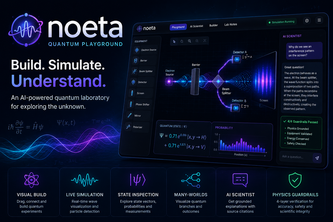
Noeta is a self-reported 3D interactive science lab that uses AI to help users understand quantum physics concepts through simulation and experimentation. It allows users to manipulate variables in real-time, observe outcomes in a 3D environment, and receive guidance from an AI mentor.
What changed
The project was submitted as part of the OpenAI 2026 hackathon. The description indicates it is a prototype built by one team member (Vetri1706 Kalanjiyam), with no evidence of prior traction or commercial activity.
Single most important open question
Is there any evidence that Noeta has moved beyond a hackathon prototype, or whether the described AI mentor and physics engine have been validated in real-world use?
What The Product Actually Is
The description states that Noeta is a 3D science lab you talk to, where users can explore quantum phenomena like tunneling and interference through interactive simulations. It includes:
- A structured description of experiments.
- An interactive 3D environment with live rendering.
- An AI mentor that guides the user, explains mistakes, and provides real-time feedback using actual numerical data.
It is built using technologies such as React Three Fiber, PyTorch, Python, and OpenAI tools (e.g., GPT-5.6, OpenAI Codex). The system uses a physics engine running in the background thread and a trained neural network to simulate quantum behavior quickly.
Inference The product appears to be an educational tool designed for students or learners interested in quantum mechanics, combining visualization, interactivity, and AI-driven instruction.
Positioning & Claim Evolution
The author positions Noeta as a tool that builds understanding, not just delivers information. The tagline "Build. Simulate. Understand. Quantum physics with AI" reflects this goal.
Claims made:
- Users can manipulate physical parameters in real time.
- The system provides structured explanations and feedback.
- It aims to replace traditional textbook learning with an immersive experience.
Inference The positioning is focused on interactive education, particularly for complex scientific topics, using AI as a facilitator rather than a standalone tool.
Target Customer & ICP
The description does not explicitly name target customers or define an Ideal Customer Profile (ICP). However, it implies the following:
- The primary audience likely includes students studying quantum physics.
- Educators seeking tools to enhance classroom instruction.
- Learners who benefit from hands-on experimentation and visual learning.
Inference Noeta targets individuals engaged in science education, especially those interested in quantum mechanics. It may also appeal to researchers or educators looking for simulation-based teaching aids.
Business Model & Pricing Evidence
There is no evidence of a business model or pricing structure in the description. The project is presented as a hackathon submission with no indication of monetization plans, customer acquisition strategies, or revenue streams.
Inference No commercial model has been described; this remains unproven.
Technical & Delivery Signals
The author describes:
- A physics engine running on a background thread to avoid UI lag.
- A trained neural network (PyTorch) used for fast prediction of quantum behavior.
- Use of React Three Fiber and WebGL for 3D rendering.
- Integration with tools like OpenAI Codex, GPT-5.6, and LaTeX for scientific notation.
Challenges addressed include:
- Fixing 3D model color issues.
- Resolving animation conflicts.
- Managing overlapping UI panels on small screens.
Inference The technical stack suggests a prototype built with modern web technologies, capable of handling real-time physics simulations and interactive UIs. It shows some engineering sophistication but lacks evidence of production-grade delivery or scalability.
Traction & Maturity Signals
There is no evidence of traction, adoption, or usage metrics beyond the hackathon submission. The project is described as a single-person effort, with no mention of users, customers, or market validation.
Inference No signs of product-market fit or user engagement are evident. This is a pre-product stage prototype.
Competitive Context
The description does not reference competitors or similar products. However, the concept aligns with:
- Educational platforms that use simulations (e.g., PhET, Khan Academy).
- AI-powered tutoring systems.
- 3D visualization tools for science education.
Inference Noeta operates in a space where interactive science education tools exist, but there is no evidence of direct competition or differentiation from existing offerings.
Open Questions & Risks
Key risks and open questions include:
- The project is described as a hackathon submission, suggesting it has not yet been tested in real-world conditions.
- Only one team member is listed, raising questions about scalability and long-term development capacity.
- No evidence of revenue, users, or product-market fit.
- The AI mentor and physics engine are described as functional but not validated beyond the prototype.
Inference There is a high risk of overstatement in claims about functionality and impact. The lack of traction raises concerns about whether the project will evolve into a viable product.
Questions the description leaves open
- What specific scientific accuracy has been validated for the physics engine?
- Has the AI mentor been tested with real users or only in controlled scenarios?
- Are there plans to expand beyond quantum tunneling and wave interference?
- How is the neural network trained, and what data sources were used?
- Is there any plan to monetize or scale this beyond a prototype?
- What are the technical limitations of the current implementation that would prevent production use?
Overall Assessment
Not evidenced
There is no evidence of revenue, customers, traction, or commercial viability beyond the hackathon submission. The project is described as a single-developer prototype, with no indication of product-market fit, scalability, or business model.
The author states that the system works and includes technical details, but these are not independently verified. Noeta appears to be an early-stage idea with potential for future development, but it does not yet meet criteria for investment or partnership consideration based on the provided information.
Confidence Level Low
Reasoning
The description is self-reported and unverified; there is no evidence of traction, revenue, or customer validation.
User Stories BotA demo video on every pull request
Get a demo video on every new feature
GitHub App that watches your pull requests and records a narrated, captioned demo.
Save time on demo prep and make informed decisions faster with a video walkthrough of every new feature.
Source
Submitted to the OpenAI 2026 hackathon on Devpost. Project home on Devpost. Back to the full gallery on Devpost.
This competitive analysis was produced by top-founders.com (opens in a new tab)
Generated by a language model from this project's public Devpost page — its tagline, the author's own write-up and any built-with tags listed there — as captured in August 2026. Short quotations are the author's words. It is an opinion on the idea as a business, not on the people behind it, and it reflects the description as published then. If the project has moved on, request a correction below. The analysis is not independent research and contains no verified traction, revenue or customer data.
An independent guide by KFG International LLC — not affiliated with, endorsed by, or connected to Devpost or OpenAI.