

Archive position — measured, not model output
0 likes on Devpost
2,263 of the 7,850 archived projects have more likes, and 5,587 share exactly 0 — so this project's #3,499 place in the like-ranked listing is a tie-break inside that group, not a ranking.
Projects (log scale)
Likes on Devpost. ▲ marks this project's group.
Show the figures
| Likes | Projects | Share of archive |
|---|---|---|
| 0 | 5,587 | 71.2% |
| 1 | 1,758 | 22.4% |
| 2 | 284 | 3.6% |
| 3–4 | 132 | 1.7% |
| 5–9 | 75 | 1.0% |
| 10+ | 14 | 0.2% |
 User Stories BotA demo video on every pull request
Get a demo video on every new feature
GitHub App that watches your pull requests and records a narrated, captioned demo.
Save time on demo prep and make informed decisions faster with a video walkthrough of every new feature.
Executive Summary
What the company appears to be
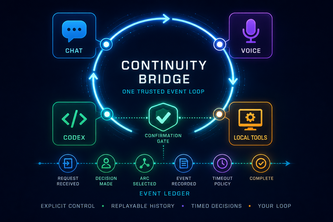
Continuity Bridge is a self-reported local-first event-sourced system designed to create a trusted continuity layer between AI interfaces (Chat, Voice, Codex, local tools) by enforcing confirmation and replayable history for cross-session workflows.
What changed
The project evolved from a simple confirmation screen into a structured ledger-based architecture that supports canonical event recording, versioned snapshots, and replayable user intent across platforms. It was built as an MVP for the OpenAI 2026 hackathon.
Single most important open question
Is there any evidence of real-world usage or integration with external AI services beyond the author’s own development environment?
Note
This analysis is based entirely on the self-reported, unverified description provided by the author. No third-party verification, traction data, revenue figures, customer names, or independent sources are available.
What The Product Actually Is
The description states that Continuity Bridge is:
- A local-first, event-sourced confirmation gate for cross-session AI workflows.
- An append-only JSONL event store with versioned snapshot projections.
- A system enforcing a canonical lifecycle:
- REQUEST_CREATED
- CONFIRMATION_REQUESTED
- CONFIRMATION_ACCEPTED
- REQUEST_COMPLETED
- A tool that binds confirmation to exact request state (ID, version, session, content hash).
- A system using a command-line interface and a local graphical confirmation room.
- Built in Python with deterministic architecture.
Inference The product is not a finished commercial offering but an experimental prototype or proof-of-concept built within a hackathon framework. It does not appear to be integrated into any existing AI platform or service at this time.
Positioning & Claim Evolution
The author claims:
- Continuity Bridge began as a "deceptively simple question" about what happens when Chat, Voice, and local tools are used together.
- The core idea evolved from a confirmation screen into a "portable ledger of user intent, decisions, timeouts, corrections, and completed work across AI platforms."
- It is positioned not to replace interfaces but to give them a shared event grammar.
Inference The positioning has shifted from solving a narrow UX problem (confirmation) to enabling broader architectural trust in multi-platform AI workflows. However, the description does not indicate any commercial or productized version of this idea beyond the MVP.
Target Customer & ICP
The description states:
- Continuity Bridge is intended for use with Chat, Voice, Codex, and local tools.
- It aims to support "replay, auditing, resumable workflows, timed user callbacks, token and time accounting, crash recovery, and future cross-platform adapters."
There is no explicit mention of target personas or industries. The focus appears to be on developers or users who work with multiple AI interfaces and want a consistent continuity layer.
Not evidenced No specific customer segments, buyer personas, or use cases beyond the author’s own workflow are described.
Business Model & Pricing Evidence
The description states:
- Continuity Bridge is local-first and deterministic.
- No external service is required.
- Provider identifiers remain opaque references.
- The MVP is not commercialized.
Not evidenced There is no indication of pricing, monetization strategy, or business model. The project is described as a hackathon submission with no evidence of revenue streams or customer acquisition plans.
Technical & Delivery Signals
The description states:
- Built in Python using a deliberately small and deterministic architecture.
- Core components include:
- Data models for loops, requests, decisions, events
- Orchestrator enforcing confirmation rules
- Append-only JSONL event store
- Versioned snapshot projections
- Command-line interface (CLI)
- Local graphical confirmation room
- Commit flow is event-first: validate → append event → atomically replace snapshot → recover if needed.
- Supports idempotent replay, crash recovery, derived metadata, and continuation callbacks.
Inference The system shows a strong technical foundation for handling event consistency and state management. However, it remains an MVP with no evidence of production-grade deployment or scalability features.
Traction & Maturity Signals
The description states:
- The project was built as an MVP for the OpenAI 2026 hackathon.
- It includes 22 passing tests covering lifecycle, recovery, and validation behavior.
- Manual flow testing included Chat request → Voice reads → exact hash-bound confirmation → execution authorization → completion commit.
Not evidenced No evidence of real-world adoption, user feedback, or product-market fit. The project is described as a prototype with no indication of traction or growth metrics.
Competitive Context
The description states:
- Modern AI tools treat Chat, Voice, coding agents, and local tools as separate rooms.
- Continuity Bridge creates a neutral continuity layer between those platforms.
- It does not aim to replace existing tools but to give them shared event grammar.
Not evidenced No mention of competitors or direct substitutes. The author does not reference any existing systems that solve similar problems.
Open Questions & Risks
The description states:
- The project is local-first and deterministic, with no external service.
- It excludes demo data, caches, bytecode, and virtual environments to avoid runtime state contamination.
- Validation ordering was a challenge; corrections must be validated before being recorded.
- UI framing was initially misaligned (e.g., “game-select screen” analogy).
- External provider adapters, cross-process locking, and transactional storage were intentionally left out of the MVP.
Inference
- The lack of external integrations or production use cases raises questions about scalability and real-world applicability.
- The exclusion of advanced features like cross-process locking suggests a limited scope for enterprise adoption.
- The project’s MVP nature implies no commercial viability or long-term roadmap beyond the hackathon.
Questions the description leaves open
- What is the current status of integration with external AI platforms (e.g., OpenAI, Google, etc.)?
- Has there been any user testing or feedback from developers using this system in practice?
- Are there plans to move beyond a local-first architecture to support distributed or cloud-based workflows?
- How does Continuity Bridge handle multi-user scenarios or shared workspaces?
- What are the technical limitations of the current JSONL-based event store for larger-scale use cases?
Overall Assessment
The description states:
- This is an MVP built for a hackathon.
- It has no evidence of revenue, customers, or traction.
- The author is a solo developer (Tin Tin).
- Future work includes connecting adapters and expanding functionality.
Not evidenced No indication of investment interest, partnership potential, or commercial readiness. The project is clearly experimental and not yet a productized solution.
Assessment At this stage, Continuity Bridge is a promising technical exploration with strong foundational design but no demonstrated market traction or business model. It may be worth exploring further if the founder intends to build out a scalable version, but it does not currently meet criteria for investment or partnership at scale.
User Stories BotA demo video on every pull request
Get a demo video on every new feature
GitHub App that watches your pull requests and records a narrated, captioned demo.
Save time on demo prep and make informed decisions faster with a video walkthrough of every new feature.
Source
Submitted to the OpenAI 2026 hackathon on Devpost. Project home on Devpost. Back to the full gallery on Devpost.
This competitive analysis was produced by top-founders.com (opens in a new tab)
Generated by a language model from this project's public Devpost page — its tagline, the author's own write-up and any built-with tags listed there — as captured in August 2026. Short quotations are the author's words. It is an opinion on the idea as a business, not on the people behind it, and it reflects the description as published then. If the project has moved on, request a correction below. The analysis is not independent research and contains no verified traction, revenue or customer data.
An independent guide by KFG International LLC — not affiliated with, endorsed by, or connected to Devpost or OpenAI.