

Archive position — measured, not model output
0 likes on Devpost
2,263 of the 7,850 archived projects have more likes, and 5,587 share exactly 0 — so this project's #5,461 place in the like-ranked listing is a tie-break inside that group, not a ranking.
Projects (log scale)
Likes on Devpost. ▲ marks this project's group.
Show the figures
| Likes | Projects | Share of archive |
|---|---|---|
| 0 | 5,587 | 71.2% |
| 1 | 1,758 | 22.4% |
| 2 | 284 | 3.6% |
| 3–4 | 132 | 1.7% |
| 5–9 | 75 | 1.0% |
| 10+ | 14 | 0.2% |
 User Stories BotA demo video on every pull request
Get a demo video on every new feature
GitHub App that watches your pull requests and records a narrated, captioned demo.
Save time on demo prep and make informed decisions faster with a video walkthrough of every new feature.
Executive Summary
What the company appears to be
Nabi Markdown is a self-reported, browser-based practice app for learning Markdown syntax through structured, hands-on exercises. The author describes it as an English-first tool designed to help users internalize Markdown structure via repeated practice with immediate feedback.
What changed
The project was built over a three-day period using AI tools (Codex, GPT-5.6) and a minimal tech stack (React, TypeScript, Vite). It is described as a small, focused learning experience without long-term tracking or gamification features.
Single most important open question — the commercial due-diligence read
Is there evidence of user demand or adoption beyond the single developer’s personal project? The description does not indicate any traction, revenue, customers, or usage metrics. The product is self-reported as a prototype or proof-of-concept with no indication of market validation.
What The Product Actually Is
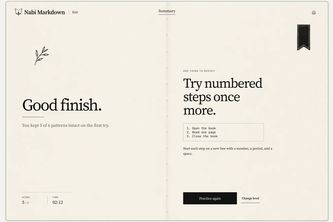
The description states that Nabi Markdown is a short, English-first practice app for making Markdown feel natural. It allows users to select one of five levels, read a rendered Markdown goal on the left, write the corresponding Markdown on the right, and press "Check" to receive feedback.
- Users are given a goal (rendered Markdown) and must recreate it using correct syntax.
- The app accepts varied wording or spelling but checks only structural correctness.
- Feedback is specific: if structure is missing or malformed, it names the exact syntax to fix.
- A retry gives a different prompt for the same skill, not a copy of the original answer.
- The experience is intentionally brief (ten minutes), with no account, streaks, XP, or long-term profile.
Inference The app appears to be a browser-based tool built using React and CodeMirror, with local Markdown parsing into an AST for structural validation. It uses deterministic rules to grade user input without relying on AI services for grading.
Positioning & Claim Evolution
The author claims that Nabi Markdown addresses the gap between explaining Markdown and actually practicing it — based on a personal observation of a coworker who learned after being shown how to write a few marks.
- The product is positioned as a quiet, low-effort way to build muscle memory in Markdown.
- It is described as not a course or tutorial but a practice tool.
- The app avoids gamification and long-term engagement features to keep the experience light and focused.
Inference The positioning evolved from a general idea of helping people learn Markdown to a specific, minimalistic approach that emphasizes structure over content, with a focus on short, repeatable practice sessions.
Target Customer & ICP
The description states that Nabi Markdown is for people who already know how to structure their thoughts but haven’t practiced the syntax needed to express those thoughts in Markdown.
- The target audience includes individuals learning Markdown, especially those who have tried tutorials or guides but still struggle with writing it themselves.
- It is aimed at casual learners who want a quiet, self-directed way to practice without commitment or pressure.
Inference The ICP appears to be early-stage learners or people transitioning from non-technical to technical writing environments — such as writers, researchers, or junior developers.
Business Model & Pricing Evidence
There is no evidence of pricing, monetization strategy, or business model in the description. The app is described as a small, open-source tool with no account or subscription features.
Inference The project is self-reported as a prototype or personal build, not a commercial offering. No indication exists that it has moved beyond the developer’s own use or hackathon submission.
Technical & Delivery Signals
- Built using React, TypeScript, Vite.
- Uses CodeMirror for editing and local Markdown parsing into an AST.
- Grading is deterministic and structural, not based on AI.
- The app supports keyboard-first controls, visible whitespace, accessible labels, sound and reduced-motion support.
- All implementation was done through Codex (GPT-5.6), with some external tools like CodeRabbit, Claude, and Mobbin for design and review.
Inference The technical stack is minimal and modern, focused on a clean, accessible interface. The use of AI for building and refining the curriculum suggests an experimental or exploratory approach rather than a production-ready system.
Traction & Maturity Signals
The description does not provide any evidence of traction, revenue, customers, or usage metrics. It is described as a single-person project built in three days, submitted to a hackathon.
- No mention of users, downloads, or engagement.
- The app is open source and publicly deployed.
- There are unit tests and browser journeys for the critical learning path, but no evidence of adoption or retention.
Inference There is no indication that Nabi Markdown has moved beyond a prototype or personal project. It lacks any signs of market traction or user engagement.
Competitive Context
The description does not mention competitors or a competitive landscape. The author focuses on the unique aspects of the product — such as structure-only grading, retry mechanics, and open-book interface — but does not compare it to existing Markdown learning tools.
Inference No evidence exists of a known market for similar tools or how Nabi Markdown would position itself against them. The project appears to be in a nascent stage with no competitive analysis provided.
Open Questions & Risks
- No traction or user data: The product is described as a prototype, not validated by users.
- Single developer: The team size is listed as one person, which raises questions about scalability and long-term maintenance.
- Unproven commercial viability: No evidence of monetization, pricing, or business model.
- Limited scope: The app is intentionally small and lacks features like progress tracking, gamification, or multi-language support.
- AI dependency for development: While the grading is local, the product itself was built using AI tools — which may not be sustainable or scalable as a business.
Questions the description leaves open
- What is your plan to validate user demand beyond personal experience?
- How do you intend to monetize this tool if it remains free and open-source?
- Are there any plans to expand beyond English, and how would that work technically?
- Do you have a roadmap for scaling beyond the current five-level structure?
- What is your long-term vision for Nabi Markdown — is it intended to be a standalone product or part of a larger platform?
Overall Assessment
The description states that Nabi Markdown is a self-reported, hackathon project built by one developer using AI tools. It is described as a small, open-source tool with no evidence of traction, revenue, or customer adoption.
Assessment Not evidenced as a viable commercial opportunity at this stage. The product is a prototype with no market validation, and the author has not indicated any intention to pursue monetization or growth beyond personal use. It may be an interesting experiment but lacks the signals of a scalable business or investment-ready product.
User Stories BotA demo video on every pull request
Get a demo video on every new feature
GitHub App that watches your pull requests and records a narrated, captioned demo.
Save time on demo prep and make informed decisions faster with a video walkthrough of every new feature.
Source
Submitted to the OpenAI 2026 hackathon on Devpost. Project home on Devpost. Back to the full gallery on Devpost.
This competitive analysis was produced by top-founders.com (opens in a new tab)
Generated by a language model from this project's public Devpost page — its tagline, the author's own write-up and any built-with tags listed there — as captured in August 2026. Short quotations are the author's words. It is an opinion on the idea as a business, not on the people behind it, and it reflects the description as published then. If the project has moved on, request a correction below. The analysis is not independent research and contains no verified traction, revenue or customer data.
An independent guide by KFG International LLC — not affiliated with, endorsed by, or connected to Devpost or OpenAI.