

Archive position — measured, not model output
1 like on Devpost
505 of the 7,850 archived projects have more likes, and 1,758 share exactly 1 — so this project's #1,516 place in the like-ranked listing is a tie-break inside that group, not a ranking.
Projects (log scale)
Likes on Devpost. ▲ marks this project's group.
Show the figures
| Likes | Projects | Share of archive |
|---|---|---|
| 0 | 5,587 | 71.2% |
| 1 | 1,758 | 22.4% |
| 2 | 284 | 3.6% |
| 3–4 | 132 | 1.7% |
| 5–9 | 75 | 1.0% |
| 10+ | 14 | 0.2% |
 User Stories BotA demo video on every pull request
Get a demo video on every new feature
GitHub App that watches your pull requests and records a narrated, captioned demo.
Save time on demo prep and make informed decisions faster with a video walkthrough of every new feature.
Executive Summary
The company appears to be a solo-engineered tool for generating technical and administrative documents using AI-assisted templates. The author states that Neogreg was built as part of an OpenAI hackathon submission, with no evidence of revenue, customers or traction. The product is positioned as a time-saving solution for electricians and small contractors, but the description does not indicate whether it has moved beyond prototype or been adopted by users.
The single most important open question is: Has Neogreg achieved any real-world adoption or usage beyond the author's own development?
Confidence level Low. The evidence is entirely self-reported and unverified, with no data on revenue, customers, or product-market fit.
What The Product Actually Is
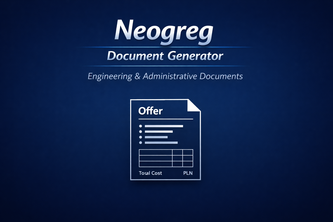
The description states that Neogreg is a document generator for technical and administrative documents, designed to reduce time spent on repetitive tasks such as quotations, contracts, reports, and survey documentation. It uses structured templates and AI capabilities (specifically referencing GPT-5) to create consistent and professional documents.
The author describes the system as combining document templates, user inputs, and AI to automate document creation. The tool is said to be built using web technologies including HTML5, CSS3, JavaScript, JSON, PDF generation, and integration with OpenAI APIs.
Inference The product appears to be a web-based application that allows users to input data and generate documents from pre-defined templates using AI assistance.
Positioning & Claim Evolution
The author states that Neogreg was inspired by personal experience with technical documentation work. It is positioned as a tool to reduce time spent on administrative tasks, allowing specialists to focus more on their core technical work.
The project’s claim evolution shows a progression from a personal solution to a modular platform for multiple technical industries. The author notes that the electrical engineering module is the first part of a larger system, with plans to expand into HVAC, plumbing, construction, and other fields.
Inference The positioning has evolved from a niche tool for one user to a broader platform targeting multiple technical sectors, but this is not yet evidenced by adoption or product usage.
Target Customer & ICP
The description states that Neogreg is designed for electricians and small contractors, with the goal of saving time, reducing paperwork, and ensuring consistent professional documentation.
Inference The target customer appears to be small-scale technical professionals who perform repetitive documentation tasks. However, there is no evidence of actual customers or user feedback.
Business Model & Pricing Evidence
There is no evidence in the description of a business model or pricing structure. The author does not state whether Neogreg will be offered as a freemium, subscription, or one-time purchase product.
Inference No commercial model has been described or evidenced.
Technical & Delivery Signals
The project was built using web technologies, including HTML5, CSS3, JavaScript, JSON, and PDF generation. It integrates with OpenAI APIs, specifically referencing GPT-5. The author states that the system combines document templates, user inputs, and AI to create documents.
Inference The tool is likely a web-based application using AI for content generation, but there is no evidence of delivery mechanism or scalability beyond the author’s own use case.
Traction & Maturity Signals
The description does not provide any traction signals, such as revenue, customers, user engagement, or product usage. It states that Neogreg was built for a hackathon and has evolved into a modular platform, but there is no evidence of real-world adoption or product-market fit.
Inference No traction or maturity indicators are evidenced.
Competitive Context
The description does not mention any direct competitors or competitive landscape. It is unclear whether similar tools already exist in the market for technical document generation, nor if Neogreg differentiates itself from them.
Inference No competitive context is provided.
Open Questions & Risks
- No traction or adoption: The tool has not been demonstrated to have real-world usage.
- Solo development: Only one team member is listed, which raises questions about scalability and product-market fit.
- Unverified claims: All statements are self-reported and unverified; no third-party validation exists.
- Lack of commercial model: No indication of how the tool will be monetized or whether it has a sustainable business model.
Inference The lack of any real-world usage, revenue, or customer feedback raises significant risk that Neogreg may not have achieved product-market fit.
Questions the description leaves open
- Has Neogreg been used by any external users beyond the author?
- What is the current development status — is it a prototype or a working product?
- Have you identified specific customers or use cases for the tool?
- How do you plan to monetize Neogreg, and what pricing model are you considering?
- What are the key challenges in scaling the platform across multiple technical industries?
Overall Assessment
Not evidenced.
The description provides no data on revenue, customers, or product-market fit. The tool is described as a solo-engineered hackathon project that has evolved into a modular platform concept, but there is no evidence of real-world traction or commercial viability.
Inference Without evidence of adoption, usage, or revenue, it is not possible to assess whether Neogreg is a viable investment or partnership opportunity. The project remains in the early conceptual or prototype phase.
User Stories BotA demo video on every pull request
Get a demo video on every new feature
GitHub App that watches your pull requests and records a narrated, captioned demo.
Save time on demo prep and make informed decisions faster with a video walkthrough of every new feature.
Source
Submitted to the OpenAI 2026 hackathon on Devpost. Project home on Devpost. Back to the full gallery on Devpost.
This competitive analysis was produced by top-founders.com (opens in a new tab)
Generated by a language model from this project's public Devpost page — its tagline, the author's own write-up and any built-with tags listed there — as captured in August 2026. Short quotations are the author's words. It is an opinion on the idea as a business, not on the people behind it, and it reflects the description as published then. If the project has moved on, request a correction below. The analysis is not independent research and contains no verified traction, revenue or customer data.
An independent guide by KFG International LLC — not affiliated with, endorsed by, or connected to Devpost or OpenAI.