

Archive position — measured, not model output
1 like on Devpost
505 of the 7,850 archived projects have more likes, and 1,758 share exactly 1 — so this project's #1,518 place in the like-ranked listing is a tie-break inside that group, not a ranking.
Projects (log scale)
Likes on Devpost. ▲ marks this project's group.
Show the figures
| Likes | Projects | Share of archive |
|---|---|---|
| 0 | 5,587 | 71.2% |
| 1 | 1,758 | 22.4% |
| 2 | 284 | 3.6% |
| 3–4 | 132 | 1.7% |
| 5–9 | 75 | 1.0% |
| 10+ | 14 | 0.2% |
 User Stories BotA demo video on every pull request
Get a demo video on every new feature
GitHub App that watches your pull requests and records a narrated, captioned demo.
Save time on demo prep and make informed decisions faster with a video walkthrough of every new feature.
Executive Summary
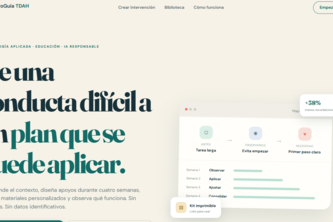
What the company appears to be: NeuroGuía TDAH is an educational application designed for teachers and families supporting children aged 6–12 with ADHD. The product aims to bridge the gap between psychological knowledge and practical everyday action by turning observable situations into structured intervention workflows, offering AI-guided support without diagnosing or labeling the child.
What changed: The author states that the project evolved from a simple prototype into a more robust application through iterative professional review and feedback. Key enhancements included adding deeper knowledge cards, multi-child follow-up capabilities, exportable backups, and printable resources.
Single most important open question: Is there evidence of real-world adoption or usage by teachers and families? The description contains no data on user engagement, retention, or impact beyond the author’s own professional review.
What The Product Actually Is
The description states that NeuroGuía TDAH is an educational application for teachers and families supporting children aged 6 to 12. It transforms observable situations into structured intervention workflows using GPT-5.6 in a controlled way, with features such as:
- Structured observation and interpretation
- AI-generated educational strategies
- Printable resources
- Four-week action plans
- Multi-child profile support
- Data export (JSON and CSV)
- Demonstration cases for testing
The application uses a lightweight web architecture built with HTML, CSS, JavaScript, Node.js, Express, Vercel serverless functions, and OpenAI’s GPT-5.6 API.
Inference: The product is not described as a diagnostic tool or a generic chatbot but rather as an AI-assisted workflow for educators and caregivers to support children with ADHD in school and home environments.
Positioning & Claim Evolution
The author positions NeuroGuía TDAH as a tool that helps teachers and families turn observable challenges into personalized plans, printable resources, and meaningful follow-up — without diagnosing or blaming the child.
It is described as distinct from generic ADHD resources or chatbots because it combines:
- Professional psychological knowledge
- Contextual AI guidance
- Printable classroom/home resources
- Structured planning
- Multi-child organization
- Meaningful follow-up
The product was shaped by the author’s own professional review of every iteration, including decisions around:
- Avoiding diagnostic labels
- Separating observation from interpretation
- Using a structured JSON contract for GPT responses
- Ensuring data privacy through local storage and deterministic code
Inference: The positioning reflects an intent to offer responsible, non-invasive AI support in sensitive educational contexts.
Target Customer & ICP
The description states that NeuroGuía TDAH supports teachers and families of children aged 6 to 12 who are dealing with ADHD-related challenges.
It also mentions:
- Support for multiple children per user
- Class grouping capabilities
- Independent profiles for each child
- Exportable backups and CSV summaries
There is no mention of specific customer segments beyond these groups, nor any indication of whether the tool targets schools, private tutors, or individual parents.
Inference: The core ICP appears to be educators and caregivers working with children aged 6–12 who want structured support without diagnostic labeling.
Business Model & Pricing Evidence
There is no evidence in the description of a business model or pricing structure. The author does not state whether the product will be sold, offered free, monetized via subscriptions, or funded through grants or partnerships.
Not evidenced: No information on revenue streams, pricing tiers, or commercialization plans.
Technical & Delivery Signals
The application is built using:
- Responsive browser interface (HTML, CSS, JavaScript)
- Node.js and Express for local development
- Vercel serverless functions for production
- OpenAI Responses API with GPT-5.6
- localStorage for anonymous profiles and observations
- Deterministic code for plans, printables, charts, backups, exports
The author notes that:
- The OpenAI API key remains on the server and is never exposed to the browser.
- A controlled JSON response contract ensures reliable rendering.
- Automated tests are used via Node.js test runner.
- GitHub is used for version control and Vercel for continuous deployment.
Inference: The technical stack suggests a lightweight, client-side focused solution with serverless backend components and strong emphasis on privacy and deterministic behavior.
Traction & Maturity Signals
The description provides no evidence of traction or maturity indicators such as:
- Revenue
- Customer base
- User engagement metrics
- Product usage data
- Market validation
It does state that the final product was shaped by professional review, but this is not evidence of real-world adoption.
Not evidenced: No data on actual users, retention, or impact beyond the author’s own experience.
Competitive Context
The description does not provide any information about competitors or how NeuroGuía TDAH compares to existing tools in the ADHD support space. It only states that it is distinct from generic chatbots and static resource libraries.
Not evidenced: No competitive analysis, market positioning, or comparison with other products.
Open Questions & Risks
- Lack of commercial traction or user data: The product appears to be a prototype or early-stage tool without evidence of real-world usage.
- Unverified claims about AI safety and control: While the author describes constraints on GPT-5.6 use, there is no independent verification that these safeguards are effective in practice.
- Single-person team: With only one member listed, scalability and long-term maintenance may be concerns.
- No pricing or monetization strategy: Unclear how the product will generate value or revenue.
- Self-reported nature of all claims: All information is unverified and based solely on the author’s own account.
Questions the description leaves open
- What specific feedback did you receive from teachers or families during development?
- How do you plan to validate the effectiveness of the AI-generated strategies in real-world settings?
- Are there any pilot programs or early adopters currently using the tool?
- What is your roadmap for scaling beyond a single developer?
- How will you ensure data privacy and compliance with educational regulations (e.g., GDPR, FERPA)?
- Do you have plans to integrate with existing school systems or platforms?
- What are the key assumptions behind the product’s value proposition?
Overall Assessment
Not evidenced: No information is provided about financials, funding rounds, valuation, or partnership opportunities.
The project appears to be an early-stage prototype submitted for a hackathon. It shows thoughtful design around responsible AI use and educational support but lacks evidence of commercial viability, traction, or scalability.
Confidence level: Low — based entirely on self-reported claims with no external validation or data points.
User Stories BotA demo video on every pull request
Get a demo video on every new feature
GitHub App that watches your pull requests and records a narrated, captioned demo.
Save time on demo prep and make informed decisions faster with a video walkthrough of every new feature.
Source
Submitted to the OpenAI 2026 hackathon on Devpost. Project home on Devpost. Back to the full gallery on Devpost.
This competitive analysis was produced by top-founders.com (opens in a new tab)
Generated by a language model from this project's public Devpost page — its tagline, the author's own write-up and any built-with tags listed there — as captured in August 2026. Short quotations are the author's words. It is an opinion on the idea as a business, not on the people behind it, and it reflects the description as published then. If the project has moved on, request a correction below. The analysis is not independent research and contains no verified traction, revenue or customer data.
An independent guide by KFG International LLC — not affiliated with, endorsed by, or connected to Devpost or OpenAI.