

Archive position — measured, not model output
0 likes on Devpost
2,263 of the 7,850 archived projects have more likes, and 5,587 share exactly 0 — so this project's #5,444 place in the like-ranked listing is a tie-break inside that group, not a ranking.
Projects (log scale)
Likes on Devpost. ▲ marks this project's group.
Show the figures
| Likes | Projects | Share of archive |
|---|---|---|
| 0 | 5,587 | 71.2% |
| 1 | 1,758 | 22.4% |
| 2 | 284 | 3.6% |
| 3–4 | 132 | 1.7% |
| 5–9 | 75 | 1.0% |
| 10+ | 14 | 0.2% |
 User Stories BotA demo video on every pull request
Get a demo video on every new feature
GitHub App that watches your pull requests and records a narrated, captioned demo.
Save time on demo prep and make informed decisions faster with a video walkthrough of every new feature.
Executive Summary
What the company appears to be
MyConstituency is a self-reported project that aims to centralize and make accessible electoral data for citizens of Malawi — particularly around MPs, local governments, and Traditional Authorities (T/A). It was built as a hackathon submission by one individual (Manfred Chirambo) with help from AI tools like ChatGPT. The author states it uses GraphQL, GSAP, MEC, Qwik, Rust, and Supabase.
What changed
The project is described as having started from a personal frustration with finding basic electoral information in Malawi — specifically, the lack of easy access to data that should be public but is scattered across PDFs. It evolved into a full-stack application attempting to extract, clean, and present this data in a searchable format.
Single most important open question
Is there any evidence of traction or user adoption beyond the author’s own development efforts? The description does not indicate whether the tool has been used by others or deployed for public use.
Note: This analysis is based entirely on self-reported information from the project description. No independent verification, revenue data, customer base, or historical usage is available.
What The Product Actually Is
The description states that MyConstituency is a tool that allows users to find electoral data — such as MPs, local governments, and Traditional Authorities (T/A) — in one place. It was built using a combination of technologies including Rust for backend, Supabase for database, and Qwik for frontend rendering.
- The author describes building a full-stack app from scratch.
- Data comes from government PDFs that were manually scraped and cleaned.
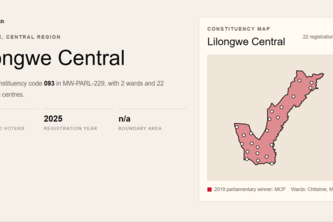
- The system includes historical views and maps of constituencies.
- It is described as being built with AI assistance (e.g., ChatGPT).
Inference: Based on the description, MyConstituency appears to be a data aggregation and visualization tool aimed at improving access to electoral information in Malawi. However, no actual product or live deployment is evidenced.
Positioning & Claim Evolution
The author positions MyConstituency as an effort to democratize access to public data in Malawi — especially where infrastructure and service delivery are lacking. The project was inspired by the difficulty of finding basic electoral information, which led to a desire to make such data searchable and accessible.
- The tagline says: “A place where my fellow Malawians and any foreign weirdos curious about our electoral process can easily find all the data in one place.”
- The author claims that technology can fix access issues without waiting for large-scale infrastructure or budgetary support.
- There is an emphasis on using AI to extract and clean data from PDFs.
Claim vs Fact: These are self-reported claims about intent, not proof of traction or impact. The project was submitted to a hackathon and has no evidence of being used beyond its development phase.
Target Customer & ICP
The description states that the target users are:
- Fellow Malawians who need to know their electoral representatives.
- Foreign observers or researchers interested in Malawi’s electoral process.
There is no indication of specific personas, segmentation strategies, or user research. The author mentions a “foreign weirdo” — implying curiosity from outsiders — but does not elaborate on how they would engage with the tool.
Not evidenced: No evidence of defined customer segments, usage patterns, or feedback loops.
Business Model & Pricing Evidence
There is no mention of pricing, monetization, or business model in the description. The project was built as a hackathon submission and does not appear to have any revenue streams or commercial intent described.
Not evidenced: No evidence of pricing, subscriptions, or monetization strategy.
Technical & Delivery Signals
The author reports building:
- A Rust-based backend
- Supabase for data storage
- Qwik for frontend rendering
- GSAP for animations
- GraphQL for API access
- MEC (likely a reference to Malawi Electoral Commission)
- Data cleaning pipelines using AI tools like ChatGPT
Challenges included:
- Government data not designed for use (PDF-only, no APIs)
- Scope creep due to over-engineering (e.g., choosing Rust)
- Token exhaustion from AI usage
- Missing data year
Inference: The technical stack suggests a developer-focused approach with some ambition. However, the project was built under time constraints and with limited resources — not necessarily a scalable or production-ready architecture.
Traction & Maturity Signals
There is no evidence of:
- Users or customers
- Revenue or monetization
- Product adoption or engagement metrics
- Deployment in production
- Any form of public release or ongoing maintenance
The project was submitted to a hackathon and described as being "out of tokens" — indicating it has not yet reached a functional state for broader use.
Not evidenced: No traction, user base, or product maturity indicators are provided.
Competitive Context
No competitive landscape is described. The author does not reference existing tools or platforms that might offer similar services in Malawi or elsewhere.
Not evidenced: No information on competitors or market positioning.
Open Questions & Risks
- Unverified data source: Government PDFs are not structured for machine use, and the project relies heavily on manual scraping.
- Limited team size: Only one developer (Manfred Chirambo) is mentioned.
- Over-engineering risk: Choice of Rust and AI-heavy development may have added unnecessary complexity.
- No commercial viability: No pricing or monetization model is evident.
- Token dependency: The project ran out of OpenAI tokens, suggesting reliance on external tools that are not scalable or sustainable.
- Lack of traction: No evidence of users or adoption beyond the author’s own development.
Inference: The project lacks commercial viability and scalability without further development and validation.
Questions the description leaves open
- What is the current status of data availability? Are there any ongoing efforts to obtain structured datasets from official sources?
- Has there been any feedback or engagement from users in Malawi beyond the author’s own use?
- How do you plan to sustain development beyond the initial hackathon phase?
- Do you have a clear path toward monetization or long-term impact?
- What are the legal and ethical considerations around scraping government data?
- Are there any partnerships with local organizations, NGOs, or government bodies that could support this project?
Overall Assessment
There is no evidence of commercial traction, revenue, or user adoption beyond the author’s own development efforts. The project is described as a hackathon submission and has not yet reached a functional state for public use.
Not evidenced: No basis to assess investment potential or partnership viability at this stage.
The description indicates strong intent and technical capability, but no demonstrated product-market fit or sustainable model. It remains an experimental idea with possible future value — but not ready for investment or strategic partnership consideration without further development and validation.
User Stories BotA demo video on every pull request
Get a demo video on every new feature
GitHub App that watches your pull requests and records a narrated, captioned demo.
Save time on demo prep and make informed decisions faster with a video walkthrough of every new feature.
Source
Submitted to the OpenAI 2026 hackathon on Devpost. Project home on Devpost. Back to the full gallery on Devpost.
This competitive analysis was produced by top-founders.com (opens in a new tab)
Generated by a language model from this project's public Devpost page — its tagline, the author's own write-up and any built-with tags listed there — as captured in August 2026. Short quotations are the author's words. It is an opinion on the idea as a business, not on the people behind it, and it reflects the description as published then. If the project has moved on, request a correction below. The analysis is not independent research and contains no verified traction, revenue or customer data.
An independent guide by KFG International LLC — not affiliated with, endorsed by, or connected to Devpost or OpenAI.