

Archive position — measured, not model output
0 likes on Devpost
2,263 of the 7,850 archived projects have more likes, and 5,587 share exactly 0 — so this project's #5,504 place in the like-ranked listing is a tie-break inside that group, not a ranking.
Projects (log scale)
Likes on Devpost. ▲ marks this project's group.
Show the figures
| Likes | Projects | Share of archive |
|---|---|---|
| 0 | 5,587 | 71.2% |
| 1 | 1,758 | 22.4% |
| 2 | 284 | 3.6% |
| 3–4 | 132 | 1.7% |
| 5–9 | 75 | 1.0% |
| 10+ | 14 | 0.2% |
 User Stories BotA demo video on every pull request
Get a demo video on every new feature
GitHub App that watches your pull requests and records a narrated, captioned demo.
Save time on demo prep and make informed decisions faster with a video walkthrough of every new feature.
Executive Summary
Company: nemu
Self-reported basis: The entire analysis is based on the project description provided by the caller — its name, tagline, the author's own write-up, and technology tags. No external corroboration or historical data is available.
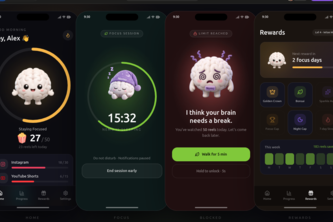
What it appears to be: A mobile application for Android that uses accessibility services and usage stats APIs to monitor short-form video consumption (Reels, Shorts), track habits, and encourage healthier digital behavior through a playful companion character.
What changed: The project was submitted as part of the OpenAI 2026 hackathon; no indication of prior development or commercial activity is evident.
Single most important open question: Is there evidence that users are willing to engage with this product beyond the hackathon phase, and if so, what is the nature of their engagement?
What The Product Actually Is
The description states that nemu is an Android application designed to monitor and influence user behavior around short-form video consumption (Reels, Shorts). It uses:
- Accessibility Service for detecting Reels and Shorts
- Usage Stats API to determine foreground applications
- React Native for the UI
- Kotlin native modules for Android integrations
The app tracks scrolling habits in real time, allows users to set daily limits, blocks access once those limits are exceeded, and includes a character companion that reacts to user habits.
Inference: The product is built as a mobile application with a focus on behavioral change rather than strict time management or blocking. It leverages Android APIs for monitoring and local processing.
Positioning & Claim Evolution
The description claims that nemu aims to create a healthier relationship with short-form content by replacing guilt-based productivity tools with playful encouragement and awareness. The app is positioned not as a punitive tool but as a companion that celebrates healthy behavior and gently reminds users when they're slipping into endless scrolling.
Inference: This positioning reflects an attempt to differentiate from existing screen-time apps that rely on timers or guilt-inducing messages, suggesting a behavioral design approach focused on motivation over restriction.
Target Customer & ICP
The description does not identify specific customer segments or personas. It implies the app targets individuals who struggle with excessive scrolling on Instagram, YouTube, and TikTok, but no demographic or psychographic data is provided.
Inference: The target audience likely includes people seeking better control over their digital habits, particularly those who feel overwhelmed by short-form content platforms.
Business Model & Pricing Evidence
There is no evidence in the description of a business model or pricing strategy. No mention of monetization methods, subscriptions, freemium tiers, or paid features.
Inference: The project appears to be a hackathon submission with no commercial structure described.
Technical & Delivery Signals
The app is built using:
- React Native for UI
- Kotlin native modules for Android integrations
- Accessibility Service and Usage Stats API for monitoring
- Permissions for digital wellbeing functionality
It separates UI from monitoring services so tracking continues in the background. The architecture emphasizes local processing to maintain privacy.
Inference: Technical implementation suggests a functional prototype with attention to performance, battery usage, and user privacy. However, no evidence of scalability or production deployment is evident.
Traction & Maturity Signals
The project was submitted to the OpenAI 2026 hackathon. No evidence of revenue, customers, user base, or adoption beyond the submission exists in the description.
Inference: The product has not yet reached a market-ready stage; it remains a prototype or proof-of-concept.
Competitive Context
The description does not reference competitors or existing solutions in the digital wellbeing space. It only contrasts nemu with "most screen-time apps that fail because they rely on guilt or simple timers."
Inference: The competitive landscape is unknown, but the app positions itself as an alternative to traditional time-tracking tools.
Open Questions & Risks
- Unproven market demand: No evidence of user engagement beyond the hackathon.
- Privacy concerns: While local processing is mentioned, Android accessibility services and usage stats APIs raise potential privacy issues.
- Limited scope: The app only supports Android and focuses on Instagram, YouTube, and TikTok.
- Unclear path to monetization: No business model or revenue strategy described.
Questions the description leaves open
- What is the intended user acquisition strategy post-hackathon?
- How does the app handle edge cases in detecting Reels vs. regular content?
- Are there plans for cross-platform support beyond Android?
- What are the long-term goals for monetization or commercial viability?
- Has any user testing been conducted outside of the hackathon environment?
Overall Assessment
Not evidenced.
The description provides no information about traction, revenue, customer data, or financials. It describes a concept and prototype but does not indicate whether there is a viable business opportunity or strategic fit for investment or partnership.
Inference: Without further evidence of user engagement, product-market fit, or commercial viability, this project cannot be evaluated as a serious investment or partnership candidate at this stage.
User Stories BotA demo video on every pull request
Get a demo video on every new feature
GitHub App that watches your pull requests and records a narrated, captioned demo.
Save time on demo prep and make informed decisions faster with a video walkthrough of every new feature.
Source
Submitted to the OpenAI 2026 hackathon on Devpost. Project home on Devpost. Back to the full gallery on Devpost.
This competitive analysis was produced by top-founders.com (opens in a new tab)
Generated by a language model from this project's public Devpost page — its tagline, the author's own write-up and any built-with tags listed there — as captured in August 2026. Short quotations are the author's words. It is an opinion on the idea as a business, not on the people behind it, and it reflects the description as published then. If the project has moved on, request a correction below. The analysis is not independent research and contains no verified traction, revenue or customer data.
An independent guide by KFG International LLC — not affiliated with, endorsed by, or connected to Devpost or OpenAI.