

Archive position — measured, not model output
0 likes on Devpost
2,263 of the 7,850 archived projects have more likes, and 5,587 share exactly 0 — so this project's #5,505 place in the like-ranked listing is a tie-break inside that group, not a ranking.
Projects (log scale)
Likes on Devpost. ▲ marks this project's group.
Show the figures
| Likes | Projects | Share of archive |
|---|---|---|
| 0 | 5,587 | 71.2% |
| 1 | 1,758 | 22.4% |
| 2 | 284 | 3.6% |
| 3–4 | 132 | 1.7% |
| 5–9 | 75 | 1.0% |
| 10+ | 14 | 0.2% |
 User Stories BotA demo video on every pull request
Get a demo video on every new feature
GitHub App that watches your pull requests and records a narrated, captioned demo.
Save time on demo prep and make informed decisions faster with a video walkthrough of every new feature.
Executive Summary
What the company appears to be
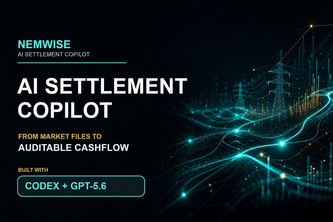
NEMwise is a self-reported AI-powered settlement copilot for Australian energy retailers. The project description states it ingests AEMO settlement files and allows users to ask natural-language questions about cash flow, exposure, and unbilled revenue. It claims to operate as a chat-first workspace that parses complex data formats, validates schemas, and answers domain-specific queries using AI tool calling and read-only SQL.
What changed
The author describes NEMwise evolving from a proof-of-concept chatbot into an end-to-end settlement platform during the OpenAI Build Week hackathon. It was built as a full-stack application with React/TanStack frontend, Streamlit cockpit, FastAPI worker, Docker deployment, and automated tests.
Single most important open question
Is there evidence of real-world usage or traction from energy retailers, or is this a prototype that has not yet been tested in production?
What The Product Actually Is
The description states that NEMwise is:
- A chat-first settlement workspace for Australian energy retailers.
- Capable of uploading settlement files and answering operational questions in natural language.
- Designed to parse multiple file types, including XML reports, ZIP archives, CSVs, Excel workbooks, and reference data.
- Uses an AI agent orchestrator powered by OpenAI Python SDK with tool calling.
- Operates on a deterministic domain layer, separating AI reasoning from financial computation.
- Supports version-aware cash-flow exports, tracking settlement revisions.
- Includes a clean-room synthetic market data generator for demonstrations and testing.
It is described as a full-stack application built using React, Streamlit, FastAPI, Docker, and Python-based tools like pandas, DuckDB, and Pydantic.
Not evidenced:
- Whether the product has been deployed or used in production.
- If any customers or users have engaged with it beyond the hackathon.
- Any revenue, pricing, or monetization model.
Positioning & Claim Evolution
The author states that NEMwise was built to address problems in manual settlement workflows involving spreadsheets and specialist knowledge. It positions itself as:
- Not a generic “chat with your CSV” tool.
- An AI operating layer for a real, specialised financial workflow.
- A platform where AI makes complex systems easier to use without becoming an unverified source of truth.
The project evolved from a proof-of-concept chatbot into a working settlement platform during the hackathon. The vision includes:
- Becoming the conversational operating layer for energy settlement teams.
- Supporting upload once, ask naturally, understand every number, and know exactly what must happen next.
Inferred:
- The positioning implies NEMwise aims to digitize and automate a manual process in energy retailing.
- It seeks to improve trust and transparency in settlement operations through deterministic tools and AI explanations.
Not evidenced:
- No evidence of customer feedback or market validation beyond the hackathon.
- No claims about competitive advantage, differentiation, or prior product iterations.
Target Customer & ICP
The description states:
- NEMwise is designed for Australian energy retailers.
- It targets users who process large volumes of settlement data from AEMO.
- The intended user base includes analysts and finance teams responsible for cash flow forecasting, financial reporting, and audit adjustments.
Inferred:
- The target ICP likely includes small to mid-sized energy retailers with limited automation in their settlement processes.
- The product may appeal to organisations seeking to reduce reliance on spreadsheets and manual data handling.
Not evidenced:
- No specific customer personas or segmentation details.
- No evidence of actual customers or pilot programs beyond the hackathon.
- No indication of whether the team has engaged with energy retailers directly.
Business Model & Pricing Evidence
The description does not contain any information about:
- Revenue model
- Pricing structure
- Monetization strategy
- Customer acquisition plans
- Sales process or go-to-market approach
Not evidenced:
- No evidence of a business model, pricing, or monetization plan.
- No indication of whether the product is intended for internal use only or commercial sale.
Technical & Delivery Signals
The description provides technical details:
- Built with Docker, FastAPI, React, Streamlit, TanStack, Python, OpenAI SDK, pandas, DuckDB, Pydantic, pytest.
- Supports file parsing of AEMO formats (NEM12, RM16/RM27, FINAL, REV20, REV30).
- Uses a layered detection system for file identification and confidence scoring.
- Implements controlled AI tool calling, read-only SQL queries, and deterministic schema validation.
- Includes version-aware cash-flow logic, with adjustments calculated between settlement versions.
- Features a clean-room synthetic data simulator for testing and demonstration.
Inferred:
- The architecture suggests a strong focus on reliability, traceability, and auditability.
- The separation of AI from computation indicates an emphasis on trustworthiness in financial operations.
Not evidenced:
- No evidence of scalability or performance metrics.
- No information about deployment environments or infrastructure beyond Docker and Python stack.
- No mention of enterprise security features or integration capabilities beyond data warehouse support.
Traction & Maturity Signals
The description states:
- NEMwise was built during the OpenAI Build Week hackathon.
- It grew from a proof-of-concept chatbot into a working end-to-end platform.
- The team claims to have achieved several accomplishments, including:
- Supporting complex AEMO formats
- Implementing deterministic ingestion workflows
- Providing detailed validation and error reporting
- Creating a clean-room synthetic data generator
Inferred:
- The project shows early maturity in terms of functionality and system design.
- It demonstrates an understanding of domain-specific challenges and solutions.
Not evidenced:
- No evidence of real-world usage or adoption by energy retailers.
- No metrics on user engagement, retention, or performance.
- No indication of whether the product is currently used in production or tested with actual clients.
Competitive Context
The description does not provide any information about:
- Competitors
- Market landscape
- Existing tools or platforms serving similar needs in the energy retail settlement space
Not evidenced:
- No competitive analysis or positioning relative to other settlement systems.
- No mention of alternative solutions or market gaps addressed by NEMwise.
Open Questions & Risks
Key risks and open questions based on the self-reported description:
- No real-world traction or customer validation — The product is described as a hackathon prototype with no evidence of deployment or usage beyond the event.
- Unverified claims about AI trustworthiness — While it claims to separate AI from computation, there's no demonstration that this separation actually works in practice.
- Limited scalability assumptions — No mention of how the system handles large-scale data volumes or concurrent users.
- Unclear path to monetization — There is no indication of how NEMwise will generate revenue or be sold to customers.
- Single-person team — The project is attributed to one founder, which raises questions about execution capacity and scalability.
Inferred:
- The lack of customer feedback or real-world testing suggests high risk in terms of product-market fit.
- The focus on deterministic tools may limit flexibility or innovation compared to purely AI-driven approaches.
Questions the description leaves open
- Has NEMwise been tested with actual energy retailers? What was the outcome?
- How does the team plan to scale beyond a single-person development effort?
- What are the specific technical limitations of the current architecture, and how will they be addressed?
- Are there any known issues or bugs in the system that have not been resolved?
- How is data security handled, especially given the sensitive nature of settlement information?
- What is the timeline for moving from prototype to production-ready platform?
- Is there a plan to integrate with existing AEMO data sources directly?
- How does the team intend to monetize or commercialize this product?
Overall Assessment
The description presents NEMwise as a conceptually strong, technically well-designed prototype aimed at solving a real problem in energy retail settlement workflows.
However, due to its self-reported nature and lack of independent verification:
- There is no evidence of traction, revenue, or customer adoption.
- The product remains unproven in real-world conditions.
- It appears to be a preliminary version built during a hackathon, not yet validated by market use.
Confidence Level: Low
This project shows potential but lacks the commercial due-diligence signals required for investment or partnership consideration. A follow-up evaluation would require evidence of early adopters, pilot programs, or measurable performance in live environments.
User Stories BotA demo video on every pull request
Get a demo video on every new feature
GitHub App that watches your pull requests and records a narrated, captioned demo.
Save time on demo prep and make informed decisions faster with a video walkthrough of every new feature.
Source
Submitted to the OpenAI 2026 hackathon on Devpost. Project home on Devpost. Back to the full gallery on Devpost.
This competitive analysis was produced by top-founders.com (opens in a new tab)
Generated by a language model from this project's public Devpost page — its tagline, the author's own write-up and any built-with tags listed there — as captured in August 2026. Short quotations are the author's words. It is an opinion on the idea as a business, not on the people behind it, and it reflects the description as published then. If the project has moved on, request a correction below. The analysis is not independent research and contains no verified traction, revenue or customer data.
An independent guide by KFG International LLC — not affiliated with, endorsed by, or connected to Devpost or OpenAI.