

Archive position — measured, not model output
0 likes on Devpost
2,263 of the 7,850 archived projects have more likes, and 5,587 share exactly 0 — so this project's #5,493 place in the like-ranked listing is a tie-break inside that group, not a ranking.
Projects (log scale)
Likes on Devpost. ▲ marks this project's group.
Show the figures
| Likes | Projects | Share of archive |
|---|---|---|
| 0 | 5,587 | 71.2% |
| 1 | 1,758 | 22.4% |
| 2 | 284 | 3.6% |
| 3–4 | 132 | 1.7% |
| 5–9 | 75 | 1.0% |
| 10+ | 14 | 0.2% |
 User Stories BotA demo video on every pull request
Get a demo video on every new feature
GitHub App that watches your pull requests and records a narrated, captioned demo.
Save time on demo prep and make informed decisions faster with a video walkthrough of every new feature.
Executive Summary
Project: Nebulaflow
Self-reported basis: The analysis is based entirely on the author-supplied project description from Devpost, including name, tagline, write-up, and technology stack — all self-reported and unverified. No external corroboration or traction data is available.
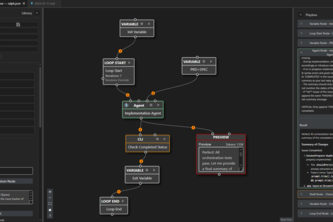
What it appears to be: A node-based visual workflow editor for developers, built as a single-module component within a larger "software factory" ecosystem. It allows users to design workflows using nodes that represent CLI commands, agents, control flow, and previews. The tool is described as inspired by tools like Blender Geometry Nodes and Unreal Engine Blueprints but applied to coding agents.
What changed: The project was submitted to the OpenAI 2026 hackathon. No indication of prior development or product iteration beyond this submission exists in the provided description.
Single most important open question: Is there evidence of any real-world usage, customer feedback, or traction that would suggest a viable path to commercial adoption?
What The Product Actually Is
The description states:
- Nebulaflow is a node-based agentic workflow editor.
- It allows users to visually design and run developer workflows as node graphs.
- Workflows include CLI, Agent, control-flow, and previews.
- It is part of a larger suite for software factories, with modules such as an Agent Editor, Marketplace, Agent Kit, and harness primitive generation.
Inference: The product appears to be a visual development tool aimed at developers who want to automate or streamline repetitive coding tasks using node-based workflows. However, no functional screenshots, live demos, or executable code samples are provided.
Not evidenced:
- No actual functionality demonstrated.
- No UI/UX details, interaction patterns, or workflow examples.
- No mention of how the tool integrates with existing developer environments or CI/CD pipelines.
Positioning & Claim Evolution
The description states:
- Nebulaflow is inspired by Blender Geometry Nodes and Unreal Engine Blueprints, suggesting a visual, node-based approach to coding.
- It aims to help developers create reliable, semi-deterministic workflows.
- The tool is positioned as part of a larger software factory ecosystem.
Inference: The positioning is that Nebulaflow is a developer productivity tool, focused on workflow automation through visual design. It attempts to bridge the gap between low-code tools and traditional development environments.
Not evidenced:
- No evidence of prior versions or evolution of claims.
- No indication of how it differentiates from existing node-based tools like Node-RED, Apache Airflow, or similar platforms.
- No mention of whether this is a standalone tool or a component in a broader platform.
Target Customer & ICP
The description states:
- Nebulaflow helps developers create workflows to ease the burden of repetitive work.
- It supports CLI, Agent, control-flow, and previews.
- It was built with TypeScript, React, CSS, HTML, suggesting a developer audience.
Inference: The primary customer is likely developer teams or individual developers who want to automate tasks using visual workflows. The tool may appeal to those working in environments where repetitive coding or scripting is common.
Not evidenced:
- No specific customer personas or use cases provided.
- No indication of whether the tool targets enterprise, indie devs, or open-source contributors.
- No evidence of any existing customers or feedback from target users.
Business Model & Pricing Evidence
The description states:
- Nebulaflow is one module in a larger suite for software factories.
- It is part of a larger ecosystem, including Agent Editor, Marketplace, Agent Kit, and harness primitive generation.
Inference: The business model may be based on a suite or platform approach, where Nebulaflow is one component within a broader offering. Pricing is not mentioned.
Not evidenced:
- No pricing information.
- No indication of monetization strategy (e.g., freemium, enterprise licensing, SaaS).
- No evidence of any revenue streams or commercialization plans beyond the hackathon submission.
Technical & Delivery Signals
The description states:
- Built with React, TypeScript, CSS, HTML.
- Challenges included preventing architecture drift, refactoring layered to vertically sliced architecture, and performance for large workflows with many nodes.
Inference: The tool is built using modern web technologies and attempts to address architectural complexity in development tools. It acknowledges performance challenges, which may indicate early-stage technical limitations.
Not evidenced:
- No demonstration of actual performance or scalability.
- No evidence of how the tool handles complex workflows or integrates with external systems.
- No mention of backend infrastructure or deployment strategy.
Traction & Maturity Signals
The description states:
- Nebulaflow was submitted to the OpenAI 2026 hackathon.
- It is part of a larger suite, suggesting future development plans.
- The author notes time saved with an agent during design and implementation phase.
Inference: The project is in a very early stage, likely a prototype or proof-of-concept, submitted for a hackathon. There is no evidence of real-world usage or adoption.
Not evidenced:
- No customer data, user feedback, or adoption metrics.
- No evidence of product-market fit or traction beyond the hackathon submission.
- No indication of whether the tool has been used in production or by other developers.
Competitive Context
The description states:
- Inspired by Blender Geometry Nodes and Unreal Engine Blueprints, suggesting a visual workflow paradigm.
- It is part of a software factory suite, implying it may compete with or complement tools like Node-RED, Apache Airflow, or similar platforms.
Inference: Nebulaflow competes in the space of visual workflow automation for developers, but its positioning is unclear relative to existing tools. The inspiration from Blender and Unreal suggests a focus on visual design, but it’s not clear how it differentiates from other node-based tools.
Not evidenced:
- No competitive analysis or differentiation strategy provided.
- No evidence of market research or awareness of existing tools in the space.
- No indication of whether it targets niche or mainstream developer workflows.
Open Questions & Risks
The description states:
- The project is a single-module tool within a larger suite.
- It was built by one person (PriNova).
- Challenges included architecture drift, refactoring, and performance.
Inference:
- Single-person development raises concerns about scalability, maintenance, and long-term viability.
- Lack of traction or adoption suggests no validated demand.
- Performance issues with large workflows may indicate technical limitations that could hinder real-world use.
Open questions:
- No evidence of product-market fit or customer validation.
- No revenue model or monetization strategy described.
- No indication of team size, roadmap, or future development plans beyond the hackathon.
Questions the description leaves open
- What specific workflows or tasks does Nebulaflow aim to automate?
- How does it differ from existing tools like Node-RED, Apache Airflow, or Unreal Engine Blueprints?
- Has the tool been tested with real developers or teams?
- What is the roadmap for the full software factory suite?
- Are there any early adopters or pilot users?
- How does it handle performance and scalability in large workflows?
- What are the plans for monetization or commercialization?
Overall Assessment
Self-reported basis: The analysis is based entirely on a hackathon submission, with no evidence of traction, revenue, or customer adoption.
Assessment:
- Not evidenced as a viable product or business at this stage.
- The tool appears to be an early-stage prototype with limited commercial viability.
- No clear path to monetization or market traction is evident.
- A potential investment or partnership would require further evidence of product-market fit, team capability, and roadmap execution.
Confidence: Low — based on minimal self-reported evidence and no external validation.
User Stories BotA demo video on every pull request
Get a demo video on every new feature
GitHub App that watches your pull requests and records a narrated, captioned demo.
Save time on demo prep and make informed decisions faster with a video walkthrough of every new feature.
Source
Submitted to the OpenAI 2026 hackathon on Devpost. Project home on Devpost. Back to the full gallery on Devpost.
This competitive analysis was produced by top-founders.com (opens in a new tab)
Generated by a language model from this project's public Devpost page — its tagline, the author's own write-up and any built-with tags listed there — as captured in August 2026. Short quotations are the author's words. It is an opinion on the idea as a business, not on the people behind it, and it reflects the description as published then. If the project has moved on, request a correction below. The analysis is not independent research and contains no verified traction, revenue or customer data.
An independent guide by KFG International LLC — not affiliated with, endorsed by, or connected to Devpost or OpenAI.