

Archive position — measured, not model output
0 likes on Devpost
2,263 of the 7,850 archived projects have more likes, and 5,587 share exactly 0 — so this project's #5,494 place in the like-ranked listing is a tie-break inside that group, not a ranking.
Projects (log scale)
Likes on Devpost. ▲ marks this project's group.
Show the figures
| Likes | Projects | Share of archive |
|---|---|---|
| 0 | 5,587 | 71.2% |
| 1 | 1,758 | 22.4% |
| 2 | 284 | 3.6% |
| 3–4 | 132 | 1.7% |
| 5–9 | 75 | 1.0% |
| 10+ | 14 | 0.2% |
 User Stories BotA demo video on every pull request
Get a demo video on every new feature
GitHub App that watches your pull requests and records a narrated, captioned demo.
Save time on demo prep and make informed decisions faster with a video walkthrough of every new feature.
Executive Summary
What the company appears to be
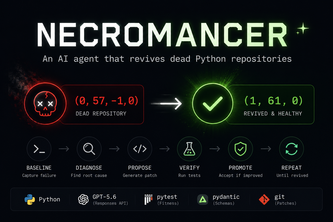
Necromancer is a command-line AI agent that revives abandoned Python repositories by diagnosing why they failed and applying minimal, verified fixes. It uses GPT-5.6 for diagnosis and patch generation, but enforces deterministic verification of each change via a sandboxed test runner and anti-cheat policy.
What changed
The project is a self-reported hackathon submission (Devpost entry) describing an AI-powered tool to revive dead open-source Python code. It claims to use GPT-5.6 in a structured pipeline with deterministic checks, but no evidence of revenue, customers or product adoption exists beyond the authors’ own account.
Single most important open question
Is there any evidence that this system works reliably at scale, or is it limited to specific, curated test cases?
Note: This analysis is based entirely on the self-reported project description provided by the caller. No external verification, traction data, or third-party sources are available.
What The Product Actually Is
The description states that Necromancer is a command-line agent designed to revive abandoned Python repositories. It operates through a multi-stage process:
- It runs the test suite of a target repository to establish a baseline of failures.
- It uses GPT-5.6 to analyze failure tracebacks and propose minimal source-only patches.
- Each proposed patch is applied in a disposable snapshot, re-run against tests, and only promoted if real test results prove progress.
- The system enforces an anti-cheat policy that prevents editing test files or injecting skips.
The core principle is: “GPT-5.6 proposes, deterministic code decides.”
Inference: This is not a general-purpose AI tool but a specialized agent for fixing dead Python repos using structured reasoning and verification layers.
Positioning & Claim Evolution
The authors position Necromancer as an AI-powered solution to the problem of abandoned open-source libraries — specifically those that fail to install or run due to dependency changes, API deprecations, or missing maintainers.
They claim:
- The tool can autonomously revive a repository from completely broken to passing tests.
- It uses GPT-5.6 for diagnosis and patch generation, but avoids model self-declaration of success.
- It includes an anti-cheat mechanism that prevents cheating via test edits or skips.
- It benchmarks itself on real repositories with mixed results (full revival, partial revivals, out-of-scope cases).
Claim vs Fact: These are claims made by the authors. There is no evidence of actual usage, performance metrics beyond benchmarking, or customer feedback.
Target Customer & ICP
The description does not explicitly define a target customer or ideal customer profile (ICP). However, it implies:
- Developers who encounter broken open-source libraries in their projects.
- Maintainers or contributors looking to revive legacy codebases.
- Organizations using or relying on older Python repositories that have become incompatible.
Inference: The tool is likely aimed at developers working with legacy Python ecosystems and those seeking automation for dependency management or code modernization.
Business Model & Pricing Evidence
There is no evidence of a business model or pricing structure in the description. The project is described as a hackathon submission, not a commercial product.
Not evidenced: No information about monetization, licensing, or revenue streams.
Technical & Delivery Signals
The system architecture includes:
- A sandboxed test runner that captures structured JSON outputs.
- An evidence-based scoring system to compare test results.
- A patch application layer with preimage hash checks and anti-cheat policies.
- Use of GPT-5.6 via the OpenAI Responses API with strict structured outputs.
- Integration with Codex for engineering support across thirteen documented sessions.
Inference: The tool is built with a deliberate focus on trustworthiness, using deterministic verification to counter model hallucinations or self-deception.
Traction & Maturity Signals
The description includes:
- Benchmarking results on four real repositories.
- One full revival (algorithms repo), two partial revivals, and one out-of-scope case.
- Self-correction capability when GPT-5.6 produces malformed diffs.
- A documented process of fixing a false claim in the anti-cheat policy.
Not evidenced: No data on user adoption, customer feedback, or real-world deployment beyond the hackathon submission.
Competitive Context
The description does not mention competitors or existing tools in this space. It positions Necromancer as solving a niche problem — reviving dead Python code — without reference to similar tools or platforms.
Not evidenced: No competitive landscape analysis or comparison with other AI agents, dependency management tools, or open-source revival projects.
Open Questions & Risks
- Unverified claims: The tool is described as working autonomously, but no independent validation exists.
- Limited scope: It only works on Python repositories and does not yet support other languages.
- Hackathon origin: The project is a hackathon submission, suggesting it may be experimental or incomplete.
- Dependency on GPT-5.6: No indication of whether the tool will function without access to this specific model or API.
- No production-ready pipeline: The full four-stage pipeline (Coroner, Archaeologist, Surgeon, Historian) is not yet wired into the CLI.
Inference: The tool may be more of a proof-of-concept than a scalable product.
Questions the description leaves open
- What are the actual limitations of the current system? Is it only effective on certain types of failures?
- How does the anti-cheat policy handle edge cases not covered in the benchmarking?
- Are there any known issues with applying patches to complex dependency chains or multi-module projects?
- Has the tool been tested beyond the four repositories mentioned in the write-up?
- What are the plans for expanding support beyond Python and integrating with GitHub workflows?
- How does the system handle cases where a repository has no tests at all?
Overall Assessment
This is a self-reported hackathon project that describes a novel approach to reviving dead code using AI. It shows technical sophistication in combining LLMs with deterministic verification, but lacks evidence of traction, revenue, or real-world usage.
Assessment: Not ready for investment or partnership at this stage. The tool demonstrates potential as a proof-of-concept and may evolve into a useful product, but there is no demonstrated commercial viability or market demand beyond the authors’ own claims.
User Stories BotA demo video on every pull request
Get a demo video on every new feature
GitHub App that watches your pull requests and records a narrated, captioned demo.
Save time on demo prep and make informed decisions faster with a video walkthrough of every new feature.
Source
Submitted to the OpenAI 2026 hackathon on Devpost. Project home on Devpost. Back to the full gallery on Devpost.
This competitive analysis was produced by top-founders.com (opens in a new tab)
Generated by a language model from this project's public Devpost page — its tagline, the author's own write-up and any built-with tags listed there — as captured in August 2026. Short quotations are the author's words. It is an opinion on the idea as a business, not on the people behind it, and it reflects the description as published then. If the project has moved on, request a correction below. The analysis is not independent research and contains no verified traction, revenue or customer data.
An independent guide by KFG International LLC — not affiliated with, endorsed by, or connected to Devpost or OpenAI.