

Archive position — measured, not model output
0 likes on Devpost
2,263 of the 7,850 archived projects have more likes, and 5,587 share exactly 0 — so this project's #5,495 place in the like-ranked listing is a tie-break inside that group, not a ranking.
Projects (log scale)
Likes on Devpost. ▲ marks this project's group.
Show the figures
| Likes | Projects | Share of archive |
|---|---|---|
| 0 | 5,587 | 71.2% |
| 1 | 1,758 | 22.4% |
| 2 | 284 | 3.6% |
| 3–4 | 132 | 1.7% |
| 5–9 | 75 | 1.0% |
| 10+ | 14 | 0.2% |
 User Stories BotA demo video on every pull request
Get a demo video on every new feature
GitHub App that watches your pull requests and records a narrated, captioned demo.
Save time on demo prep and make informed decisions faster with a video walkthrough of every new feature.
Executive Summary
What the company appears to be
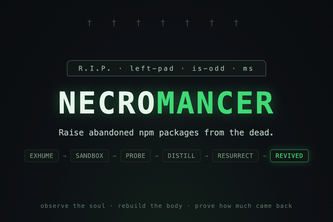
Necromancer is a self-reported tool that attempts to reconstruct abandoned npm packages using AI and sandboxed behavioral analysis. The author states it operates in six phases: Exhume, Sandbox, Probe, Distill, Resurrect, and Report — aiming to rebuild package behavior without trusting the original source code.
What changed
The project is a self-contained hackathon submission (submitted to OpenAI 2026 hackathon), with no evidence of prior development or commercial traction. It represents an experimental approach to dependency resurrection using LLMs, behavioral testing, and sandboxing.
Single most important open question
Is there any evidence that Necromancer has been used in production or by other developers beyond the author’s own experiments?
Note: This analysis is based entirely on the self-reported project description provided. No external verification, revenue data, customer base, or traction metrics are available.
What The Product Actually Is
The description states that Necromancer is a tool designed to "raise abandoned npm packages from the dead." It claims to operate through six defined phases:
- Exhume – retrieves the package tarball and verifies registry integrity.
- Sandbox – isolates execution in Docker with no network or lifecycle scripts.
- Probe – runs the package and records behavior using coverage tools.
- Distill – generates a behavioral spec (SOUL.md) and test suite (vitest).
- Resurrect – uses LLMs to rebuild the package based on behavioral data, with feedback loops.
- Report – outputs an assessment in HTML format with SHA-256 provenance receipts.
It also claims to avoid overclaiming by reporting “N of M observed behaviors passed,” and includes a “Last Rites” mechanism to prevent memorization.
Inference: The tool is built for code reconstruction and verification, not general-purpose software development or deployment. It is not a package manager or dependency resolver in the traditional sense.
Positioning & Claim Evolution
The author positions Necromancer as a solution to the problem of abandoned npm packages — citing the 2016 left-pad incident as a key inspiration. The tool is described as aiming for honesty and verifiability, with no claims of “identical” reconstruction, only behavioral fidelity.
It emphasizes:
- Trustless rebuilding via sandboxing.
- Behavioral specification over source code trust.
- Judge loop feedback to improve LLM output.
- Reproducibility through no-credentials replay mode.
Claim: The tool is built to prove its own claims, not just make them.
Inference: This positioning reflects a niche but high-value use case in dependency management and security.
Target Customer & ICP
The description does not identify specific customer segments or personas. It implies the target audience includes:
- Developers working with legacy or abandoned npm packages.
- Security-conscious teams managing dependencies.
- Researchers or engineers experimenting with LLM-based code reconstruction.
Inference: The tool is likely aimed at developers or organizations that depend on npm packages and want to safely resurrect them, but no explicit ICP is stated.
Business Model & Pricing Evidence
No business model or pricing information is provided in the description. The project is described as a hackathon submission with no mention of monetization, licensing, or commercial use cases.
Not evidenced: No evidence of any revenue streams, pricing tiers, or commercialization plans.
Technical & Delivery Signals
The tool is built using:
- Languages/Technologies: TypeScript, Node.js, Docker, OpenAI API/Codex CLI
- Tools: Commander (CLI), vitest, c8/V8 (coverage), Vitest (test runner)
- Architecture: Sandboxed execution, deterministic judge loop, behavioral spec generation
Key technical features:
- Read-only container mounts
- URL rewriting for coverage tracking
- Held-out tests to prevent memorization
- Offline verification mode
Inference: The tool is technically sophisticated and built with security in mind. It uses sandboxing and LLMs in a structured way, but lacks evidence of production deployment or scalability.
Traction & Maturity Signals
The project is described as a hackathon submission (OpenAI 2026). It includes:
- Seven real packages resurrected end-to-end
- 72 tests with clean typecheck
- No-credentials replay mode
- Public cemetery of verified resurrections planned
Not evidenced: No evidence of adoption, usage metrics, or production deployment. The project is described as experimental and not yet commercialized.
Competitive Context
The description does not mention competitors or similar tools. It appears to be a novel approach in the space of dependency management and package resurrection, especially with its use of LLMs and behavioral testing.
Inference: There may be no direct competitors, but the concept overlaps with:
- Dependency scanning tools
- Package manager security tools
- LLM-assisted code generation platforms
Open Questions & Risks
- No production use or adoption — described only as a hackathon project.
- Unproven scalability — no evidence of handling large packages or native dependencies.
- Limited commercial viability — no pricing, business model, or monetization strategy.
- High technical complexity — requires sandboxing, coverage tracking, and LLM feedback loops.
- No external validation — all claims are self-reported.
Inference: The tool is experimental and not yet mature for enterprise use or commercial deployment.
Questions the description leaves open
- Has Necromancer been used in production environments beyond the author’s own experiments?
- What is the current fidelity rate of resurrections, and how does it scale with package complexity?
- Are there any known limitations or edge cases in handling native dependencies or multi-module packages?
- How does the judge loop handle ambiguous or conflicting behavioral data?
- Is there a plan to integrate Necromancer into CI/CD pipelines or dependency management tools?
- What are the long-term goals for the project — is it intended to be a commercial product or open-source tool?
Overall Assessment
Not evidenced: No evidence of traction, revenue, or market validation.
Inference: The project shows strong technical execution and a clear problem-solution fit. However, as a hackathon submission with no commercialization or adoption data, it is not yet ready for investment or partnership consideration. It may be a promising prototype, but lacks the maturity and evidence of market demand to justify further due diligence at this stage.
User Stories BotA demo video on every pull request
Get a demo video on every new feature
GitHub App that watches your pull requests and records a narrated, captioned demo.
Save time on demo prep and make informed decisions faster with a video walkthrough of every new feature.
Source
Submitted to the OpenAI 2026 hackathon on Devpost. Project home on Devpost. Back to the full gallery on Devpost.
This competitive analysis was produced by top-founders.com (opens in a new tab)
Generated by a language model from this project's public Devpost page — its tagline, the author's own write-up and any built-with tags listed there — as captured in August 2026. Short quotations are the author's words. It is an opinion on the idea as a business, not on the people behind it, and it reflects the description as published then. If the project has moved on, request a correction below. The analysis is not independent research and contains no verified traction, revenue or customer data.
An independent guide by KFG International LLC — not affiliated with, endorsed by, or connected to Devpost or OpenAI.