

Archive position — measured, not model output
0 likes on Devpost
2,263 of the 7,850 archived projects have more likes, and 5,587 share exactly 0 — so this project's #7,458 place in the like-ranked listing is a tie-break inside that group, not a ranking.
Projects (log scale)
Likes on Devpost. ▲ marks this project's group.
Show the figures
| Likes | Projects | Share of archive |
|---|---|---|
| 0 | 5,587 | 71.2% |
| 1 | 1,758 | 22.4% |
| 2 | 284 | 3.6% |
| 3–4 | 132 | 1.7% |
| 5–9 | 75 | 1.0% |
| 10+ | 14 | 0.2% |
 User Stories BotA demo video on every pull request
Get a demo video on every new feature
GitHub App that watches your pull requests and records a narrated, captioned demo.
Save time on demo prep and make informed decisions faster with a video walkthrough of every new feature.
Executive Summary
The description states that "Unreal Engine Visual Effects Designer for AI Game Developers" is a self-contained project built by one developer (Daryl Lai) to help aspiring AI game developers create visually compelling VFX in Unreal Engine without deep technical or artistic expertise. The author claims it uses GPT-5.6 in Codex, Unreal Engine 5.8 MCP, and a knowledge graph built with Graphify to automate and improve VFX creation workflows.
The project appears to be an experimental prototype focused on bridging the gap between AI-generated game content and professional visual quality by encoding artistic principles into reusable technical instructions within a knowledge graph. It is not evidenced to have any revenue, customers, or traction beyond its author's personal use case and development iteration.
Key open question
Does this project represent a viable product or tool that could be commercialized for broader adoption among AI game developers, or is it limited to the author’s specific use case?
What The Product Actually Is
The description states that the product is a "reusable pre-built Unreal Engine VFX knowledge graph" designed to act as a "second brain" for Codex to guide artistic and technical decisions when creating visual effects. It claims to translate creative prompts into technically grounded VFX implementations using:
- Unreal Engine 5.8 MCP
- GPT-5.6 in Codex
- A knowledge graph built with Graphify
- Specialized Codex skills for VFX art direction, implementation, and quality review
The system is said to:
- Interpret creative intent and reference images
- Retrieve relevant techniques from a knowledge graph
- Convert that knowledge into an implementation plan
- Build effects in Unreal Engine using Niagara capabilities and MCP
- Use ImageGen for textures
- Audit results against artistic and technical criteria
- Save successful lessons back into the knowledge graph
The final outputs are:
- VFX effect assets with close parity to developer imagination
- A growing knowledge graph that improves future effect creation
Not evidenced: whether this is a working product, or just a prototype; no evidence of actual deployment, usage, or integration with other tools beyond what the author describes.
Positioning & Claim Evolution
The description states that the project aims to be a "force multiplier" for aspiring AI game developers who want to create visually compelling VFX without needing prior experience in VFX artistry. It positions itself as solving a gap between functional gameplay and aesthetic appeal, particularly in genres like MMORPGs where visual spectacle is critical.
The author claims that while AI can help build games, it often fails to produce visually impressive effects unless developers invest significant time and resources into learning Unreal Engine or hiring professionals. This tool seeks to reduce that effort by providing a structured way for AI agents to understand and implement VFX with artistic nuance.
It also states that the goal is not to make beginners equivalent to professional studios, but rather to "meaningfully reduce that gap" — helping developers ship faster while moving closer to professional standards.
Inferences:
- The product is positioned as an enhancement to existing AI game development workflows.
- It targets a niche: AI game developers lacking VFX expertise.
- It leverages the idea of “second brain” or “knowledge graph” as a competitive advantage over raw prompt-based tools.
Not evidenced: actual market positioning, customer feedback, or comparison with competitors.
Target Customer & ICP
The description states that the target customer is "aspiring AI game developers" who have no VFX background and want to create visually compelling effects in Unreal Engine. These users are described as:
- People with strong creative ideas but limited technical or artistic experience
- Interested in genres like MMORPGs where visual spectacle matters
- Looking to avoid being labeled “AI slop” by critics or players
The author also identifies a personal use case: creating spell effects for his own power fantasy games, suggesting that the tool may be tailored for individual creators rather than teams or studios.
Not evidenced:
- Specific demographics of target users
- Size or characteristics of the market segment
- Evidence of existing customers or user groups beyond the author
Business Model & Pricing Evidence
The description does not state any business model or pricing strategy. It only describes the technical components and workflow of the system.
Inferences:
- The project seems to be a personal prototype, not yet monetized.
- If commercialized, it might be offered as a SaaS tool or plugin for Unreal Engine developers.
- Pricing could be based on access to the knowledge graph, API usage, or subscription tiers.
Not evidenced: any revenue model, pricing plans, or monetization strategy.
Technical & Delivery Signals
The description states that the system is built using:
- GPT-5.6 in Codex
- Unreal Engine 5.8 MCP
- C++ and Python scripts for automation
- Graphify for knowledge graph construction
- Obsidian-compatible Markdown pages for documentation
- Specialized Codex skills adapted from "leonxlnx/taste-skill"
- NiagaraStackAutomation plugin for unsafe editor operations
It also mentions:
- A knowledge graph with 18 curated source pages, 74 nodes, and 866 directed relationships
- Use of temporal validation and quality scorecards
- Transfer evaluation between effects
- Formal schema contracts and controlled vocabulary
Inferences:
- The system is technically complex and involves multiple layers of AI, automation, and engine integration.
- It uses a knowledge graph approach to store reusable VFX logic and artistic principles.
Not evidenced: actual delivery mechanism, scalability, or performance metrics.
Traction & Maturity Signals
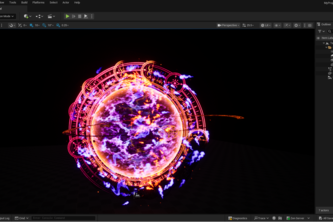
The description states that the project was submitted to the OpenAI 2026 hackathon on Devpost. The author built three effects (Arcane Cosmic Fireball, HyperBeam, Celestial Judgment) over two days of iteration, using a knowledge graph with 18 source pages and 74 nodes.
No evidence of:
- Revenue generation
- Customer adoption or feedback
- Product usage beyond the author’s own development
- Market traction or user engagement
Inferences:
- The project is in early prototype stage.
- It has been tested on a small number of effects.
- It may have potential for further development but lacks real-world validation.
Competitive Context
The description does not mention any direct competitors. However, it implies that current tools lack the ability to provide artistic nuance when generating VFX through AI prompts in Unreal Engine.
It contrasts its approach with:
- Generic natural-language access to Unreal Engine via MCP
- Tools that do not incorporate artistic judgment or reusable knowledge
Inferences:
- The tool may compete with general-purpose AI agents for Unreal Engine, such as those using Codex or other LLMs.
- It could be seen as a niche solution for developers who want to avoid the trial-and-error process of creating VFX manually.
Not evidenced: competitive landscape, existing solutions, or differentiation from similar tools.
Open Questions & Risks
- Lack of commercial viability: The project is described as a personal prototype with no evidence of monetization or customer traction.
- High technical complexity: Requires deep integration with Unreal Engine and custom plugins, which may limit adoption.
- Limited scalability: The knowledge graph appears to be manually curated by one person, raising questions about how it would scale.
- Unclear market demand: No evidence of target users beyond the author’s own use case.
- Dependency on proprietary tools: Relies heavily on GPT-5.6 and Codex, which may not be accessible or affordable for others.
- No validation of results: The system claims to audit effects but does not provide data on how often it produces acceptable outputs.
Questions the description leaves open
- What is the current state of the knowledge graph? Is it fully functional, or still in early development?
- How many developers have used this tool beyond yourself, and what feedback did they give?
- Are there plans to monetize this product, and if so, how?
- Can you demonstrate a working example of the system in action?
- What are the limitations of the current approach, especially regarding scalability or generalization?
- How does the system handle edge cases or novel effect types not covered by the knowledge graph?
- Are there any legal or licensing concerns around using proprietary tools like GPT-5.6 and Codex?
- How would this tool integrate into existing game development pipelines?
Overall Assessment
The description states that this is a self-reported project built by one developer (Daryl Lai) for personal use and submission to a hackathon. There is no evidence of revenue, customers, or traction beyond the author’s own development process.
This appears to be an experimental prototype with potential for future development but lacks commercial viability or market validation at this stage.
Assessment: Not ready for investment or partnership.
Inferences:
- The project shows technical innovation and a clear problem statement.
- However, it is not yet proven to deliver value beyond the author’s own use case.
- Further development, testing, and market validation are required before any commercial opportunity can be assessed.
Not evidenced: any financials, customer data, or product-market fit.
User Stories BotA demo video on every pull request
Get a demo video on every new feature
GitHub App that watches your pull requests and records a narrated, captioned demo.
Save time on demo prep and make informed decisions faster with a video walkthrough of every new feature.
Source
Submitted to the OpenAI 2026 hackathon on Devpost. Project home on Devpost. Back to the full gallery on Devpost.
This competitive analysis was produced by top-founders.com (opens in a new tab)
Generated by a language model from this project's public Devpost page — its tagline, the author's own write-up and any built-with tags listed there — as captured in August 2026. Short quotations are the author's words. It is an opinion on the idea as a business, not on the people behind it, and it reflects the description as published then. If the project has moved on, request a correction below. The analysis is not independent research and contains no verified traction, revenue or customer data.
An independent guide by KFG International LLC — not affiliated with, endorsed by, or connected to Devpost or OpenAI.