

Archive position — measured, not model output
0 likes on Devpost
2,263 of the 7,850 archived projects have more likes, and 5,587 share exactly 0 — so this project's #7,460 place in the like-ranked listing is a tie-break inside that group, not a ranking.
Projects (log scale)
Likes on Devpost. ▲ marks this project's group.
Show the figures
| Likes | Projects | Share of archive |
|---|---|---|
| 0 | 5,587 | 71.2% |
| 1 | 1,758 | 22.4% |
| 2 | 284 | 3.6% |
| 3–4 | 132 | 1.7% |
| 5–9 | 75 | 1.0% |
| 10+ | 14 | 0.2% |
 User Stories BotA demo video on every pull request
Get a demo video on every new feature
GitHub App that watches your pull requests and records a narrated, captioned demo.
Save time on demo prep and make informed decisions faster with a video walkthrough of every new feature.
Executive Summary
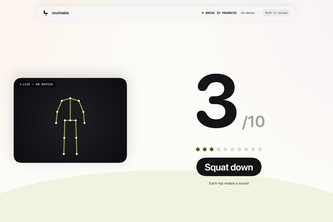
What the company appears to be: Unsittable is a self-reported macOS menu bar application designed to enforce physical movement during work breaks by requiring users to perform squats before resuming work. The app uses computer vision (AVFoundation + Apple Vision) to detect body landmarks and count squats, with local processing and no data upload.
What changed: The project was built over a few days during OpenAI Build Week as a hackathon submission. It is described as a one-person effort with no external funding or traction evidence.
The single most important open question: Is there any evidence of user adoption, revenue, or product-market fit beyond the author's own testing and development?
Analysis basis: This report is based entirely on the self-reported description provided by the author. No third-party verification, archived data, or external sources are available. All claims are attributed to the project description as stated.
What The Product Actually Is
- The description states that Unsittable is a native macOS menu bar app.
- It starts a break after 50 minutes of work and gives a one-minute warning.
- When the timer runs out, it covers all connected displays with a break screen.
- Users must perform ten squats to resume work.
- AVFoundation captures camera frames; Apple Vision detects body landmarks.
- The classifier tracks hips and knees, counts reps only after standing back up.
- All processing happens locally; no frames are saved or uploaded.
- It is built using Swift, SwiftUI, AppKit, and Xcode.
Inference: The app appears to be a productivity tool that combines time management with physical activity. However, the description does not confirm whether it has been released beyond the hackathon version or if it has any commercial distribution.
Positioning & Claim Evolution
- The author claims Unsittable tackles the issue of ignoring break reminders.
- It positions itself as a solution to "what if the break didn’t end until I actually moved?"
- The product is described as a “native macOS menu bar app” that enforces physical movement through squatting.
- It was submitted for an OpenAI hackathon, suggesting a prototype or experimental nature.
Inference: The positioning seems to be centered on personal productivity and health awareness. However, there’s no evidence of market research, user feedback, or competitive positioning beyond the author's own experience.
Target Customer & ICP
- The description does not name specific customer segments.
- It implies a target audience of people who sit too long at work and ignore break reminders.
- The app is designed for Mac users (macOS).
- No mention of enterprise, education, or other verticals.
Inference: Based on the author’s intent, the ICP likely includes individuals seeking to improve posture or reduce sedentary behavior during work hours. However, no evidence supports any defined persona or segment beyond a generic “Mac user.”
Business Model & Pricing Evidence
- The description states that Unsittable is designed as a one-time-purchase Mac app.
- The Build Week judging build is free to try.
- No pricing information, subscription models, or monetization strategy are mentioned.
Inference: The business model appears to be a one-time purchase with an initial free trial. However, there is no evidence of actual sales, pricing tiers, or revenue generation.
Technical & Delivery Signals
- Built using Swift and SwiftUI.
- Uses AppKit for overlay windows on multiple displays.
- Implements Codex Desktop and GPT-5.6 during development.
- Camera processing uses AVFoundation and Apple Vision APIs.
- Includes subsystems for scheduler, overlay lifecycle, camera capture, pose tracking, onboarding, failure recovery, tests, and release tools.
- Debugging tools like PoseTelemetry.swift and DebugSnapshotHarness.swift were used.
- The app handles camera permission, interruptions, and recovery.
- Supports front- and side-view tracking, subject continuity, and fallbacks (e.g., timed break).
Inference: The technical stack and architecture suggest a well-thought-out prototype. However, the lack of production data or user feedback makes it unclear how robust or scalable this approach is.
Traction & Maturity Signals
- The project was submitted to an OpenAI hackathon.
- No evidence of revenue, customers, or usage metrics.
- No mention of downloads, retention, or user engagement.
- The author describes the app as a “judging build” and not yet released for general use.
Inference: There is no traction or maturity signal beyond the author’s own development. No data on adoption, performance, or long-term viability exists in the description.
Competitive Context
- No mention of competitors or similar products.
- The idea of enforcing movement during work breaks is not described as novel or unique.
- No market analysis or differentiation strategy is provided.
Inference: Without any reference to existing solutions or competitive landscape, it's impossible to assess how Unsittable fits into the broader productivity or wellness space.
Open Questions & Risks
- The app is a one-person project with no team or external support.
- No evidence of product-market fit or user testing beyond the author’s own use.
- The description lacks any mention of scalability, long-term maintenance, or monetization plans.
- The use of GPT-5.6 and Codex during development raises questions about whether the codebase is fully under human control or influenced by AI-generated components.
- No mention of security, privacy, or compliance considerations.
Inference: The biggest risk is that this remains a personal prototype with no commercial traction or sustainable business model.
Questions the description leaves open
- What is the actual user base or testing done beyond your own use?
- How do you plan to monetize this app beyond a one-time purchase?
- Have you considered alternative exercises or accessibility needs (e.g., users unable to squat)?
- Are there plans for expansion into other platforms or integrations?
- What is the long-term roadmap and how will you validate product-market fit?
Note: These questions are based on the lack of evidence in the description regarding traction, monetization, and scalability.
Overall Assessment
- The project is described as a hackathon submission with no verified revenue or user data.
- It has no external funding, partnerships, or traction indicators.
- The author is a solo developer working on a niche productivity tool.
- No evidence of commercial viability, market demand, or scalable business model.
Assessment: Not evidenced. This is a self-reported prototype with no signs of commercial readiness or investment potential. It lacks the foundational signals required for due diligence beyond initial curiosity.
User Stories BotA demo video on every pull request
Get a demo video on every new feature
GitHub App that watches your pull requests and records a narrated, captioned demo.
Save time on demo prep and make informed decisions faster with a video walkthrough of every new feature.
Source
Submitted to the OpenAI 2026 hackathon on Devpost. Project home on Devpost. Back to the full gallery on Devpost.
This competitive analysis was produced by top-founders.com (opens in a new tab)
Generated by a language model from this project's public Devpost page — its tagline, the author's own write-up and any built-with tags listed there — as captured in August 2026. Short quotations are the author's words. It is an opinion on the idea as a business, not on the people behind it, and it reflects the description as published then. If the project has moved on, request a correction below. The analysis is not independent research and contains no verified traction, revenue or customer data.
An independent guide by KFG International LLC — not affiliated with, endorsed by, or connected to Devpost or OpenAI.