

Archive position — measured, not model output
1 like on Devpost
505 of the 7,850 archived projects have more likes, and 1,758 share exactly 1 — so this project's #1,573 place in the like-ranked listing is a tie-break inside that group, not a ranking.
Projects (log scale)
Likes on Devpost. ▲ marks this project's group.
Show the figures
| Likes | Projects | Share of archive |
|---|---|---|
| 0 | 5,587 | 71.2% |
| 1 | 1,758 | 22.4% |
| 2 | 284 | 3.6% |
| 3–4 | 132 | 1.7% |
| 5–9 | 75 | 1.0% |
| 10+ | 14 | 0.2% |
 User Stories BotA demo video on every pull request
Get a demo video on every new feature
GitHub App that watches your pull requests and records a narrated, captioned demo.
Save time on demo prep and make informed decisions faster with a video walkthrough of every new feature.
Executive Summary
Project: Omni study AI
Self-reported basis: The analysis is based entirely on the author’s own description of the project as submitted to the OpenAI 2026 hackathon on Devpost. No external verification or additional data are available.
Commercial due-diligence read: The project appears to be a student-built prototype for AI-assisted studying, likely using OpenAI's Codex and Python. It is not evidenced to have any commercial traction, revenue, or customer base. The single most important open question is whether this represents a viable product-market fit or merely an experimental proof-of-concept.
What The Product Actually Is
The description states:
- “It made the work easy for me to study”
- “using the codex, python, databases, etc.”
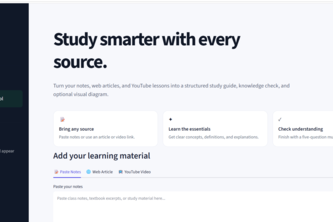
Inference: The product appears to be a tool built using OpenAI's Codex and Python, likely involving some form of AI automation or database integration aimed at helping students study. It is described as a website or application that simplifies studying.
Not evidenced: No specific functionality, features, or technical architecture beyond the tools used are detailed.
Positioning & Claim Evolution
The description states:
- “As a student I wanted an ai model that helps me in studying quickly and learn fast”
- “I want to increase the functionality of the website that I have created and dynamic versions”
Inference: The positioning is that of a personal, student-focused AI tool for studying. It evolved from a personal need into a prototype with ambitions for expansion.
Not evidenced: No evidence of market positioning, branding, or strategic direction beyond the author’s personal motivation and future plans.
Target Customer & ICP
The description states:
- “As a student I wanted an ai model that helps me in studying quickly and learn fast”
Inference: The target customer is a student seeking AI-assisted study tools. The ICP appears to be a single user (the founder) or a small cohort of students.
Not evidenced: No evidence of customer segmentation, personas, or broader market targeting beyond the author’s personal experience.
Business Model & Pricing Evidence
The description states:
- “I want to increase the functionality of the website that I have created and dynamic versions”
Inference: There is no explicit mention of a business model or pricing strategy. The project appears to be a prototype, not a commercial offering.
Not evidenced: No evidence of revenue streams, pricing models, or monetization plans.
Technical & Delivery Signals
The description states:
- “using the codex, python, databases, etc.”
- “many errors we occurred during the process of running the real time project”
Inference: The product is built with basic AI and development tools (Codex, Python, SQLite). It was likely developed in a short timeframe, as evidenced by the mention of errors and challenges.
Not evidenced: No evidence of scalability, robustness, or production-ready delivery. No details on deployment, infrastructure, or performance.
Traction & Maturity Signals
The description states:
- “we are proud that we have completed it successfully”
- “I want to increase the functionality of the website that I have created and dynamic versions”
Inference: The project is a completed prototype. It has no evidence of traction, adoption, or user engagement beyond the author’s personal use.
Not evidenced: No evidence of users, customers, or usage metrics. No data on product maturity or iteration history.
Competitive Context
The description states:
- “As a student I wanted an ai model that helps me in studying quickly and learn fast”
Inference: The project is likely in a crowded space of AI-assisted learning tools. However, no evidence is provided about existing competitors or market positioning.
Not evidenced: No evidence of competitive landscape, differentiation, or market analysis.
Open Questions & Risks
- No commercial traction: The project is described as a prototype with no evidence of users or revenue.
- Single founder: The team size is listed as 1, suggesting limited development capacity.
- Unverified claims: All descriptions are self-reported and lack independent verification.
- No scalability or robustness: Mention of errors during real-time execution suggests instability.
Inference: The project may be a personal experiment rather than a scalable product. It lacks commercial viability indicators.
Questions the description leaves open
- What specific problem in studying are you solving, and how is your solution different from existing tools?
- Have you tested the tool with other students? If so, what feedback did you get?
- What are your plans for monetization or scaling beyond this prototype?
- How do you plan to address the technical challenges mentioned (e.g., errors during real-time execution)?
- Are there any existing competitors in the market, and how do you see your tool fitting into that space?
Overall Assessment
Assessment: Not evidenced.
Inference: There is no evidence to support a commercial investment or partnership case. The project is described as a student-built prototype with no demonstrated traction, revenue, or customer base. It may be an early-stage idea or experiment, but it does not meet the criteria for due-diligence evaluation at this stage.
User Stories BotA demo video on every pull request
Get a demo video on every new feature
GitHub App that watches your pull requests and records a narrated, captioned demo.
Save time on demo prep and make informed decisions faster with a video walkthrough of every new feature.
Source
Submitted to the OpenAI 2026 hackathon on Devpost. Project home on Devpost. Back to the full gallery on Devpost.
This competitive analysis was produced by top-founders.com (opens in a new tab)
Generated by a language model from this project's public Devpost page — its tagline, the author's own write-up and any built-with tags listed there — as captured in August 2026. Short quotations are the author's words. It is an opinion on the idea as a business, not on the people behind it, and it reflects the description as published then. If the project has moved on, request a correction below. The analysis is not independent research and contains no verified traction, revenue or customer data.
An independent guide by KFG International LLC — not affiliated with, endorsed by, or connected to Devpost or OpenAI.