

Archive position — measured, not model output
1 like on Devpost
505 of the 7,850 archived projects have more likes, and 1,758 share exactly 1 — so this project's #1,574 place in the like-ranked listing is a tie-break inside that group, not a ranking.
Projects (log scale)
Likes on Devpost. ▲ marks this project's group.
Show the figures
| Likes | Projects | Share of archive |
|---|---|---|
| 0 | 5,587 | 71.2% |
| 1 | 1,758 | 22.4% |
| 2 | 284 | 3.6% |
| 3–4 | 132 | 1.7% |
| 5–9 | 75 | 1.0% |
| 10+ | 14 | 0.2% |
 User Stories BotA demo video on every pull request
Get a demo video on every new feature
GitHub App that watches your pull requests and records a narrated, captioned demo.
Save time on demo prep and make informed decisions faster with a video walkthrough of every new feature.
Executive Summary
What the company appears to be
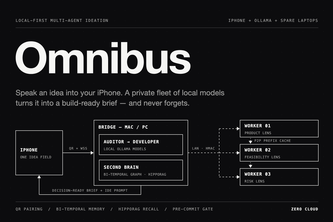
Omnibus is a self-reported tool that turns personal laptops into a local AI fleet for code development. The author states it uses a mobile app to control these machines via QR code, with each laptop acting as an executor of AI tasks while maintaining full privacy by keeping all data local. It includes features like a bi-temporal knowledge graph, anti-pattern registry, and pre-commit gate reviewing diffs.
What changed
The project description is self-reported and unverified; it does not contain evidence of revenue, customers, or adoption. The author describes building the system using their own tools and methods but provides no external validation or traction metrics.
Single most important open question
Is there any evidence that Omnibus has been used beyond its creator's own development environment? If so, how is it being adopted?
What The Product Actually Is
The description states that Omnibus:
- Turns personal laptops into a local AI fleet.
- Uses a mobile app to control these machines via QR code.
- Runs on any device with sufficient RAM (e.g., 8 GB).
- Integrates with Codex for code generation and auditing.
- Maintains privacy by ensuring nothing leaves the local machine.
- Includes a bi-temporal knowledge graph, anti-pattern registry, and pre-commit gate reviewing diffs.
Inference Omnibus appears to be a developer tool designed to improve AI-assisted coding through local execution, context retention, and code review automation. It is built around the idea of leveraging underused hardware (e.g., old laptops) for private AI workloads.
Positioning & Claim Evolution
The author claims:
- Omnibus addresses three core problems in developer workflows: re-explaining constraints to AI, reviewing agent diffs for mistakes, and enforcing rules about code leaving machines.
- It functions as a “personal prompt engineer” that turns half-formed ideas into specific prompts tailored to the project.
- The tool is built against the principle of privacy by design — nothing ever leaves home.
- It uses local hardware to run models (e.g., quantized 7B models) and stores knowledge in a bi-temporal graph.
Inference Omnibus positions itself as a local-first, privacy-preserving AI assistant for developers who want to maintain control over their data and workflows. Its evolution seems focused on integrating local execution with contextual memory and automated code review.
Target Customer & ICP
The description states:
- Omnibus targets developers working in companies who repeatedly explain constraints to AI models.
- It is intended for use on personal or work laptops, especially older ones that might otherwise be idle.
Not evidenced No explicit customer segments, personas, or market size are mentioned. The author does not describe how many users exist or what their needs are beyond their own experience.
Business Model & Pricing Evidence
The description states:
- Omnibus is built as a personal tool without accounts or API keys.
- It runs locally and requires no cloud infrastructure.
- There is no mention of pricing, subscriptions, or monetization strategies.
Inference There is no evidence of a business model or pricing structure. The tool appears to be self-hosted and free to use, with no indication of commercial intent or revenue generation.
Technical & Delivery Signals
The description states:
- Omnibus uses TypeScript on Node.js, React Native, Expo.io, Ollama, and Swift.
- It implements a bi-temporal knowledge graph, HMAC-signed fleet protocol, and deterministic multi-device merge.
- The system includes automated tests (199 across 34 suites), WebSocket sessions, and kill-and-restart audits.
- It supports both Mac and Windows environments.
Inference The technical stack suggests a strong focus on local execution, security, and developer experience. The use of contracts, types, and independent review indicates a disciplined engineering approach.
Traction & Maturity Signals
The description states:
- The project was submitted to the OpenAI 2026 hackathon.
- It includes real bug fixes found during adversarial testing (37 bugs).
- The tool has an anti-pattern registry that learns from its own mistakes.
- It integrates Codex for code writing and auditing.
Not evidenced No evidence of actual users, customer feedback, or adoption beyond the creator’s own use. No revenue, ARR, or traction data is provided.
Competitive Context
The description states:
- Omnibus aims to solve issues related to prompt engineering, context loss, and code review bottlenecks.
- It competes with tools that allow AI to assist in coding but lack local execution or privacy controls.
Not evidenced No mention of competitors or competitive positioning beyond implied niche areas like local-first AI tools or prompt engineering assistants.
Open Questions & Risks
The description states:
- The tool is built by a single person (team size: 1).
- It relies heavily on local hardware and may not scale well.
- It uses experimental technologies like Codex, which could introduce instability.
- There are no external validations or third-party integrations.
Inference Key risks include lack of scalability, limited team capacity, dependency on niche tech (Codex), and absence of user feedback or market traction. The single-founder model raises concerns about long-term sustainability and growth potential.
Questions the description leaves open
- How many people are currently using Omnibus beyond yourself?
- Have you tested the system with real teams or organizations?
- What is your plan for scaling beyond a single developer’s workflow?
- Are there any plans to integrate cloud-based features or APIs in the future?
- How do you intend to monetize this tool if at all?
Overall Assessment
Not evidenced There is no evidence of revenue, funding rounds, or valuation. No indication exists whether this project has attracted investors or partners.
Inference Given the lack of traction, customers, or commercialization, there is insufficient basis to assess investment or partnership viability at this stage. The tool appears to be a proof-of-concept or personal project with no clear path to market adoption or monetization.
User Stories BotA demo video on every pull request
Get a demo video on every new feature
GitHub App that watches your pull requests and records a narrated, captioned demo.
Save time on demo prep and make informed decisions faster with a video walkthrough of every new feature.
Source
Submitted to the OpenAI 2026 hackathon on Devpost. Project home on Devpost. Back to the full gallery on Devpost.
This competitive analysis was produced by top-founders.com (opens in a new tab)
Generated by a language model from this project's public Devpost page — its tagline, the author's own write-up and any built-with tags listed there — as captured in August 2026. Short quotations are the author's words. It is an opinion on the idea as a business, not on the people behind it, and it reflects the description as published then. If the project has moved on, request a correction below. The analysis is not independent research and contains no verified traction, revenue or customer data.
An independent guide by KFG International LLC — not affiliated with, endorsed by, or connected to Devpost or OpenAI.