

Archive position — measured, not model output
0 likes on Devpost
2,263 of the 7,850 archived projects have more likes, and 5,587 share exactly 0 — so this project's #5,500 place in the like-ranked listing is a tie-break inside that group, not a ranking.
Projects (log scale)
Likes on Devpost. ▲ marks this project's group.
Show the figures
| Likes | Projects | Share of archive |
|---|---|---|
| 0 | 5,587 | 71.2% |
| 1 | 1,758 | 22.4% |
| 2 | 284 | 3.6% |
| 3–4 | 132 | 1.7% |
| 5–9 | 75 | 1.0% |
| 10+ | 14 | 0.2% |
 User Stories BotA demo video on every pull request
Get a demo video on every new feature
GitHub App that watches your pull requests and records a narrated, captioned demo.
Save time on demo prep and make informed decisions faster with a video walkthrough of every new feature.
Executive Summary
What the company appears to be
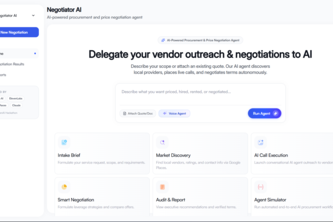
Negotiator AI is a self-reported voice-first procurement agent that uses AI to automate vendor discovery, live phone calling, quote extraction, and price negotiation for local businesses. It claims to operate as an autonomous system that builds locked briefs, calls vendors, extracts spoken prices, and generates evidence-backed reports with negotiation leverage.
What changed
The project is a self-reported hackathon submission (Devpost entry) describing a prototype built in a short timeframe using AI tools like Codex, GPT-5.6, ElevenLabs, Twilio, and Google Places. It does not indicate any prior commercial traction or revenue.
Single most important open question
Is there evidence of real-world adoption, customer feedback, or product-market fit beyond the self-reported prototype? The description contains no data on actual users, pricing, or business outcomes.
What The Product Actually Is
The description states that Negotiator AI is a voice-first procurement agent. It claims to:
- Discover local vendors using Google Places API
- Place live phone calls via Twilio and ElevenLabs Conversational AI
- Extract itemized prices from spoken conversations
- Use AI leverage strategies to negotiate binding price discounts
- Generate executive comparison reports based on verified quotes
It also states that the system supports user input via voice or document upload, and that it tracks call outcomes (e.g., no answer, decline, quote received), extracts only explicitly stated amounts from transcripts, and flags missing terms.
The product is described as a serverless web application built with Next.js, React, TypeScript, Tailwind CSS, and integrated with Twilio, ElevenLabs, Google Places, and GPT-5.6 for transcript normalization and report generation.
Inference The system appears to be a proof-of-concept prototype designed to demonstrate an end-to-end workflow for procurement automation using AI and telephony tools.
Positioning & Claim Evolution
The description states that Negotiator AI is positioned as:
- A voice-first procurement agent
- An autonomous agent that automates vendor discovery, calling, quote collection, and negotiation
- A tool to turn a messy procurement process into an auditable workflow
It claims to solve the problem of “getting a fair price” without requiring users to become procurement specialists.
The project also states it was built for a hackathon, suggesting that this is not a commercial product yet but rather a prototype or demonstration.
Inference Positioning is focused on simplifying procurement through automation and AI, with an emphasis on trustworthiness and auditability. The claim of “autonomous” and “binding price discounts” are self-reported and unverified.
Target Customer & ICP
The description states that the product targets users who:
- Need to source business services (e.g., hiring contractors, buying laptops, planning weddings)
- Want to avoid the hassle of chasing vendors, repeating briefs, and comparing vague totals
- Are looking for a way to get fair pricing without becoming procurement specialists
It also mentions that the system is designed to work with user-defined needs, which can be described by voice or uploaded as documents.
Inference The ICP appears to be individuals or small teams who are doing ad-hoc procurement and want to reduce time spent on vendor communication and quote comparison. No specific industry or persona is named.
Business Model & Pricing Evidence
The description does not state any pricing model, revenue streams, or commercialization plans.
It mentions that the system uses user-defined briefs and approved contacts, suggesting a consent-based approach to calling vendors, but no indication of monetization.
Inference There is no evidence of a business model or pricing structure. The project is described as a hackathon submission with no commercial traction.
Technical & Delivery Signals
The system is built using:
- Frontend: Next.js 16, React 19, TypeScript, Tailwind CSS
- Voice/Telephony: ElevenLabs Conversational AI, Twilio
- Discovery: Google Places API (Text Search)
- AI Tools: Codex, GPT-5.6, Python, Node.js
- Infrastructure: Vercel, Redis-compatible durable state for serverless functions
The description notes that the system handles:
- Asynchronous webhook states
- Serverless persistence across function instances
- Failure handling (e.g., unanswered calls)
- Transcript-based quote extraction with evidence constraints
It also mentions that the UI is designed to explain uncertainty rather than hide it.
Inference Technical architecture shows a focus on reliability, state management, and voice interaction. The system is built for serverless deployment and handles complex telephony workflows.
Traction & Maturity Signals
The description states that this is a hackathon submission, not a commercial product.
It mentions:
- A team of two (Gargie Singh, Harsh Singh)
- A demo limited to three verified, consented participants
- That the system was built in a short timeframe
- No mention of customers, revenue, or usage data
Inference There is no evidence of traction, adoption, or commercial maturity. The project is described as a prototype.
Competitive Context
The description does not provide any information about competitors or market positioning beyond the stated problem.
It does not reference existing tools for procurement automation, vendor management, or price comparison.
Inference No competitive landscape is evident from the description. The project appears to be in a nascent stage with no known direct competitors mentioned.
Open Questions & Risks
- Unverified claims: All features and functionality are self-reported.
- No commercial traction: No evidence of customers, revenue, or adoption.
- Prototype nature: Built for a hackathon; not yet a product in production.
- Limited scope: Demo is restricted to three vendors, suggesting scalability concerns.
- Voice-based complexity: Live telephony introduces failure states and reliability risks that are not fully addressed beyond the prototype level.
Inference The project lacks commercial validation and may be at an early stage of development. Risks include unproven market demand, technical limitations in voice automation, and lack of product-market fit.
Questions the description leaves open
- What is the actual user journey for a typical procurement task?
- How do you ensure compliance with vendor consent and privacy laws?
- Have you tested the system with real users or vendors beyond the demo?
- What are the technical limitations of the current prototype that would prevent scaling?
- Is there any plan to monetize this product, and how?
- How does the system handle edge cases like vendors refusing to speak or speaking unclearly?
Overall Assessment
Not evidenced.
The description is a self-reported hackathon submission with no evidence of commercial traction, revenue, customers, or business model. The project is described as a prototype built in a short timeframe and does not indicate any current or planned commercialization.
Confidence Level Low
Reasoning
No data on users, pricing, adoption, or product-market fit. All claims are self-reported and unverified.
User Stories BotA demo video on every pull request
Get a demo video on every new feature
GitHub App that watches your pull requests and records a narrated, captioned demo.
Save time on demo prep and make informed decisions faster with a video walkthrough of every new feature.
Source
Submitted to the OpenAI 2026 hackathon on Devpost. Project home on Devpost. Back to the full gallery on Devpost.
This competitive analysis was produced by top-founders.com (opens in a new tab)
Generated by a language model from this project's public Devpost page — its tagline, the author's own write-up and any built-with tags listed there — as captured in August 2026. Short quotations are the author's words. It is an opinion on the idea as a business, not on the people behind it, and it reflects the description as published then. If the project has moved on, request a correction below. The analysis is not independent research and contains no verified traction, revenue or customer data.
An independent guide by KFG International LLC — not affiliated with, endorsed by, or connected to Devpost or OpenAI.