

Archive position — measured, not model output
0 likes on Devpost
2,263 of the 7,850 archived projects have more likes, and 5,587 share exactly 0 — so this project's #5,501 place in the like-ranked listing is a tie-break inside that group, not a ranking.
Projects (log scale)
Likes on Devpost. ▲ marks this project's group.
Show the figures
| Likes | Projects | Share of archive |
|---|---|---|
| 0 | 5,587 | 71.2% |
| 1 | 1,758 | 22.4% |
| 2 | 284 | 3.6% |
| 3–4 | 132 | 1.7% |
| 5–9 | 75 | 1.0% |
| 10+ | 14 | 0.2% |
 User Stories BotA demo video on every pull request
Get a demo video on every new feature
GitHub App that watches your pull requests and records a narrated, captioned demo.
Save time on demo prep and make informed decisions faster with a video walkthrough of every new feature.
Executive Summary
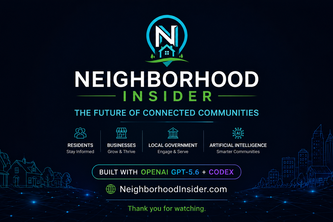
The company appears to be a single-person project (Melanie Vanderpaardt) building an AI-powered community intelligence platform for local residents and businesses. The author states that the platform unifies local news, events, jobs, business information, and AI marketing tools into one experience. It is built using Next.js, React, TypeScript, PostgreSQL, Supabase, Stripe, GitHub, and Vercel, with significant use of OpenAI GPT-5.6 and Codex during development.
The platform is described as a single integrated product that serves residents, businesses, employers, and administrators through dedicated dashboards. The author claims it enables local businesses to manage their presence and generate marketing content using an AI Creative Studio.
The most important open question is whether the project has any traction or revenue yet — the description contains no evidence of either.
Note: This analysis is based entirely on the self-reported, unverified account provided by the author. No independent verification, archived data, or third-party sources are available. All claims in this report are labeled as "the description states" and should be treated as such.
What The Product Actually Is
- The description states that Neighborhood Insider is an AI-powered community intelligence platform.
- It unifies local news, businesses, events, jobs, financial insights, neighborhood information, and AI marketing tools into one experience.
- Businesses can manage their presence through a Business Dashboard.
- The platform includes an AI Creative Studio for generating professional marketing campaigns, advertisements, promotional graphics, and business content.
- The platform is designed to serve residents, businesses, employers, and administrators through dedicated dashboards.
Inference: Based on the description, it appears to be a multi-purpose SaaS product with both consumer and business-facing components. However, no evidence of actual functionality or user base is provided.
Positioning & Claim Evolution
- The description states that Neighborhood Insider was created to solve the problem of fragmented local information.
- It positions itself as a unified platform where residents can discover everything happening in their neighborhood while businesses gain intelligent tools to grow and engage with their community.
- The author claims it brings together multiple types of local data and AI-powered marketing features into one experience, rather than requiring users to navigate multiple disconnected applications.
Inference: The positioning suggests a shift from fragmented information sources toward centralized community intelligence. However, the claim of "AI-powered" is not substantiated with evidence of actual AI use beyond development assistance.
Target Customer & ICP
- The description states that the platform serves residents, businesses, employers, and administrators.
- It includes local news, events, jobs, and business information as key features.
- Businesses are described as using a Business Dashboard and an AI Creative Studio to manage presence and generate marketing content.
Inference: The ICP appears to be broad — including both individuals seeking community updates and small businesses needing affordable marketing tools. No specific segmentation or targeting details are provided.
Business Model & Pricing Evidence
- The description states that businesses can use a Business Dashboard and an AI Creative Studio.
- It implies that businesses gain access to AI marketing tools as part of the platform.
- There is no mention of pricing, subscriptions, monetization strategy, or revenue model in the description.
Inference: No evidence of business model or pricing structure is provided. The author does not describe how the platform intends to generate revenue from users or businesses.
Technical & Delivery Signals
- Built with Next.js, React, TypeScript, PostgreSQL, Supabase, Stripe, GitHub, and Vercel.
- OpenAI GPT-5.6 was used for product strategy, UX design, content generation, and software development.
- OpenAI Codex was used for coding, debugging, testing, refactoring, and rapid iteration.
Inference: The technical stack suggests a modern web application built with AI-assisted development practices. However, no evidence of deployment, scalability, or production readiness is provided.
Traction & Maturity Signals
- The description states that the platform was built for the OpenAI 2026 hackathon.
- It includes accomplishments such as building a working AI-powered community intelligence platform and creating an integrated experience.
- No evidence of users, customers, revenue, or adoption is provided.
Inference: This appears to be an early-stage prototype or proof-of-concept. There is no indication of traction or product-market fit.
Competitive Context
- The description does not mention any competitors or existing solutions in the market.
- It implies that local information is fragmented across many platforms, suggesting a gap in the market.
- No evidence of competitive landscape or differentiation strategy is provided.
Inference: Without knowledge of existing players or market dynamics, it's unclear how Neighborhood Insider would compete or whether there’s sufficient demand for such a platform.
Open Questions & Risks
- The project is described as a single-person effort (team size: 1).
- No evidence of revenue, customers, or traction.
- The use of AI tools during development does not imply actual AI functionality in the product.
- The platform claims to unify many services but lacks clarity on how it will scale or maintain quality across all features.
- The lack of any monetization strategy or pricing model raises questions about long-term viability.
Inference: High risk due to lack of evidence for traction, revenue, or scalability. The single-founder model may limit execution capacity.
Questions the description leaves open
- What specific local data sources are integrated into the platform?
- How does the AI Creative Studio actually function? Is it a tool or an experience?
- Has any portion of the platform been tested with real users or businesses?
- What is the monetization strategy for businesses using the platform?
- Are there any partnerships or integrations with local governments, news outlets, or event organizers?
- How does the platform plan to scale beyond a single community or region?
Note: These questions aim to uncover whether the claims in the description are backed by reality.
Overall Assessment
- The description states that this is a hackathon project built for the OpenAI 2026 hackathon.
- There is no evidence of revenue, customers, or traction.
- The platform appears to be an early-stage concept with no demonstrated product-market fit.
- The single-founder model and lack of business model details raise significant concerns.
Inference: At this stage, the project lacks commercial viability indicators. It may be a promising idea, but there is insufficient evidence to support investment or partnership interest. Further due diligence would require proof of concept, traction, and a clear path to monetization.
User Stories BotA demo video on every pull request
Get a demo video on every new feature
GitHub App that watches your pull requests and records a narrated, captioned demo.
Save time on demo prep and make informed decisions faster with a video walkthrough of every new feature.
Source
Submitted to the OpenAI 2026 hackathon on Devpost. Project home on Devpost. Back to the full gallery on Devpost.
This competitive analysis was produced by top-founders.com (opens in a new tab)
Generated by a language model from this project's public Devpost page — its tagline, the author's own write-up and any built-with tags listed there — as captured in August 2026. Short quotations are the author's words. It is an opinion on the idea as a business, not on the people behind it, and it reflects the description as published then. If the project has moved on, request a correction below. The analysis is not independent research and contains no verified traction, revenue or customer data.
An independent guide by KFG International LLC — not affiliated with, endorsed by, or connected to Devpost or OpenAI.