

Archive position — measured, not model output
0 likes on Devpost
2,263 of the 7,850 archived projects have more likes, and 5,587 share exactly 0 — so this project's #7,464 place in the like-ranked listing is a tie-break inside that group, not a ranking.
Projects (log scale)
Likes on Devpost. ▲ marks this project's group.
Show the figures
| Likes | Projects | Share of archive |
|---|---|---|
| 0 | 5,587 | 71.2% |
| 1 | 1,758 | 22.4% |
| 2 | 284 | 3.6% |
| 3–4 | 132 | 1.7% |
| 5–9 | 75 | 1.0% |
| 10+ | 14 | 0.2% |
 User Stories BotA demo video on every pull request
Get a demo video on every new feature
GitHub App that watches your pull requests and records a narrated, captioned demo.
Save time on demo prep and make informed decisions faster with a video walkthrough of every new feature.
Executive Summary
What the company appears to be
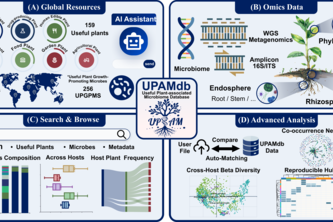
UPAMdb is a self-reported research workspace for medicinal plant microbiome studies. The project started as a database but evolved into an interface that combines structured search, interactive analysis, and grounded AI assistance. It allows researchers to ask natural-language questions and receive answers based on retrieved study metadata from a MySQL-backed database, with GPT-5.6 used to summarize results while preserving links to source records.
What changed
The project began as a medicinal plant microbiome database and expanded into a research copilot that integrates AI-driven summarization with structured retrieval and visualization tools.
Single most important open question
Is there any evidence of actual use or adoption by researchers, or traction beyond the hackathon submission?
What The Product Actually Is
The description states that UPAMdb is a research workspace for medicinal plant microbiome research, which started as a database but evolved into a system combining structured search, interactive analysis, and AI assistance. It uses:
- A PHP API layer backed by MySQL
- A browser frontend built with HTML, CSS, JavaScript, Bootstrap, ECharts, and Plotly
- An AI layer using GPT-5.6, which interprets questions and produces grounded explanations from database records
- A retrieval pipeline including query analyzer, plant-name mapper, SQL generator, retrieval engine, and context formatter
It is described as a system that:
- Searches medicinal plant and microbiome study metadata
- Converts natural-language research questions into structured retrieval tasks
- Maps entities like plant names, taxonomy, hosts, and study components
- Retrieves matching records from MySQL
- Summarizes results using GPT-5.6
- Displays microbial abundance, diversity, network, geographic, and taxonomy views
- Supports pharmacopoeia and medicinal plant reference data
Inference The product is a hybrid of database access, AI summarization, and visualization tools designed for scientific researchers.
Positioning & Claim Evolution
The author states that UPAMdb was originally a medicinal plant microbiome database, but evolved into a research workspace that combines structured search, interactive analysis, and grounded AI assistance.
It is positioned as:
- A tool to reduce friction in accessing scientific datasets
- An interface that allows natural-language exploration without hiding underlying evidence
- A system where responses lead researchers back to the studies, filters, and records that produced them
The project's positioning evolved from a simple database to a research copilot that connects language queries to structured data retrieval and AI-assisted summarization.
Inference The evolution reflects an attempt to add value beyond raw data access by integrating AI in a way that maintains auditability and traceability.
Target Customer & ICP
The description states that UPAMdb is intended for researchers working with medicinal plant microbiome studies, particularly those who need to navigate complex datasets involving metadata, taxonomy, and study records.
It supports:
- Pharmacopoeia and medicinal plant reference data
- Microbial abundance, diversity, network, geographic, and taxonomy views
Inference The target customer is likely a scientific researcher or data analyst in the field of medicinal plants and microbiomes. However, no evidence of actual users or customer segments is provided.
Business Model & Pricing Evidence
Not evidenced.
The description does not mention any pricing model, monetization strategy, or business model. It is unclear whether UPAMdb is intended for commercial use, open access, or research-only deployment.
Technical & Delivery Signals
The system is built with:
- Backend: PHP API layer backed by MySQL
- Frontend: HTML, CSS, JavaScript, Bootstrap, ECharts, Plotly.js
- AI Layer: GPT-5.6 (used for interpreting questions and summarizing results)
- Data Retrieval Pipeline: Includes query analyzer, plant-name mapper, SQL generator, retrieval engine, and context formatter
Key technical features:
- Natural-language to structured search conversion
- Database-backed retrieval with study IDs and metadata preserved
- AI layer receives only retrieved database context (not entire database), for focus and audibility
- Visualizations for microbial abundance, diversity, network, geographic, and taxonomy data
Inference The architecture suggests a research-focused tool, not a scalable commercial product. It is built with standard web technologies and integrates AI via API calls.
Traction & Maturity Signals
Not evidenced.
There is no evidence of:
- Revenue
- Customers
- User adoption
- Product usage metrics
- Deployment in real-world settings
The only signal of maturity is that the project was submitted to an OpenAI 2026 hackathon, indicating it is a prototype or proof-of-concept, not a production-ready product.
Competitive Context
Not evidenced.
No mention of competitors, market size, or competitive positioning. The description does not indicate whether similar tools exist in the marketplace or how UPAMdb differentiates from them.
Open Questions & Risks
- Unverified claims: All information is self-reported and unverified.
- No traction: No evidence of real-world use or adoption beyond a hackathon submission.
- Limited scope: The system appears to be built for a very niche scientific domain (medicinal plant microbiome research).
- AI dependency: Heavy reliance on GPT-5.6 without clear indication of how it's integrated or maintained.
- Prototype nature: Submitted as part of a hackathon; no evidence of further development or productization.
Questions the description leaves open
- What is the actual scientific use case for this tool? Who are the users?
- How does the system handle data inconsistency or legacy schema issues in real-world datasets?
- Is there any plan to move beyond the current prototype into a production-ready product?
- How is the AI layer validated or audited to ensure accuracy and prevent hallucinations?
- What is the long-term vision for UPAMdb — is it intended as a standalone tool, or part of a larger platform?
Overall Assessment
Not evidenced.
There is no evidence of:
- Revenue
- Customers
- Traction
- Product-market fit
- Commercial viability
The project is described as a hackathon submission, and the author states that it was built during OpenAI Build Week. It is unclear whether this represents a viable business or product opportunity, or if it is simply a prototype.
Confidence level Low — based entirely on self-reported information with no external validation or evidence of adoption or commercialization.
User Stories BotA demo video on every pull request
Get a demo video on every new feature
GitHub App that watches your pull requests and records a narrated, captioned demo.
Save time on demo prep and make informed decisions faster with a video walkthrough of every new feature.
Source
Submitted to the OpenAI 2026 hackathon on Devpost. Project home on Devpost. Back to the full gallery on Devpost.
This competitive analysis was produced by top-founders.com (opens in a new tab)
Generated by a language model from this project's public Devpost page — its tagline, the author's own write-up and any built-with tags listed there — as captured in August 2026. Short quotations are the author's words. It is an opinion on the idea as a business, not on the people behind it, and it reflects the description as published then. If the project has moved on, request a correction below. The analysis is not independent research and contains no verified traction, revenue or customer data.
An independent guide by KFG International LLC — not affiliated with, endorsed by, or connected to Devpost or OpenAI.