

Archive position — measured, not model output
0 likes on Devpost
2,263 of the 7,850 archived projects have more likes, and 5,587 share exactly 0 — so this project's #5,502 place in the like-ranked listing is a tie-break inside that group, not a ranking.
Projects (log scale)
Likes on Devpost. ▲ marks this project's group.
Show the figures
| Likes | Projects | Share of archive |
|---|---|---|
| 0 | 5,587 | 71.2% |
| 1 | 1,758 | 22.4% |
| 2 | 284 | 3.6% |
| 3–4 | 132 | 1.7% |
| 5–9 | 75 | 1.0% |
| 10+ | 14 | 0.2% |
 User Stories BotA demo video on every pull request
Get a demo video on every new feature
GitHub App that watches your pull requests and records a narrated, captioned demo.
Save time on demo prep and make informed decisions faster with a video walkthrough of every new feature.
Executive Summary
What the company appears to be
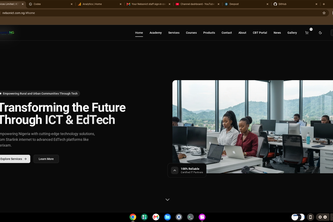
NelsonictNG is a self-reported all-in-one digital learning, school CBT (Computer-Based Testing), and ICT services portal built for students, schools, teachers, and growing organisations. It integrates CBT practice, structured online courses, performance tracking, and administrative tools within a single platform.
What changed
The project was submitted to the OpenAI 2026 hackathon on Devpost. The author describes it as an educational technology solution that uses AI-assisted development (via Codex) to build a system with role-based access, secure authentication, and school-managed student accounts — particularly avoiding the need for minors to use email or phone numbers.
The single most important open question
Is there any evidence of real-world usage, customer feedback, or revenue generation beyond the author's own description?
Note: This analysis is based entirely on the self-reported, unverified project description provided by the caller. No external corroboration, traction data, or financials are available.
What The Product Actually Is
The description states that NelsonictNG is an integrated digital learning platform combining:
- CBT (Computer-Based Testing) functionality
- Structured online courses
- Student performance tracking and certificates
- Teacher dashboards for managing students and grading
- Administrative controls over users, exams, events, and wallet transactions
It also includes:
- A centralized school wallet system
- Role-based access control
- User verification and password recovery features
- Two-factor authentication (2FA) for administrators
- Device login protection and rate limiting
- Email verification and secure password hashing
The platform is built using:
- Frontend: React 19, TypeScript, Vite, Tailwind CSS, shadcn/ui, Framer Motion
- Backend: PHP, PDO, MySQL
- Payment integrations: Monnify, Paystack, Flutterwave, Payee
- Infrastructure: Relational State/LGA data model, secure session management
Inference: The product appears to be a hybrid of CBT and LMS (Learning Management System) functionality, designed for school environments in Nigeria or similar contexts.
Positioning & Claim Evolution
The author positions NelsonictNG as:
- A digital learning, school CBT, and ICT services portal
- Built specifically for students, schools, teachers, and growing organisations
- Designed with a focus on accessibility and minimal identity requirements (e.g., no email or phone number needed)
Key claims include:
- The platform supports timed CBT exams and JAMB-style mock tests
- Teachers can create student accounts using examination numbers instead of emails
- Schools fund student access through a centralized wallet
- The system allows for monitoring performance, grading submissions, and providing feedback
Inference: The positioning suggests a niche market focus on African schools with limited digital infrastructure or identity systems, aiming to reduce friction in student access and payment.
Target Customer & ICP
The description identifies four main user types:
- Students – who take CBT exams, access courses, review performance
- Teachers and Schools – who manage students, fund access, monitor progress, grade submissions
- Administrators – who oversee users, roles, exams, certificates, products, events, wallet transactions, platform configuration
No explicit segmentation beyond these roles is given.
Inference: The ICP seems to be schools in Nigeria or other African countries with limited digital identity infrastructure and a need for centralized CBT and course delivery systems.
Business Model & Pricing Evidence
There is no evidence of pricing models, revenue streams, or monetization strategies in the description. The platform includes:
- An integrated Naira wallet
- School-funded access to CBT services
- Centralized payment handling via school wallets
Claim: Schools fund student access through a centralized wallet.
Not evidenced: Whether there are direct charges per user, subscription tiers, or service-based pricing.
Technical & Delivery Signals
The platform is built with:
- Frontend: React 19, TypeScript, Vite, Tailwind CSS, shadcn/ui, Framer Motion
- Backend: PHP, PDO, MySQL
- Infrastructure: Role-based authentication, fine-grained authorization, secure password hashing, email verification, 2FA, device login protection, rate limiting, DDoS protection
Notable technical features:
- Migration from free-text location fields to normalized relational State/LGA tables
- Teacher-specific dashboards
- Campaign email system with analytics and resend functionality
- AI-assisted development using Codex for refactoring, validation, and API consistency
Inference: The platform shows some architectural maturity in terms of security and scalability, but lacks evidence of production deployment or user adoption.
Traction & Maturity Signals
There is no evidence of:
- Customers
- Revenue
- User base
- Product usage metrics
- Platform uptime or performance data
The project was submitted to a hackathon (Devpost), indicating early-stage development.
Not evidenced: Any form of traction, including pilot schools, beta users, or live deployments.
Competitive Context
No mention of competitors is present in the description. The author does not reference existing platforms like Moodle, Google Classroom, or other LMS/CTB systems.
Not evidenced: Competitor landscape, differentiation strategy, or market positioning relative to existing tools.
Open Questions & Risks
- Lack of traction or real-world usage – Submitted to a hackathon; no evidence of adoption.
- Unverified claims about user experience and accessibility – Claims about reducing friction for minors are unproven.
- No monetization strategy – No indication of how the platform will generate revenue.
- Single-person team – Limited capacity for scaling or product development.
- Self-reported security measures – While described, no third-party audit or compliance evidence is provided.
Inference: The project may be in early conceptual or prototype phase with limited commercial viability without further validation.
Questions the description leaves open
- Has the platform been tested with actual schools or students?
- What specific challenges did you face during the migration of user location data?
- How do you plan to scale beyond a single developer and a single school use case?
- Are there any partnerships or pilot programs with educational institutions?
- What is your roadmap for monetization and revenue generation?
- How does the platform handle offline or low-bandwidth environments?
- Have you considered compliance with data privacy regulations (e.g., GDPR, local Nigerian laws)?
- What are the key assumptions behind the student account model that avoids email/phone?
Overall Assessment
Not evidenced: No commercial viability, traction, or financials to support an investment or partnership decision.
Assessment: Based solely on the self-reported description, NelsonictNG appears to be a conceptually sound educational tech prototype with strong technical execution. However, there is no evidence of real-world usage, customer feedback, or monetization strategy. The project is in an early stage and requires further validation before any commercial due-diligence assessment can be made.
Confidence Level: Low — the entire analysis rests on a single author’s account with no external corroboration.
User Stories BotA demo video on every pull request
Get a demo video on every new feature
GitHub App that watches your pull requests and records a narrated, captioned demo.
Save time on demo prep and make informed decisions faster with a video walkthrough of every new feature.
Source
Submitted to the OpenAI 2026 hackathon on Devpost. Project home on Devpost. Back to the full gallery on Devpost.
This competitive analysis was produced by top-founders.com (opens in a new tab)
Generated by a language model from this project's public Devpost page — its tagline, the author's own write-up and any built-with tags listed there — as captured in August 2026. Short quotations are the author's words. It is an opinion on the idea as a business, not on the people behind it, and it reflects the description as published then. If the project has moved on, request a correction below. The analysis is not independent research and contains no verified traction, revenue or customer data.
An independent guide by KFG International LLC — not affiliated with, endorsed by, or connected to Devpost or OpenAI.