

Archive position — measured, not model output
0 likes on Devpost
2,263 of the 7,850 archived projects have more likes, and 5,587 share exactly 0 — so this project's #7,456 place in the like-ranked listing is a tie-break inside that group, not a ranking.
Projects (log scale)
Likes on Devpost. ▲ marks this project's group.
Show the figures
| Likes | Projects | Share of archive |
|---|---|---|
| 0 | 5,587 | 71.2% |
| 1 | 1,758 | 22.4% |
| 2 | 284 | 3.6% |
| 3–4 | 132 | 1.7% |
| 5–9 | 75 | 1.0% |
| 10+ | 14 | 0.2% |
 User Stories BotA demo video on every pull request
Get a demo video on every new feature
GitHub App that watches your pull requests and records a narrated, captioned demo.
Save time on demo prep and make informed decisions faster with a video walkthrough of every new feature.
Executive Summary
What the company appears to be
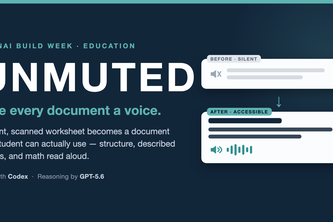
Unmuted is a self-reported tool that processes scanned educational documents for students with disabilities, aiming to make them accessible via screen readers. It uses AI to extract and restructure content (headings, tables, figures, math), describe images, and reconstruct math expressions in a way that can be spoken aloud. A key innovation is an “answer-leakage” check that prevents AI-generated descriptions from inadvertently revealing answers.
What changed
The project was built over four days by one developer using GPT-5.6, Codex, and other tools. It started as a personal response to a real accessibility problem in education — specifically, how scanned documents are inaccessible to students using screen readers. The author describes an end-to-end pipeline that includes OCR, semantic reconstruction, math rendering, figure description, and a verification step.
The single most important open question
Is there any evidence of traction, revenue, or adoption beyond the author’s own development and demo? The self-reported description contains no data on users, customers, or monetization — only claims about what the tool does and how it was built.
What The Product Actually Is
The description states that Unmuted is a tool that takes scanned educational documents and makes them usable for students with disabilities. It processes files to:
- Identify structural elements (headings, tables, figures, equations)
- Reconstruct reading order and semantic HTML
- Convert math expressions into accessible formats like MathML or spoken form
- Describe figures in ways that don’t leak answers
- Provide a human review gate before publishing changes
It is built with a pipeline using PyMuPDF, GPT-5.6 (vision), Codex, and frontend technologies including Next.js/React.
Evidence
- The author describes a structured pipeline: extract → reconstruct → math → describe + verify → front end.
- Tools mentioned include PyMuPDF, GPT-5.6, Codex, Playwright, React, Next.js, MathML, VoiceOver, and more.
- The system includes an “answer-leakage” check using a second agent that evaluates whether a description gives away the answer.
Inference The tool is described as being built in four days by one person. This suggests it’s a prototype or proof-of-concept rather than a production-grade product.
Positioning & Claim Evolution
The author positions Unmuted as solving a specific gap in accessibility: while basic screen readers and OCR work, they don’t make scanned documents usable for students with disabilities who rely on audio output. The tool aims to bridge that gap by rebuilding documents so they can be navigated and understood.
Key claims:
- “Most of what school hands out was never built to be heard.”
- “No other document-remediation tool checks this [answer-leakage].”
- “Accessible. Invalid.” — a concept that highlights the distinction between technical compliance and pedagogical integrity.
Evidence
- The author explicitly contrasts current tools with their own solution.
- They describe an original idea: the answer-leakage check, which they claim no other tool implements.
- The tagline is self-reported as “Unmuted makes scanned materials usable for students with disabilities.”
Inference The positioning implies a niche in educational accessibility, particularly for students using screen readers. It also signals a focus on pedagogical correctness over mere compliance.
Target Customer & ICP
The description states that Unmuted is intended for students with disabilities who use screen readers and struggle with scanned documents in education.
Evidence
- The author writes about “students with disabilities” and specifically mentions those using screen readers.
- The problem described involves biology worksheets, slides, and chapters — typical educational materials.
- The tool is built to make content usable for students who cannot see the visual elements of a document.
Inference The primary customer appears to be educators or institutions that serve students with visual impairments. However, no evidence is provided about whether these institutions are actual users or if there’s any market engagement beyond the author's own work.
Business Model & Pricing Evidence
There is no evidence of a business model or pricing structure in the description.
Evidence
- No mention of monetization, licensing, subscriptions, or fees.
- The project was submitted to a hackathon and is described as a prototype built by one person.
- No indication of whether it’s intended for commercial sale or internal use.
Inference It's unclear if this is a product in development, an open-source tool, or something that may evolve into a paid service. The lack of business model information is significant.
Technical & Delivery Signals
The author describes building the system over four days using:
- GPT-5.6 (vision)
- Codex
- PyMuPDF
- Playwright
- React/Next.js
- MathML, VoiceOver, WCAG compliance
Evidence
- A structured pipeline is outlined: extract → reconstruct → math → describe + verify.
- The tool uses bounding boxes and confidence scores for each element.
- The UI is keyboard-operable and semantically marked up.
Inference The system is built using modern AI and web technologies. However, the description does not indicate whether it’s scalable, production-ready, or integrated into existing platforms.
Traction & Maturity Signals
There is no evidence of traction, adoption, or customer engagement beyond the author's own development.
Evidence
- The project was built in four days by one person.
- It was submitted to a hackathon.
- No mention of users, customers, revenue, or usage metrics.
- No indication of whether it has been tested with real students or educators.
Inference This is likely a prototype or proof-of-concept. There is no evidence of any market validation or product-market fit.
Competitive Context
The author claims that no other document-remediation tool checks for answer leakage, which suggests a unique value proposition in the accessibility space.
Evidence
- The author states: “No other document-remediation tool checks this.”
- They reference the need to make documents usable, not just compliant.
- The focus on pedagogical correctness is distinct from typical accessibility tools.
Inference The competitive landscape may include general OCR and accessibility tools, but Unmuted’s specific innovation in preventing answer leakage sets it apart. However, no direct competitors are named or described.
Open Questions & Risks
- No traction or revenue: The tool is described as a prototype built by one person.
- Unverified claims: The author makes strong claims about uniqueness and impact without supporting data.
- Single-person development: No team, no funding, no external validation.
- Unclear path to market: No evidence of how the tool would scale or be adopted by institutions.
- Technical limitations: The system is described as a hackathon prototype; it’s unclear if it’s production-ready.
Inference The project lacks commercial viability indicators. It may be an idea worth exploring, but there is no evidence that it has moved beyond concept stage.
Questions the description leaves open
- What is the actual scope of the problem you're solving? Is this a widespread issue in education?
- Have you tested the tool with real students or educators? If so, what feedback did you get?
- How do you plan to monetize or scale this product?
- Are there any existing tools that already attempt to solve this problem, and how does Unmuted differ?
- What are your plans for expanding beyond a single-person development model?
Overall Assessment
Not evidenced.
There is no evidence of revenue, customers, or traction. The project is described as a hackathon submission built by one person over four days. It is not clear whether this represents a viable business opportunity or just an idea with potential.
Confidence Low This analysis is based entirely on self-reported information and lacks any external validation or data on adoption, revenue, or user engagement.
User Stories BotA demo video on every pull request
Get a demo video on every new feature
GitHub App that watches your pull requests and records a narrated, captioned demo.
Save time on demo prep and make informed decisions faster with a video walkthrough of every new feature.
Source
Submitted to the OpenAI 2026 hackathon on Devpost. Project home on Devpost. Back to the full gallery on Devpost.
This competitive analysis was produced by top-founders.com (opens in a new tab)
Generated by a language model from this project's public Devpost page — its tagline, the author's own write-up and any built-with tags listed there — as captured in August 2026. Short quotations are the author's words. It is an opinion on the idea as a business, not on the people behind it, and it reflects the description as published then. If the project has moved on, request a correction below. The analysis is not independent research and contains no verified traction, revenue or customer data.
An independent guide by KFG International LLC — not affiliated with, endorsed by, or connected to Devpost or OpenAI.