

Archive position — measured, not model output
0 likes on Devpost
2,263 of the 7,850 archived projects have more likes, and 5,587 share exactly 0 — so this project's #5,455 place in the like-ranked listing is a tie-break inside that group, not a ranking.
Projects (log scale)
Likes on Devpost. ▲ marks this project's group.
Show the figures
| Likes | Projects | Share of archive |
|---|---|---|
| 0 | 5,587 | 71.2% |
| 1 | 1,758 | 22.4% |
| 2 | 284 | 3.6% |
| 3–4 | 132 | 1.7% |
| 5–9 | 75 | 1.0% |
| 10+ | 14 | 0.2% |
 User Stories BotA demo video on every pull request
Get a demo video on every new feature
GitHub App that watches your pull requests and records a narrated, captioned demo.
Save time on demo prep and make informed decisions faster with a video walkthrough of every new feature.
Executive Summary
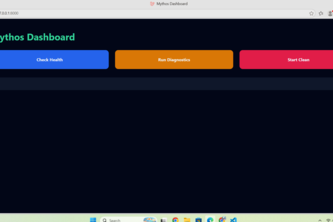
The company appears to be a solo developer project named Mythos Agent, a local system monitoring and maintenance tool built with Python, FastAPI, and Next.js. The author states it provides a dashboard for checking system health, running diagnostics, and cleaning temporary files on a local machine. It was submitted as a hackathon project to the OpenAI 2026 hackathon.
What changed: The project is described as a working prototype built in a hackathon context, with no evidence of commercial traction or product-market fit beyond its own self-description.
The single most important open question: Is there any evidence that this tool has been adopted by users beyond the author’s own use case, or whether it has evolved into a product with a sustainable business model?
What The Product Actually Is
The description states that Mythos Agent is a local AI-assisted system monitoring and maintenance tool. It provides:
- System health checks
- Live diagnostics for CPU, RAM, and disk usage
- Temporary file cleanup
- A FastAPI backend that performs real system operations on the local machine
- A browser-based dashboard
The author notes that it was built using Python, FastAPI, psutil, and Next.js. It is described as a working prototype, not a commercial product.
Evidence: The author's own write-up describes how it works, but there is no evidence of actual deployment or usage beyond the hackathon context.
Positioning & Claim Evolution
The author positions Mythos Agent as:
- A tool to simplify system monitoring and maintenance
- A way to make fragmented or overly technical utilities more accessible
- A local system assistant that provides clear diagnostics and cleanup actions
It is described as a local system utility, not a cloud-based or SaaS product.
Evidence: The author’s own description reflects this positioning, but no claims about market traction, user feedback, or competitive differentiation are provided.
Target Customer & ICP
The author states that the tool is for:
- People who use computers daily
- Users who do not have a simple way to understand system health, resource usage, or temporary-file buildup
It is described as targeting individual users of local machines rather than enterprise customers.
Evidence: The description implies a personal user base, but no evidence of actual customer segments, personas, or market research is provided.
Business Model & Pricing Evidence
There is no evidence in the description of any business model or pricing structure. The author describes it as a hackathon project and does not mention monetization, subscriptions, or paid features.
Evidence: The author’s own write-up makes no claims about revenue, pricing, or commercial viability.
Technical & Delivery Signals
The project is built with:
- Backend: Python, FastAPI
- Frontend: Next.js, HTML, CSS, JavaScript
- System libraries: psutil
- AI tools used: Codex, GPT-5.6
- Deployment: Local machine, public GitHub repository
- Functionality: Live diagnostics, temporary file cleanup, dashboard
The author states that it includes:
- Setup instructions
- API documentation
- Demo screenshots
- A demo video
- Source code published on GitHub
Evidence: The technical stack and functionality are described by the author, but no evidence of scalability, performance, or production deployment is provided.
Traction & Maturity Signals
The project is described as:
- A working prototype
- Built in a hackathon context
- Published on GitHub with documentation and demo video
- Not yet commercialized or deployed at scale
There is no evidence of user adoption, revenue, customer base, or product-market fit.
Evidence: The author’s own account indicates this is an early-stage project, not a mature product.
Competitive Context
The description does not mention any direct competitors. It is described as addressing a gap in local system monitoring tools, but no evidence of existing solutions or competitive positioning is provided.
Evidence: No competitive analysis or market context is included in the author’s write-up.
Open Questions & Risks
- Solo developer project: The team size is listed as 1, which raises questions about long-term maintenance and scalability.
- No commercial traction: There is no evidence of users, revenue, or product-market fit.
- Hackathon origin: The project was built for a hackathon, not for production use.
- Local-only functionality: It only works on local machines, limiting its potential as a SaaS or cloud-based solution.
- No pricing or monetization strategy: No indication of how the tool would be monetized.
Evidence: These are inferred from the self-reported nature of the project and lack of commercial data.
Questions the description leaves open
- What is the actual user base or adoption rate beyond your own use?
- Have you considered how this might scale beyond a single-user, local system context?
- Are there any plans to monetize or commercialize this tool?
- How do you plan to handle security and privacy concerns with local system access?
- What are the technical limitations of running this on different operating systems?
- Have you considered integrating AI features beyond what was used in the hackathon?
Overall Assessment
Not evidenced.
There is no evidence of revenue, customers, or traction to support a commercial due-diligence read. The project is described as a solo developer hackathon effort with no indication of product-market fit, scalability, or commercial viability.
The author’s own description indicates this is an early-stage prototype, not a product ready for investment or partnership. Any potential value would depend on future development and adoption — which are not evidenced here.
Inference: If the project evolves into a product with traction, it may warrant further due diligence. As of now, there is no evidence to support commercial viability or strategic interest.
User Stories BotA demo video on every pull request
Get a demo video on every new feature
GitHub App that watches your pull requests and records a narrated, captioned demo.
Save time on demo prep and make informed decisions faster with a video walkthrough of every new feature.
Source
Submitted to the OpenAI 2026 hackathon on Devpost. Project home on Devpost. Back to the full gallery on Devpost.
This competitive analysis was produced by top-founders.com (opens in a new tab)
Generated by a language model from this project's public Devpost page — its tagline, the author's own write-up and any built-with tags listed there — as captured in August 2026. Short quotations are the author's words. It is an opinion on the idea as a business, not on the people behind it, and it reflects the description as published then. If the project has moved on, request a correction below. The analysis is not independent research and contains no verified traction, revenue or customer data.
An independent guide by KFG International LLC — not affiliated with, endorsed by, or connected to Devpost or OpenAI.