

Archive position — measured, not model output
0 likes on Devpost
2,263 of the 7,850 archived projects have more likes, and 5,587 share exactly 0 — so this project's #5,425 place in the like-ranked listing is a tie-break inside that group, not a ranking.
Projects (log scale)
Likes on Devpost. ▲ marks this project's group.
Show the figures
| Likes | Projects | Share of archive |
|---|---|---|
| 0 | 5,587 | 71.2% |
| 1 | 1,758 | 22.4% |
| 2 | 284 | 3.6% |
| 3–4 | 132 | 1.7% |
| 5–9 | 75 | 1.0% |
| 10+ | 14 | 0.2% |
 User Stories BotA demo video on every pull request
Get a demo video on every new feature
GitHub App that watches your pull requests and records a narrated, captioned demo.
Save time on demo prep and make informed decisions faster with a video walkthrough of every new feature.
Executive Summary
What the company appears to be
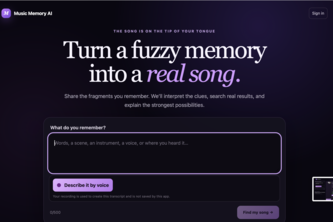
Music Memory AI is a self-reported search tool that claims to help users find songs from incomplete or vague memory cues — such as lyrics, mood, context, or voice characteristics. It uses a hybrid approach combining direct retrieval, GPT-5.6 for structured clue extraction and diversified queries, and deterministic ranking based on external sources like YouTube.
What changed
This is a hackathon project submitted to the OpenAI 2026 hackathon. The author states it was built in a short timeframe using a specific tech stack and with Codex as an engineering collaborator. No prior version or commercial history is evidenced.
Single most important open question
Is there any evidence of user adoption, revenue, or traction beyond the author's own description? The project is not demonstrated to have customers, monetization, or market validation.
What The Product Actually Is
The description states that Music Memory AI allows users to search for songs using incomplete or vague memory cues such as:
- Approximate or inaccurate lyrics
- Movie, series, or advertisement context
- Mood, tempo, genre, or instruments
- Singer or voice characteristics
- Scene details
It returns ranked results with explanations, evidence categories, and YouTube links. Users can refine searches, confirm or reject candidates, and save discoveries.
The system uses three retrieval strategies:
- Direct — for distinctive phrases or title fragments.
- AI-assisted — using GPT-5.6 to extract clues and propose diversified queries.
- Smart — chooses between direct and AI-assisted based on input.
GPT-5.6 is used only for structured clue extraction and query generation, not for ranking or inserting unsupported metadata.
YouTube provides candidates, and TypeScript code normalizes and ranks them deterministically, selecting the best representative recording after aggregation of evidence across versions.
Frontend: React, TypeScript, Vite on Cloudflare Pages
Backend: Hono API on Cloudflare Workers
Authentication & saved songs: Supabase
Tools used: Codex, OpenAI, YouTube, MediaRecorder, Zod
Inference The product is a search engine for music that attempts to bridge memory gaps using AI and external data sources.
Positioning & Claim Evolution
The author states the core promise:
“Find the song you almost remember from incomplete lyrics, descriptions, context, era, mood, or voice clues.”
This positioning targets people who struggle to recall exact song titles or lyrics but have a sense of what they're looking for — a common problem in music discovery.
There is no evidence of prior versions or iterative positioning. The project is described as a single submission to a hackathon.
Inference The product positions itself as a niche tool for memory-based music search, not a general-purpose music platform or streaming service.
Target Customer & ICP
The description does not name specific customer segments or personas. It implies the user base includes people who:
- Have partial memories of songs
- Are trying to identify music from context (e.g., movie scenes)
- Want to explore music based on mood, genre, or voice
It is unclear if the target audience is casual users, music enthusiasts, or professionals like DJs or content creators.
Inference The ICP likely includes individuals with vague musical memory and a need for discovery tools — but no explicit segmentation or targeting data is provided.
Business Model & Pricing Evidence
There is no evidence of pricing, monetization, or business model in the description. The project is described as a hackathon submission without any indication of commercial intent or revenue streams.
Inference No business model or pricing structure is evidenced; this remains unknown.
Technical & Delivery Signals
The system uses:
- GPT-5.6 for clue extraction and query generation (not ranking)
- Deterministic code to resolve identity, aggregate evidence, and rank results
- External grounding via YouTube and other providers
- Cloudflare Workers + Pages for deployment
- Supabase for authentication and saved songs
- React + TypeScript frontend
Codex was used throughout development as an engineering collaborator.
The system passes:
- Strict TypeScript checking
- ESLint
- 240 automated tests
- Production builds for Worker and frontend
- All 24 benchmark case/pipeline runs with perfect Recall@1, Recall@3, Recall@5, and MRR
Inference The technical architecture is well-defined and tested in development. However, no live performance or scalability data is provided.
Traction & Maturity Signals
The project is described as a hackathon submission (OpenAI 2026). No evidence of:
- Users
- Revenue
- Customers
- Product usage metrics
- Market traction
It has not been demonstrated beyond the author’s own account and recorded test cases.
Inference There is no evidence of traction or maturity beyond a prototype built in a short time.
Competitive Context
The description does not mention competitors. It implies the product addresses a gap in traditional music search, where users must know precise terms.
It is unclear whether similar tools exist (e.g., Shazam, SoundHound, AI-based music identification services), but no such references are made.
Inference No competitive landscape is described or evidenced.
Open Questions & Risks
- Unverified claims: The product is presented as a working solution, but there is no independent validation.
- No user feedback or adoption: No evidence of real-world usage or customer data.
- Limited scope: The system only works with YouTube and external providers; it does not appear to include full music libraries or APIs.
- AI dependency: Reliance on GPT-5.6 for clue extraction, which may be inconsistent or unreliable in live use.
- Hackathon origin: The project is a one-off submission, not a developed product.
Inference Risks include lack of real-world testing, unproven scalability, and no commercial viability.
Questions the description leaves open
- What are the actual limitations of the system in live use?
- How does it handle edge cases or ambiguous inputs?
- Has anyone used this beyond the development phase?
- Are there plans to integrate with music libraries or APIs beyond YouTube?
- How is the ranking algorithm validated in practice?
- What are the long-term plans for monetization or product evolution?
Overall Assessment
There is no evidence of traction, revenue, or customer adoption. The project is described as a hackathon submission with no indication of commercial intent or market validation.
Inference This is not a viable investment or partnership opportunity based on the self-reported description alone. It lacks any signal of product-market fit or business viability.
User Stories BotA demo video on every pull request
Get a demo video on every new feature
GitHub App that watches your pull requests and records a narrated, captioned demo.
Save time on demo prep and make informed decisions faster with a video walkthrough of every new feature.
Source
Submitted to the OpenAI 2026 hackathon on Devpost. Project home on Devpost. Back to the full gallery on Devpost.
This competitive analysis was produced by top-founders.com (opens in a new tab)
Generated by a language model from this project's public Devpost page — its tagline, the author's own write-up and any built-with tags listed there — as captured in August 2026. Short quotations are the author's words. It is an opinion on the idea as a business, not on the people behind it, and it reflects the description as published then. If the project has moved on, request a correction below. The analysis is not independent research and contains no verified traction, revenue or customer data.
An independent guide by KFG International LLC — not affiliated with, endorsed by, or connected to Devpost or OpenAI.