

Archive position — measured, not model output
0 likes on Devpost
2,263 of the 7,850 archived projects have more likes, and 5,587 share exactly 0 — so this project's #7,388 place in the like-ranked listing is a tie-break inside that group, not a ranking.
Projects (log scale)
Likes on Devpost. ▲ marks this project's group.
Show the figures
| Likes | Projects | Share of archive |
|---|---|---|
| 0 | 5,587 | 71.2% |
| 1 | 1,758 | 22.4% |
| 2 | 284 | 3.6% |
| 3–4 | 132 | 1.7% |
| 5–9 | 75 | 1.0% |
| 10+ | 14 | 0.2% |
 User Stories BotA demo video on every pull request
Get a demo video on every new feature
GitHub App that watches your pull requests and records a narrated, captioned demo.
Save time on demo prep and make informed decisions faster with a video walkthrough of every new feature.
Executive Summary
What the company appears to be
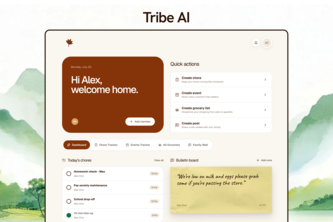
Tribe AI is a self-reported family management platform built as a hackathon project, claiming to offer an "AI-powered Family OS" that centralizes chores, events, grocery lists, and communication for families.
What changed
The author states they built this in one day during OpenAI Build Week using GPT-5.3 Sol, and submitted it to a hackathon. No evidence of prior development or product evolution is provided.
Single most important open question
Is there any evidence of actual family adoption, usage patterns, or traction beyond the single developer's self-reported account?
Analysis basis: This report is based entirely on the author’s own description of Tribe AI as submitted to the OpenAI 2026 hackathon. It contains no independent verification, archived data, or third-party corroboration. All claims are self-reported and unverified.
What The Product Actually Is
The description states that Tribe AI is a platform that:
- Assigns chores with points to give kids ownership
- Keeps family events visible
- Builds smart grocery lists from fridge contents or occasions
- Automatically tracks calories & protein
- Offers a private Family Wall for communication
- Includes an AI that understands the family's context
The author also says they built the full product experience, including chore systems, nutrition-based grocery lists, and a Family Wall with AI memory of the family’s world.
Inference: The product appears to be a single-user or small-team tool focused on family coordination, integrating AI for personalization and task management. It is not evidenced to include any enterprise or multi-family features.
Positioning & Claim Evolution
The author positions Tribe AI as:
- A "Family OS powered by AI"
- A replacement for scattered WhatsApp groups, dead notes apps, and mental load carried by parents
- A warm, emotionally intelligent tool that reduces family stress
They claim it is not a cold productivity app but one designed to feel “warm” and reduce fights.
Inference: The positioning reflects a shift from generic productivity tools toward emotional intelligence in family management. However, no evidence of prior versions or market feedback exists to confirm this evolution.
Target Customer & ICP
The author describes the target as:
- Families with two working parents
- Two kids
- A fridge full of random stuff and a calendar nobody checks
- Parents who are tired and want their evenings back
They also mention that the tool should make kids feel like contributors instead of burdens.
Inference: The ICP appears to be middle-class families with young children, but no evidence exists about specific demographics or customer segments beyond this generalization.
Business Model & Pricing Evidence
There is no evidence in the description of any pricing model, monetization strategy, or business model.
The author does not mention subscriptions, freemium tiers, or paid features.
Not evidenced: No information on how Tribe AI intends to make money or what its commercial structure might be.
Technical & Delivery Signals
The author states:
- The landing page and core flows were built in one day using GPT-5.3 Sol
- Built with Next.js, Codex, and OpenAI
- The AI has memory of the family’s world
- Voice commands are planned for future development
- Photo memories and automatic timelines are also planned
Inference: The technical stack suggests a modern SaaS approach using AI APIs and frontend frameworks. However, no evidence of scalability, performance metrics, or delivery history is provided.
Traction & Maturity Signals
The description states:
- This was built in a hackathon
- It was submitted to the OpenAI 2026 hackathon
- The author shipped something real in a short time frame
- No mention of users, usage data, or product adoption
Not evidenced: There is no evidence of traction, user base, or product maturity beyond the single developer’s account.
Competitive Context
The description does not reference any competitors or market positioning against existing tools.
It implies that current solutions (WhatsApp groups, notes apps) are inadequate but does not name them.
Not evidenced: No competitive analysis or awareness of existing family management tools is evident.
Open Questions & Risks
- Single-person development: Only one team member (Soham S) is mentioned.
- No traction or revenue evidence: The product exists only as a hackathon submission.
- Unverified claims: All features and functionality are self-reported without external validation.
- Emotional positioning without data: The emotional appeal of reducing family stress is stated but not backed by usage or feedback.
- Future plans without execution history: The author lists many future features, but no evidence of prior delivery or iteration.
Inference: The risk of overpromising and underdelivering is high due to lack of product history or user validation.
Questions the description leaves open
- What specific family use cases have you validated with real users?
- How do you plan to monetize this tool, and what pricing model are you considering?
- Have you tested the AI’s ability to understand family context in real-world settings?
- What is your roadmap for scaling beyond a single developer?
- Are there any existing tools or competitors you’ve considered, and how does Tribe differ?
Overall Assessment
Not evidenced: There is no evidence of product-market fit, revenue, traction, or commercial viability to support an investment or partnership decision.
Confidence level: Very low — this is a single-person hackathon project with no external validation or data on adoption, usage, or business model. The claims are self-reported and unverified.
The author states that Tribe AI is “just the beginning,” but there is no evidence of progress beyond the initial concept or prototype.
User Stories BotA demo video on every pull request
Get a demo video on every new feature
GitHub App that watches your pull requests and records a narrated, captioned demo.
Save time on demo prep and make informed decisions faster with a video walkthrough of every new feature.
Source
Submitted to the OpenAI 2026 hackathon on Devpost. Project home on Devpost. Back to the full gallery on Devpost.
This competitive analysis was produced by top-founders.com (opens in a new tab)
Generated by a language model from this project's public Devpost page — its tagline, the author's own write-up and any built-with tags listed there — as captured in August 2026. Short quotations are the author's words. It is an opinion on the idea as a business, not on the people behind it, and it reflects the description as published then. If the project has moved on, request a correction below. The analysis is not independent research and contains no verified traction, revenue or customer data.
An independent guide by KFG International LLC — not affiliated with, endorsed by, or connected to Devpost or OpenAI.