

Archive position — measured, not model output
0 likes on Devpost
2,263 of the 7,850 archived projects have more likes, and 5,587 share exactly 0 — so this project's #5,279 place in the like-ranked listing is a tie-break inside that group, not a ranking.
Projects (log scale)
Likes on Devpost. ▲ marks this project's group.
Show the figures
| Likes | Projects | Share of archive |
|---|---|---|
| 0 | 5,587 | 71.2% |
| 1 | 1,758 | 22.4% |
| 2 | 284 | 3.6% |
| 3–4 | 132 | 1.7% |
| 5–9 | 75 | 1.0% |
| 10+ | 14 | 0.2% |
 User Stories BotA demo video on every pull request
Get a demo video on every new feature
GitHub App that watches your pull requests and records a narrated, captioned demo.
Save time on demo prep and make informed decisions faster with a video walkthrough of every new feature.
Executive Summary
Project: Metabolis
Self-reported basis: The entire analysis is based on the author's own description of the project, submitted to the OpenAI 2026 hackathon on Devpost. No external verification or historical data are available.
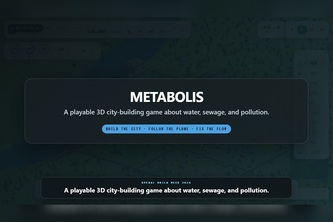
Metabolis is a deterministic 3D city-building game that presents urban systems—water, sewage, pollution, weather—as interconnected flows rather than isolated penalties. The author states it is built with TypeScript, Three.js, and WebGL, and uses Web Workers for simulation. It was developed during a hackathon using Codex as an implementation agent.
The project appears to be a prototype or vertical slice of a larger concept. No evidence of revenue, customers, or traction is provided. The most important open question is whether the core gameplay loop—fixing city flows through infrastructure—is compelling enough to sustain player engagement and attract further development or investment.
What The Product Actually Is
The description states that Metabolis is:
- A deterministic, low-poly 3D city-building game
- About the "hidden metabolism of a city"
- Built with TypeScript, Three.js, WebGL, and Web Workers
- Rendered in a single self-contained HTML file using Vite and vite-plugin-singlefile
- Designed to simulate systems like water, sewage, weather, wind, traffic, electricity, air quality, and satisfaction as connected flows
The author notes that it began as a prototype before Build Week and was completed during the hackathon using Codex for implementation.
Inference: The product is a playable simulation game with an emphasis on system interconnectivity. It is not described as a commercial product or platform but rather as a vertical slice of a potential future game or educational tool.
Positioning & Claim Evolution
The author states that Metabolis:
- Focuses on the movement of matter through a city, rather than money, zoning, and traffic
- Treats water, sewage, pollution, weather, and other systems as visible and interconnected
- Allows players to "repair cities by fixing flows, not paying away penalties"
- Is built with deterministic simulation to ensure reproducibility
Inference: The positioning is that of a novel city-building game focused on environmental realism and system dynamics. It claims to offer an alternative to traditional city-building games by emphasizing infrastructure flows over financial or zoning mechanics.
Target Customer & ICP
The description does not state:
- Who the target customer is
- Whether it's aimed at gamers, educators, urban planners, or developers
- Any specific user persona or ICP
Not evidenced: No information on who would use this product or what their needs are.
Business Model & Pricing Evidence
The description does not contain any information about:
- How the product will generate revenue
- Pricing strategy
- Monetization model
- Subscription or one-time purchase details
Not evidenced: No evidence of a business model or pricing structure.
Technical & Delivery Signals
The author states that:
- The game is written in TypeScript and rendered with Three.js and WebGL
- Simulation runs in a Web Worker for deterministic behavior
- It is packaged into a single HTML file with no external assets
- Codex was used to implement tasks, verify results, and produce reproducible builds
- The project includes visual evidence, numerical results, and performance metrics
Inference: Technical delivery appears to be focused on reproducibility and portability. The use of deterministic simulation and Web Workers suggests an emphasis on reliability and scalability.
Traction & Maturity Signals
The description states:
- Metabolis existed as a prototype before Build Week
- It was completed during the hackathon period
- It includes a "final evidence-backed demo package"
- It has no revenue, customer, or traction data beyond its development phase
Not evidenced: No evidence of user adoption, usage metrics, or market traction.
Competitive Context
The description does not mention:
- Competitors in the city-building genre
- Similar products or platforms
- Market positioning relative to existing tools
Not evidenced: No competitive landscape information provided.
Open Questions & Risks
Key risks and open questions based on the self-reported description:
- The project is described as a prototype or vertical slice, not a finished product
- No evidence of revenue, customers, or traction
- No indication of scalability beyond its current scope
- The use of Codex for implementation raises questions about long-term maintainability and team capability
- The focus on system interconnectivity may be too abstract for mainstream appeal
Inference: The project lacks commercial viability indicators. It is unclear whether it can evolve into a sustainable business or attract users beyond its development phase.
Questions the description leaves open
- What specific gameplay mechanics will drive player engagement?
- How does the deterministic simulation enhance user experience or collaboration?
- Are there plans to expand beyond the current vertical slice?
- What is the intended monetization strategy if this becomes a commercial product?
- How do you plan to make invisible systems understandable and engaging for players?
- What are the long-term goals for the project, including potential partnerships or funding?
Overall Assessment
Not evidenced: No information on valuation, funding rounds, or investment readiness.
The description indicates that Metabolis is a prototype developed during a hackathon. It lacks evidence of commercial traction, revenue, or customer adoption. The author's claims about gameplay and system design are unverified and lack supporting data.
Given the self-reported nature of all information and absence of any financial or user metrics, this project does not demonstrate sufficient commercial viability for investment or partnership consideration at this stage. Any further evaluation would require evidence of product-market fit, user engagement, or a clear path to monetization.
User Stories BotA demo video on every pull request
Get a demo video on every new feature
GitHub App that watches your pull requests and records a narrated, captioned demo.
Save time on demo prep and make informed decisions faster with a video walkthrough of every new feature.
Source
Submitted to the OpenAI 2026 hackathon on Devpost. Project home on Devpost. Back to the full gallery on Devpost.
This competitive analysis was produced by top-founders.com (opens in a new tab)
Generated by a language model from this project's public Devpost page — its tagline, the author's own write-up and any built-with tags listed there — as captured in August 2026. Short quotations are the author's words. It is an opinion on the idea as a business, not on the people behind it, and it reflects the description as published then. If the project has moved on, request a correction below. The analysis is not independent research and contains no verified traction, revenue or customer data.
An independent guide by KFG International LLC — not affiliated with, endorsed by, or connected to Devpost or OpenAI.