

Archive position — measured, not model output
1 like on Devpost
505 of the 7,850 archived projects have more likes, and 1,758 share exactly 1 — so this project's #1,448 place in the like-ranked listing is a tie-break inside that group, not a ranking.
Projects (log scale)
Likes on Devpost. ▲ marks this project's group.
Show the figures
| Likes | Projects | Share of archive |
|---|---|---|
| 0 | 5,587 | 71.2% |
| 1 | 1,758 | 22.4% |
| 2 | 284 | 3.6% |
| 3–4 | 132 | 1.7% |
| 5–9 | 75 | 1.0% |
| 10+ | 14 | 0.2% |
 User Stories BotA demo video on every pull request
Get a demo video on every new feature
GitHub App that watches your pull requests and records a narrated, captioned demo.
Save time on demo prep and make informed decisions faster with a video walkthrough of every new feature.
Executive Summary
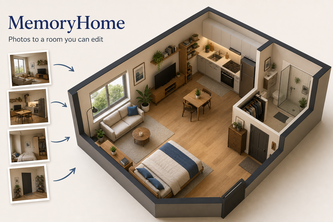
What the company appears to be: MemoryHome is a self-reported tool that turns four room photos into an editable 3D plan and furniture layout using AI-assisted photo analysis and deterministic code for geometry validation. It targets ordinary people planning real rooms, not professional CAD users.
What changed: The project description indicates development of a consumer-facing tool with a narrow AI boundary, where AI proposes elements and code verifies them. It includes a reviewed furniture catalog, collision checks, and multi-view editing capabilities across 2D and 3D interfaces.
Single most important open question: Does MemoryHome have any commercial traction or revenue-generating activity beyond the hackathon submission?
What The Product Actually Is
The description states that MemoryHome "turns four directional room photos into an editable room plan." It identifies walls, doors, and windows from these photos and uses user-provided measurements as the source of truth for geometry. Users can manipulate furniture in both 2D and 3D views, with collision detection and support for changing finishes.
The system includes:
- A shared Kotlin and Spring Boot service managing room-plan sessions, photo analysis, and geometry validation.
- A frontend built with Next.js, React, TypeScript, React Three Fiber, and Three.js.
- A locally served catalog of 51 reviewed furniture models.
- Deterministic code for physical geometry, coordinates, room bounds, collisions, persistence, and projections.
Evidence: The author describes the product's functionality in detail, including its UI/UX flow, technical architecture, and specific features like synchronized 3D/2D views, furniture manipulation, and collision checks. However, no evidence of actual usage or adoption is provided.
Positioning & Claim Evolution
The description states that MemoryHome aims to simplify the process of turning room photos into usable plans without requiring design expertise. Its guiding principle is: "AI proposes. Code verifies. You decide."
It positions itself as a tool for ordinary people planning real rooms, not professional CAD users. The product emphasizes:
- Simplicity in use
- User control over decisions
- AI assistance bounded by deterministic validation
Inference: This suggests a shift from traditional CAD tools toward more accessible design solutions, but the description does not indicate whether this positioning has been tested or validated with real users beyond the hackathon context.
Target Customer & ICP
The description states that MemoryHome is designed for "ordinary people planning a real room, not professional CAD users." It targets individuals who can take four photos of a room and want to create an editable plan without needing design skills.
Evidence: The positioning statement is clear, but there is no evidence of customer segmentation, persona development, or market research beyond the author's own claims.
Business Model & Pricing Evidence
There is no evidence in the description of any business model or pricing structure. The project appears to be a hackathon submission with no mention of monetization, subscription plans, or sales channels.
Inference: If this is intended as a commercial product, it has not yet defined how it will generate revenue or charge customers.
Technical & Delivery Signals
The system uses:
- Frontend: Next.js, React, TypeScript, React Three Fiber, Three.js
- Backend: Kotlin and Spring Boot
- AI tools: Codex, GPT-5.6 (for product definition), OpenAI API (for runtime)
- Infrastructure: AWS, Docker, PostgreSQL, Vercel
Key technical signals include:
- A narrow AI boundary where AI suggests elements and code validates them.
- Deterministic geometry validation and collision checks.
- Shared canonical data between 2D and 3D views.
- Reviewed furniture catalog with model-derived dimensions and compatibility rules.
Evidence: The description provides a detailed breakdown of the tech stack, but lacks evidence of production deployment or scalability beyond the hackathon prototype.
Traction & Maturity Signals
The project has:
- A working validation deployment at bangtaste.com
- A reviewed catalog of 51 furniture models and 12 room sets
- Regression coverage for user journeys found through screen recordings
- A reproducible demo pipeline with narration, caption QA, and immutable review files
However, there is no evidence of:
- Revenue or monetization
- Customer base or usage metrics
- Product-market fit validation
- Any form of commercial traction beyond the hackathon submission
Inference: While the product shows technical maturity, it lacks signals of commercial viability or user adoption.
Competitive Context
The description does not provide any information about existing competitors or market positioning relative to other tools that offer similar functionality (e.g., interior design apps, CAD tools, 3D room planners).
Evidence: No mention of competitive landscape, pricing strategies, or differentiation from existing solutions.
Open Questions & Risks
- No commercial traction: The project is described as a hackathon submission with no evidence of revenue, customers, or adoption.
- Unproven business model: There is no indication of how the company intends to monetize or scale the product.
- Limited external validation: All claims are self-reported and unverified; no third-party data or user feedback is included.
- AI trust boundary: While the system defines a narrow AI boundary, it's unclear if this approach will scale or be sufficient for broader market needs.
Inference: These risks suggest that while the product may be technically sound, its commercial viability remains untested.
Questions the description leaves open
- What is the current stage of development beyond the hackathon submission?
- Have you conducted any user testing or gathered feedback from potential customers?
- How do you plan to monetize this product? Are there any existing revenue streams?
- What are your go-to-market strategies and target customer acquisition plans?
- Can you provide evidence of any early traction, such as sign-ups, usage metrics, or pilot programs?
- How do you intend to scale the reviewed furniture catalog and maintain quality control?
- What is the long-term vision for MemoryHome beyond its current scope?
Overall Assessment
Not evidenced.
The description provides a detailed account of the product’s features, architecture, and development process, but contains no evidence of commercial traction, revenue, or customer adoption. The project appears to be a hackathon submission with no indication of whether it has moved beyond prototype status or has any viable path to market success.
Confidence level: Low — based entirely on self-reported information without corroboration or external validation.
User Stories BotA demo video on every pull request
Get a demo video on every new feature
GitHub App that watches your pull requests and records a narrated, captioned demo.
Save time on demo prep and make informed decisions faster with a video walkthrough of every new feature.
Source
Submitted to the OpenAI 2026 hackathon on Devpost. Project home on Devpost. Back to the full gallery on Devpost.
This competitive analysis was produced by top-founders.com (opens in a new tab)
Generated by a language model from this project's public Devpost page — its tagline, the author's own write-up and any built-with tags listed there — as captured in August 2026. Short quotations are the author's words. It is an opinion on the idea as a business, not on the people behind it, and it reflects the description as published then. If the project has moved on, request a correction below. The analysis is not independent research and contains no verified traction, revenue or customer data.
An independent guide by KFG International LLC — not affiliated with, endorsed by, or connected to Devpost or OpenAI.