

Archive position — measured, not model output
0 likes on Devpost
2,263 of the 7,850 archived projects have more likes, and 5,587 share exactly 0 — so this project's #5,374 place in the like-ranked listing is a tie-break inside that group, not a ranking.
Projects (log scale)
Likes on Devpost. ▲ marks this project's group.
Show the figures
| Likes | Projects | Share of archive |
|---|---|---|
| 0 | 5,587 | 71.2% |
| 1 | 1,758 | 22.4% |
| 2 | 284 | 3.6% |
| 3–4 | 132 | 1.7% |
| 5–9 | 75 | 1.0% |
| 10+ | 14 | 0.2% |
 User Stories BotA demo video on every pull request
Get a demo video on every new feature
GitHub App that watches your pull requests and records a narrated, captioned demo.
Save time on demo prep and make informed decisions faster with a video walkthrough of every new feature.
Executive Summary
What the company appears to be
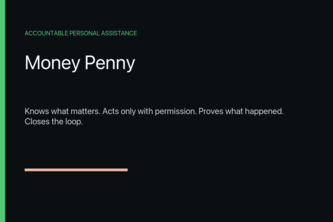
Money Penny is a personal AI assistant built as a proof-of-concept for an AI trust mechanism called Readback. The author states it is intended to function as a "personal AI chief of staff" that handles inbox attention, calendar, reminders, memory, open loops, and briefings. It includes a "Honesty Filter" designed to detect false claims made by other AI agents.
What changed
During Build Week, the project evolved from a basic personal assistant into an extension focused on verifying claims made by other agents using cryptographic signatures and bounded source checks. The core innovation is Readback — a system that ensures claims are backed by verifiable evidence or direct source checks rather than self-signed assertions.
The single most important open question
Is there a viable path to product-market fit for this trust layer, or is it purely an experimental concept with limited commercial applicability?
What The Product Actually Is
The description states that Money Penny is the personal assistant component of the project. It handles tasks like inbox attention, calendar management, reminders, memory, open loops, and briefings.
Readback is described as a "trust capability" that makes Money Penny different. It reviews another agent's report and asks: what does the evidence actually support? The system blocks claims with missing or altered evidence and requires signed proof from trusted runners or direct source checks.
The author also describes:
- A zero-dependency package using single-use approvals and signed, chained proof bundles.
- Git and GitHub connectors that perform fixed read-only operations.
- A public demo that demonstrates how the system catches false claims about a real GitHub repository.
- A no-login runtime environment with privacy scanning and hash verification.
Inference The product is not yet a commercial offering but rather an experimental prototype built during a hackathon. It focuses on AI trust mechanisms, particularly around claim verification and evidence-based decision-making.
Positioning & Claim Evolution
The author states that Money Penny was inspired by the need for a personal AI chief of staff they could actually trust. The original idea was to build a personal assistant with a focus on workflow automation (inbox attention, calendar, etc.).
During Build Week, the project evolved to emphasize trust and honesty in AI claims. The key shift was recognizing that an AI can sign a false story — a valid signature proves that a key signed something, but not that the signer deserves trust.
The author notes that this evolution came from the realization that "governing what an agent may do is not enough; a trustworthy assistant must also govern what it may claim it did."
Inference This represents a shift from a general-purpose personal assistant to a specialized tool focused on AI integrity and accountability. The positioning has moved from utility to trust infrastructure.
Target Customer & ICP
The description states that Money Penny is intended as a "personal AI chief of staff" for individuals who want to trust their AI tools more deeply.
It also mentions that the private assistant contains personal connectors and data, while the judging edition (used in demos) is generated from an explicit allowlist, privacy-scanned, tested, and hash-verified.
Inference The primary target appears to be individual users seeking a trustworthy AI assistant. However, there is no evidence of specific personas or segments beyond "users who want to trust their AI tools."
Business Model & Pricing Evidence
There is no mention of pricing, monetization strategies, or business models in the description.
Not evidenced
Technical & Delivery Signals
The project uses:
- Agent safety
- AI assistants
- Cryptography (ed25519)
- CSS, HTML, JavaScript, Node.js
- Git and GitHub integrations
- OpenAI Codex and GPT-5.6 for development support
- Local-first architecture
- Zero-dependency packages
The system includes:
- A receipt checker plus independent spot-checks
- Authority, integrity, binding, and reality checks
- Trusted-runner pinning
- Defenses against forged, altered, replayed, expired, self-issued, or instruction-bearing evidence
- Fixed read-only Git and public GitHub source adapters
- A responsive no-login demo with CI, privacy scanning, and hash verification
Inference The technical approach is focused on cryptographic verification and bounded source checks. The architecture emphasizes local-first and offline capabilities.
Traction & Maturity Signals
There is no evidence of revenue, customers, or adoption beyond the author’s own demonstration.
The project was submitted to a hackathon (OpenAI 2026) and includes a public demo. It passed 20 tests and verified all 62 release files with zero dependencies.
Not evidenced
Competitive Context
There is no mention of competitors or competitive landscape in the description.
Not evidenced
Open Questions & Risks
- The system is described as experimental, built during a hackathon.
- No evidence of commercial traction, revenue, or customer base.
- The author acknowledges that Readback is not a "magic truth machine" and has clear limitations (e.g., cannot inspect private repositories).
- The project does not appear to have any funding or team beyond one person.
- The demo environment is synthetic and may not reflect real-world usage.
Inference The project lacks commercial viability indicators. It is an experimental prototype with limited evidence of market demand or scalability.
Questions the description leaves open
- What specific use cases do you see for this trust layer in the broader AI ecosystem?
- How would you envision scaling this beyond a single-person demo?
- Are there any plans to integrate with existing AI platforms or services?
- What are your thoughts on the limitations of Readback, particularly regarding private repositories and arbitrary outcomes?
- Is there a roadmap for transitioning from prototype to product?
Overall Assessment
The project is an experimental prototype built during a hackathon. It demonstrates technical capability in AI trust mechanisms but lacks evidence of commercial traction or viability.
Not evidenced
User Stories BotA demo video on every pull request
Get a demo video on every new feature
GitHub App that watches your pull requests and records a narrated, captioned demo.
Save time on demo prep and make informed decisions faster with a video walkthrough of every new feature.
Source
Submitted to the OpenAI 2026 hackathon on Devpost. Project home on Devpost. Back to the full gallery on Devpost.
This competitive analysis was produced by top-founders.com (opens in a new tab)
Generated by a language model from this project's public Devpost page — its tagline, the author's own write-up and any built-with tags listed there — as captured in August 2026. Short quotations are the author's words. It is an opinion on the idea as a business, not on the people behind it, and it reflects the description as published then. If the project has moved on, request a correction below. The analysis is not independent research and contains no verified traction, revenue or customer data.
An independent guide by KFG International LLC — not affiliated with, endorsed by, or connected to Devpost or OpenAI.