

Archive position — measured, not model output
0 likes on Devpost
2,263 of the 7,850 archived projects have more likes, and 5,587 share exactly 0 — so this project's #3,411 place in the like-ranked listing is a tie-break inside that group, not a ranking.
Projects (log scale)
Likes on Devpost. ▲ marks this project's group.
Show the figures
| Likes | Projects | Share of archive |
|---|---|---|
| 0 | 5,587 | 71.2% |
| 1 | 1,758 | 22.4% |
| 2 | 284 | 3.6% |
| 3–4 | 132 | 1.7% |
| 5–9 | 75 | 1.0% |
| 10+ | 14 | 0.2% |
 User Stories BotA demo video on every pull request
Get a demo video on every new feature
GitHub App that watches your pull requests and records a narrated, captioned demo.
Save time on demo prep and make informed decisions faster with a video walkthrough of every new feature.
Executive Summary
Project: Codex-Loop
Self-reported basis: The analysis is based entirely on the author's own description of Codex-Loop as submitted to the OpenAI 2026 hackathon on Devpost. No external verification or historical data are available.
What the company appears to be: Codex-Loop is a self-reported project that describes itself as an experimental tool for creating, running, and reusing multi-agent workflows within the Codex ecosystem. It presents a visual graph-based interface for defining "Loops" — reusable, multi-step workflows where each step (node) can be an agent or other orchestration logic.
What changed: The author states that this project was built as a prototype to demonstrate a potential future feature in Codex, inspired by the need for higher-level orchestration of multi-agent tasks beyond what existing tools like Codex and Claude Code offer. It is described as a "next big step in agentic coding."
Single most important open question: Is there sufficient evidence that this concept has traction, market demand, or a viable path to commercialization, or does it remain an experimental prototype with no demonstrated adoption?
What The Product Actually Is
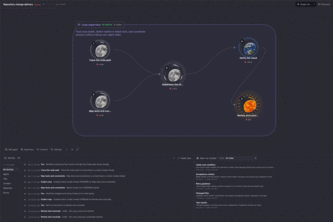
The description states that Codex-Loop is a system for defining, creating, running, and reusing custom multi-agent workflows. It uses a graph-based interface where nodes represent units of work (agents, conditions, verification steps, etc.) and edges define dependencies between them.
It includes:
- A Loop Designer that proposes workflow schemas based on natural language input.
- A visual editor using React Flow for manual adjustments.
- A simulation mode to validate workflows before execution.
- Execution capabilities through native Codex threads, with support for parallelism, context scoping, retries, and human intervention.
- Integration with Codex CLI and app-server via JSONL protocol.
The system is described as being built on top of the Codex CLI and app-server due to lack of direct access to Codex source code. The author notes that it functions as a bridge between the user and Codex's core functionality.
Inference: This appears to be a prototype or proof-of-concept tool designed to showcase how orchestration could work within the Codex environment, rather than a production-ready product.
Positioning & Claim Evolution
The description claims that Codex-Loop is a "higher-level layer" for turning multi-agent work into durable, reusable workflows. It positions itself as solving challenges not fully addressed by individual agents or scheduled prompts — such as:
- Using different models and reasoning effort levels.
- Running independent work in parallel while maintaining order.
- Limiting context per agent.
- Making failure behavior explicit.
- Enabling reuse of workflows manually, on schedule, or via webhook.
It also emphasizes a chat-first experience, with the visual graph being secondary. The author states that this approach allows users to describe outcomes in natural language without needing to understand orchestration concepts upfront.
Inference: The positioning reflects an attempt to simplify complex orchestration for developers by abstracting away complexity behind a conversational interface, while still offering fine-grained control through the visual editor.
Target Customer & ICP
The description does not explicitly name target customers or define an Ideal Customer Profile (ICP). However, it implies that Codex-Loop is aimed at:
- Developers working with multi-agent systems.
- Users who want to automate complex workflows involving multiple steps and agents.
- Teams looking for a way to make agent-based automation more inspectable, reusable, and manageable.
It suggests that the primary interaction method is through chat, which may appeal to developers who prefer conversational interfaces over traditional UIs.
Inference: The target audience likely includes advanced developers or engineering teams using Codex or similar tools, but there is no explicit segmentation or customer data provided.
Business Model & Pricing Evidence
There is no evidence in the description of a business model or pricing structure. The project is described as a prototype submitted to a hackathon and not intended for commercial use at this stage.
Inference: No commercialization strategy, revenue streams, or pricing information are evident from the self-reported description.
Technical & Delivery Signals
The author built:
- Frontend using React, TypeScript, Vite, React Flow
- Backend as an Express server with local JSON persistence
- Communication with Codex app-server via JSONL protocol over stdin/stdout
- A persistent Loop Designer that acts as a read-only Codex thread
- Skills for creating and operating Loops from other Codex tasks
The system supports:
- Parallel execution of independent nodes
- Context propagation between nodes
- Retry logic with model upgrades
- Human approval gates
- Simulation before execution
- Execution history tracking
- Webhook triggers
Inference: The technical architecture is described as functional but limited by reliance on the Codex CLI and app-server, suggesting it's a bridge solution rather than an integrated feature.
Traction & Maturity Signals
There is no evidence of revenue, customers, or adoption. The project is explicitly described as a prototype built for a hackathon and intended to inspire the Codex team.
The author notes that they are not a frontend developer by training but made UX decisions based on user experience principles.
Inference: No traction signals are present; this remains an experimental concept with no demonstrated market validation or usage metrics.
Competitive Context
The description mentions:
- Codex, which provides building blocks for agents and workflows.
- Claude Code, which offers configurable subagents and multi-agent workflows.
- The author’s goal is to create something simpler and more general than these tools, with a focus on visual clarity and chat-first interaction.
No direct competitors are named or described. The project seems to aim at filling a gap in the current agent orchestration landscape by combining ease-of-use with flexibility.
Inference: The competitive space includes existing agent platforms like Codex and Claude Code, but there is no clear indication of how Codex-Loop would differentiate itself beyond its own claims.
Open Questions & Risks
- Prototype-only status: The project is described as a hackathon submission, not a commercial product.
- Dependency on external systems: It relies on the Codex CLI and app-server instead of being integrated into Codex directly.
- No revenue or customer data: No evidence of monetization strategy or user base.
- Unverified claims: All assertions about functionality, usability, and impact are self-reported without corroboration.
- Limited scope: The author acknowledges that this is a limited replica of what could be implemented natively in Codex.
Inference: The risk of misalignment with actual market needs or technical feasibility is high due to the experimental nature and lack of independent validation.
Questions the description leaves open
- What specific feedback did you receive from the Codex team during development?
- How does this concept align with current or planned features in Codex?
- Have you tested this prototype with any real users beyond yourself?
- Is there a plan to integrate this into Codex as a native feature, and what would that require?
- What are the key assumptions about developer behavior and workflow needs that underpin this design?
- How do you envision scaling or improving upon this prototype for production use?
Overall Assessment
Not evidenced.
The description provides no information on financials, traction, team size beyond one person, or any commercial viability indicators. While the idea is conceptually interesting and aligns with trends in agentic coding, there is no evidence of a viable business model, customer demand, or path to monetization.
Inference: This project appears to be an experimental prototype with potential but lacks sufficient evidence to support investment or partnership decisions at this time.
User Stories BotA demo video on every pull request
Get a demo video on every new feature
GitHub App that watches your pull requests and records a narrated, captioned demo.
Save time on demo prep and make informed decisions faster with a video walkthrough of every new feature.
Source
Submitted to the OpenAI 2026 hackathon on Devpost. Project home on Devpost. Back to the full gallery on Devpost.
This competitive analysis was produced by top-founders.com (opens in a new tab)
Generated by a language model from this project's public Devpost page — its tagline, the author's own write-up and any built-with tags listed there — as captured in August 2026. Short quotations are the author's words. It is an opinion on the idea as a business, not on the people behind it, and it reflects the description as published then. If the project has moved on, request a correction below. The analysis is not independent research and contains no verified traction, revenue or customer data.
An independent guide by KFG International LLC — not affiliated with, endorsed by, or connected to Devpost or OpenAI.