

Archive position — measured, not model output
1 like on Devpost
505 of the 7,850 archived projects have more likes, and 1,758 share exactly 1 — so this project's #1,449 place in the like-ranked listing is a tie-break inside that group, not a ranking.
Projects (log scale)
Likes on Devpost. ▲ marks this project's group.
Show the figures
| Likes | Projects | Share of archive |
|---|---|---|
| 0 | 5,587 | 71.2% |
| 1 | 1,758 | 22.4% |
| 2 | 284 | 3.6% |
| 3–4 | 132 | 1.7% |
| 5–9 | 75 | 1.0% |
| 10+ | 14 | 0.2% |
 User Stories BotA demo video on every pull request
Get a demo video on every new feature
GitHub App that watches your pull requests and records a narrated, captioned demo.
Save time on demo prep and make informed decisions faster with a video walkthrough of every new feature.
Executive Summary
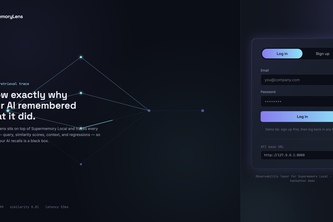
What the company appears to be: MemoryLens is a self-reported observability tool for AI memory built with OpenAI embeddings and designed to make semantic retrieval transparent, testable, and safe. It allows users to inspect retrieval traces, detect regressions, identify duplicate memories, and redact PII from memory embeddings.
What changed: The project was submitted as part of the OpenAI 2026 hackathon. No evidence suggests prior commercial activity or product development beyond this submission.
Single most important open question: Is there any evidence of actual usage, adoption, or revenue generation by users outside of the hackathon context?
What The Product Actually Is
The description states that MemoryLens is an OpenAI-powered observability dashboard for semantic memory. It shows:
- Full retrieval trace: query, ranked memories, similarity scores, latency, and context sent to the AI.
- Memory QA
- Regression detection
- Duplicate-memory detection
- PII Guard (detect, mask, redact, re-embed)
The backend is built with FastAPI, SQLite, and JWT authentication. The frontend uses vanilla JavaScript styled with Tailwind CSS and Chart.js for visualizations.
Evidence: Self-reported by the authors.
Confidence: Low — no independent verification or demonstration of product functionality beyond a hackathon submission.
Positioning & Claim Evolution
The project claims to address a trust problem in AI memory where teams cannot see which memory caused an incorrect answer. It positions itself as a tool that makes AI memory:
- Transparent
- Testable
- Safe
It also states that it provides practical tools for testing memory quality, catching regressions, detecting conflicting memories, and reducing privacy risk.
The authors note they learned that “AI memory needs the same level of evaluation and observability as AI models.”
Evidence: Self-reported.
Confidence: Low — no evidence of prior positioning or evolution in messaging beyond this single submission.
Target Customer & ICP
The description implies a target customer is teams working with AI assistants that rely on semantic memory. These are likely:
- Developers or engineering teams building AI-powered applications
- Organizations using OpenAI-based systems where memory traceability matters
However, there is no explicit mention of specific personas, use cases, or buyer segments.
Evidence: Inferred from the problem statement and intended audience.
Confidence: Low — no stated ICP or customer segmentation beyond general “teams.”
Business Model & Pricing Evidence
There is no evidence in the description of:
- A pricing model
- Revenue streams
- Monetization strategy
- Customer acquisition plans
The project is described as a hackathon submission.
Evidence: Not evidenced.
Confidence: Very low — no indication of business model or financial structure.
Technical & Delivery Signals
Technical stack includes:
- Backend: FastAPI, SQLite, JWT
- Frontend: Vanilla JavaScript, Tailwind CSS, Chart.js
- AI models: OpenAI text-embedding-3-small
- Data handling: Semantic retrieval using cosine similarity
The authors mention challenges in making semantic retrieval understandable and in managing privacy concerns.
Evidence: Self-reported.
Confidence: Low — no demonstration of delivery or production-grade implementation beyond a prototype.
Traction & Maturity Signals
There is no evidence of:
- Customers
- Revenue
- Product usage
- Market traction
- Prior versions or iterations
- Deployment in production environments
The project was submitted to a hackathon and has no indication of ongoing development or adoption.
Evidence: Not evidenced.
Confidence: Very low — no signs of maturity or traction beyond the hackathon.
Competitive Context
There is no mention in the description of:
- Competitors
- Market landscape
- Differentiation from existing tools
- Prior art or similar solutions
The authors do not reference any competitive analysis or positioning against other memory management or observability tools.
Evidence: Not evidenced.
Confidence: Very low — no competitive context provided.
Open Questions & Risks
Key risks and open questions include:
- No commercial traction or revenue: The project is a hackathon submission with no evidence of real-world usage.
- Unproven scalability: The tech stack (e.g., SQLite) may not support production-scale memory systems.
- Limited team size: Only two members, which may limit execution capacity.
- No pricing or monetization strategy: No indication of how the product would be sold or funded.
- Self-reported only: All claims are unverified and lack independent corroboration.
Evidence: Inferred from absence of data and self-reporting nature.
Confidence: Moderate — based on lack of evidence for key commercial signals.
Questions the description leaves open
- What is the actual problem you're solving, and how do you know teams are struggling with it?
- Have you validated your solution with any users or customers beyond the hackathon?
- What is your path to monetization? Are you planning to charge for access, subscriptions, or enterprise features?
- How does MemoryLens handle large-scale memory systems or high-volume retrieval queries?
- What are the technical limitations of using SQLite as a backend for memory storage at scale?
- Do you have any plans to integrate with other AI platforms beyond OpenAI?
- Are there any existing tools in this space that you're aware of, and how do you differentiate from them?
Overall Assessment
Assessment: Not evidenced.
The project is a self-reported hackathon submission, with no evidence of:
- Revenue
- Customers
- Product-market fit
- Commercial traction
- Team execution capability beyond the prototype phase
It is unclear whether this represents a viable business or product concept, or if it is merely an idea or proof-of-concept.
Confidence: Very low — no basis for investment or partnership decision at this stage.
User Stories BotA demo video on every pull request
Get a demo video on every new feature
GitHub App that watches your pull requests and records a narrated, captioned demo.
Save time on demo prep and make informed decisions faster with a video walkthrough of every new feature.
Source
Submitted to the OpenAI 2026 hackathon on Devpost. Project home on Devpost. Back to the full gallery on Devpost.
This competitive analysis was produced by top-founders.com (opens in a new tab)
Generated by a language model from this project's public Devpost page — its tagline, the author's own write-up and any built-with tags listed there — as captured in August 2026. Short quotations are the author's words. It is an opinion on the idea as a business, not on the people behind it, and it reflects the description as published then. If the project has moved on, request a correction below. The analysis is not independent research and contains no verified traction, revenue or customer data.
An independent guide by KFG International LLC — not affiliated with, endorsed by, or connected to Devpost or OpenAI.