

Archive position — measured, not model output
0 likes on Devpost
2,263 of the 7,850 archived projects have more likes, and 5,587 share exactly 0 — so this project's #5,138 place in the like-ranked listing is a tie-break inside that group, not a ranking.
Projects (log scale)
Likes on Devpost. ▲ marks this project's group.
Show the figures
| Likes | Projects | Share of archive |
|---|---|---|
| 0 | 5,587 | 71.2% |
| 1 | 1,758 | 22.4% |
| 2 | 284 | 3.6% |
| 3–4 | 132 | 1.7% |
| 5–9 | 75 | 1.0% |
| 10+ | 14 | 0.2% |
 User Stories BotA demo video on every pull request
Get a demo video on every new feature
GitHub App that watches your pull requests and records a narrated, captioned demo.
Save time on demo prep and make informed decisions faster with a video walkthrough of every new feature.
Executive Summary
What the company appears to be
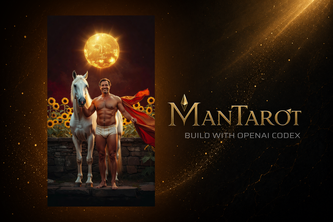
ManTarot is an AI-native storytelling platform that the author describes as a premium tarot experience for gay men. It is built using a combination of Android (Kotlin), web (Next.js), backend (Spring Boot), and multimodal AI systems including Gemini, Grok, and OpenAI Codex with GPT-5.6.
What changed
The project started as an idea by a non-technical founder (a choir conductor) who used AI coding assistants like OpenAI Codex to build the entire product from concept to beta distribution on Google Play. The author claims that Codex enabled them to direct and maintain a full stack of software while staying focused on product vision.
Single most important open question
Is there evidence of user traction or monetization beyond the closed Google Play beta, and how does the author’s claim about AI enabling product direction translate into actual product quality or scalability?
What The Product Actually Is
The description states that ManTarot is a premium AI-powered tarot platform for gay men. It includes:
- An Android application built with Kotlin and Jetpack Compose.
- A Spring Boot backend.
- A Next.js web administration platform.
- PostgreSQL database with Prisma.
- Integration of Google Play Billing, Firebase push notifications, multilingual infrastructure, and multimodal AI.
- Features such as multilingual readings, premium decks, subscriptions, one-time purchases, rewarded ads, reading history, remote content management, and a complete admin system.
The author describes it as not being a hackathon prototype but a real product currently distributed through a closed Google Play beta.
Inference It is unclear whether the platform supports full end-to-end functionality or if some features are still in development. The presence of an admin system suggests that content can be managed remotely, which implies a scalable architecture for future expansion.
Positioning & Claim Evolution
The author positions ManTarot as:
- A premium AI-powered tarot experience tailored specifically to gay men.
- Not just generic fortune-telling but an immersive and personal conversation using symbolic cards, AI-generated readings, original visual worlds, and design.
- Built with a focus on feeling, not just function.
The author also claims that ManTarot is:
- A real product, not a prototype.
- Distributed via a closed Google Play beta.
- Developed by someone without traditional software engineering background using AI tools like Codex and GPT-5.6.
There is no evidence of prior versions or evolution beyond the current beta stage, nor any indication of how this positioning has shifted over time.
Inference The positioning appears to be centered around emotional resonance, niche targeting, and AI-driven personalization, but there is no data on how users perceive or engage with these elements.
Target Customer & ICP
The author states that ManTarot is designed specifically for gay men. This is the stated target audience, though no further segmentation or demographic details are provided.
There is no evidence of:
- Customer personas
- Market size estimates
- Competitor analysis
- User feedback beyond beta testers
Inference The ICP (Ideal Customer Profile) is defined by identity and lifestyle rather than behavior or use case. The lack of deeper customer insights makes it difficult to assess whether this niche is viable or scalable.
Business Model & Pricing Evidence
The description mentions:
- Subscriptions
- One-time purchases
- Rewarded ads
- Premium tarot decks
It does not specify:
- Pricing tiers
- Revenue streams beyond monetization methods
- Monetization strategy or conversion rates
- Customer lifetime value (CLV)
- Any indication of paid users or revenue generation
Inference The business model seems to be based on freemium + premium content, with in-app purchases and ads. However, the lack of financial data prevents any assessment of viability or scalability.
Technical & Delivery Signals
Key technical elements include:
- Android app (Kotlin, Jetpack Compose)
- Backend (Spring Boot)
- Web admin (Next.js)
- Database (PostgreSQL via Prisma)
- AI orchestration:
- Gemini 2.5 Flash-Lite for generating readings
- Grok by xAI for artwork generation
- OpenAI Codex with GPT-5.6 for development and maintenance
The author claims that:
- Codex was central to building, integrating, testing, stabilizing, and maintaining the product.
- The system includes automated tests, release validation, Git auditing, documentation, and deployment workflows.
There is no evidence of:
- Scalability metrics
- Performance benchmarks
- Security practices
- Infrastructure robustness or redundancy
Inference The technical stack indicates a modular, AI-integrated architecture, but the absence of production-level data limits confidence in its stability or scalability.
Traction & Maturity Signals
The author states:
- ManTarot is currently distributed through a closed Google Play beta
- There are real beta users
- The product includes full features like billing, notifications, multilingual support, and AI orchestration
- It has undergone multiple releases (Beta22 mentioned)
However, there is no evidence of:
- User growth or retention metrics
- Revenue or monetization data
- Public reviews or testimonials
- Number of active users
- Churn rate or engagement levels
Inference While the product shows signs of maturity in terms of feature set, there is no measurable traction or adoption beyond the beta phase.
Competitive Context
The description does not mention any competitors, nor does it provide context about:
- Existing tarot apps or platforms
- AI-powered storytelling tools
- Niche-specific spiritual or wellness apps
- Market saturation or differentiation strategy
Inference There is no evidence of competitive analysis or positioning within the broader market. The author’s focus is on personalization and niche targeting, but not on how this compares to existing offerings.
Open Questions & Risks
Several potential risks are implied:
- Founder background: The author lacks a software engineering background, which raises questions about long-term technical leadership.
- AI dependency: Heavy reliance on Codex and GPT-5.6 may create vulnerabilities if access or pricing changes.
- Limited traction: No evidence of user growth, monetization, or public adoption beyond the beta.
- Niche targeting: While specific, targeting a narrow demographic could limit scalability unless proven demand exists.
- Product quality control: The author notes challenges in maintaining consistency and avoiding regressions — this suggests ongoing risk to product integrity.
Inference The project is highly dependent on one individual’s vision and tooling, with little evidence of independent validation or market traction.
Questions the description leaves open
- What specific metrics define success for the beta phase?
- How many users are currently in the closed beta, and what is their engagement level?
- Are there any plans to open the app publicly, and how will monetization be structured at scale?
- How does the team plan to manage technical debt as the product scales beyond the current AI-assisted development model?
- What is the long-term vision for international expansion beyond English/Spanish?
- Has the founder considered alternative AI tools or approaches in case of dependency risks?
Overall Assessment
Not evidenced
There is no evidence of:
- Revenue
- Customer acquisition costs (CAC)
- Unit economics
- Market size or TAM
- Financial projections
- Exit strategy or investor interest
The author’s account describes a conceptually compelling product with strong execution by one person, but lacks any data to support commercial viability, scalability, or return potential.
Confidence level Low This is a self-reported, unverified description of a product in early-stage beta. The lack of external validation, traction, or financials makes it difficult to assess whether this represents a viable opportunity for investment or partnership.
User Stories BotA demo video on every pull request
Get a demo video on every new feature
GitHub App that watches your pull requests and records a narrated, captioned demo.
Save time on demo prep and make informed decisions faster with a video walkthrough of every new feature.
Source
Submitted to the OpenAI 2026 hackathon on Devpost. Project home on Devpost. Back to the full gallery on Devpost.
This competitive analysis was produced by top-founders.com (opens in a new tab)
Generated by a language model from this project's public Devpost page — its tagline, the author's own write-up and any built-with tags listed there — as captured in August 2026. Short quotations are the author's words. It is an opinion on the idea as a business, not on the people behind it, and it reflects the description as published then. If the project has moved on, request a correction below. The analysis is not independent research and contains no verified traction, revenue or customer data.
An independent guide by KFG International LLC — not affiliated with, endorsed by, or connected to Devpost or OpenAI.