

Archive position — measured, not model output
0 likes on Devpost
2,263 of the 7,850 archived projects have more likes, and 5,587 share exactly 0 — so this project's #5,140 place in the like-ranked listing is a tie-break inside that group, not a ranking.
Projects (log scale)
Likes on Devpost. ▲ marks this project's group.
Show the figures
| Likes | Projects | Share of archive |
|---|---|---|
| 0 | 5,587 | 71.2% |
| 1 | 1,758 | 22.4% |
| 2 | 284 | 3.6% |
| 3–4 | 132 | 1.7% |
| 5–9 | 75 | 1.0% |
| 10+ | 14 | 0.2% |
 User Stories BotA demo video on every pull request
Get a demo video on every new feature
GitHub App that watches your pull requests and records a narrated, captioned demo.
Save time on demo prep and make informed decisions faster with a video walkthrough of every new feature.
Executive Summary
What the company appears to be
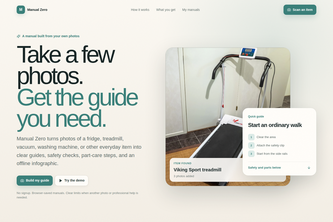
ManualZero is a self-reported product that uses GPT-5.6 and multimodal image analysis to generate structured, safety-focused guides from household item photos. It allows users to upload images of an item, its controls, and model label, then outputs a guide with repair help, safety steps, offline manual export, and follow-up question support.
What changed
The project is presented as a hackathon submission (Devpost entry for OpenAI 2026 hackathon). It is not evidenced to have launched or scaled beyond the author’s own development and demo environment.
Single most important open question
Is there any evidence of real-world usage, customer feedback, or traction beyond the author's own demonstration?
What The Product Actually Is
The description states that ManualZero turns photos of a household item into structured guides using GPT-5.6. It includes:
- A guided capture flow for full item, controls, and model label.
- Safety steps before action.
- Repair menu with movable 2.5D item view.
- Follow-up questions grounded in the current manual.
- Offline manual export (one-page).
- Use of GPT Image for infographic examples.
The app is built using Next.js, React, TypeScript, and integrates with GPT-5.6 via OpenAI API. It uses server-side image normalization and structured data validation (via Zod) before rendering in the UI.
Inference The product appears to be a proof-of-concept or prototype, not a commercial offering.
Positioning & Claim Evolution
The author states that ManualZero addresses the problem of missing manuals, where labels are hard to read and repair questions become unsafe guesswork. It positions itself as a tool that turns item photos into clear, safety-first guides.
Claim
It aims to be a replacement for traditional product manuals by leveraging AI-generated content from visual inputs.
Inference The positioning is focused on consumer use cases (household items), not enterprise or B2B.
Target Customer & ICP
Not evidenced. The description does not identify specific customer segments, personas, or ideal customer profiles beyond general household users who may need repair help.
Business Model & Pricing Evidence
Not evidenced. There is no mention of pricing, monetization strategy, or business model in the self-reported description.
Technical & Delivery Signals
The app is built with:
- Frontend: Next.js, React, TypeScript
- Backend: Server routes for image processing (Sharp), GPT-5.6 API integration
- Data Validation: Zod schema validation
- Storage: Vercel Blob storage, IndexedDB vault for offline use
- Deployment: Vercel
- Testing & CI/CD: Playwright browser coverage, Vitest tests, deterministic fixtures
The app uses multimodal analysis to reconcile evidence from full-item, control, and label photos. It stores guides as structured data rather than prose.
Inference The technical stack suggests a modern web application with offline capabilities and robust validation. However, no production deployment or scaling signals are evident.
Traction & Maturity Signals
Not evidenced. No data on users, customers, adoption, revenue, or usage metrics is provided. The project is described as a hackathon submission.
Competitive Context
Not evidenced. There is no mention of competitors or market positioning beyond the self-reported problem statement.
Open Questions & Risks
- Unverified claims: The description is entirely self-reported and unverified.
- No traction evidence: No customers, revenue, or usage data are provided.
- Prototype nature: The product appears to be a hackathon prototype, not a commercial offering.
- Limited scope: The demo only covers a few item types (washing machine, treadmill), with no indication of broader applicability.
- Safety boundaries: While the description mentions safety steps, it does not provide evidence of how these are enforced or tested in practice.
Questions the description leaves open
- What is the actual user feedback or testing done beyond the demo?
- Are there any real-world use cases or early adopters?
- How is the structured guide data validated for accuracy and safety?
- Is there a plan to scale beyond the current prototype?
- What are the technical limitations of GPT-5.6 in this context, and how are they mitigated?
Overall Assessment
Not evidenced. No financials, traction, or commercial viability data are provided. The project is described as a hackathon submission with no indication of a path to market or commercialization.
Confidence Low. This is a self-reported prototype with no evidence of real-world adoption or revenue generation.
User Stories BotA demo video on every pull request
Get a demo video on every new feature
GitHub App that watches your pull requests and records a narrated, captioned demo.
Save time on demo prep and make informed decisions faster with a video walkthrough of every new feature.
Source
Submitted to the OpenAI 2026 hackathon on Devpost. Project home on Devpost. Back to the full gallery on Devpost.
This competitive analysis was produced by top-founders.com (opens in a new tab)
Generated by a language model from this project's public Devpost page — its tagline, the author's own write-up and any built-with tags listed there — as captured in August 2026. Short quotations are the author's words. It is an opinion on the idea as a business, not on the people behind it, and it reflects the description as published then. If the project has moved on, request a correction below. The analysis is not independent research and contains no verified traction, revenue or customer data.
An independent guide by KFG International LLC — not affiliated with, endorsed by, or connected to Devpost or OpenAI.