

Archive position — measured, not model output
0 likes on Devpost
2,263 of the 7,850 archived projects have more likes, and 5,587 share exactly 0 — so this project's #5,137 place in the like-ranked listing is a tie-break inside that group, not a ranking.
Projects (log scale)
Likes on Devpost. ▲ marks this project's group.
Show the figures
| Likes | Projects | Share of archive |
|---|---|---|
| 0 | 5,587 | 71.2% |
| 1 | 1,758 | 22.4% |
| 2 | 284 | 3.6% |
| 3–4 | 132 | 1.7% |
| 5–9 | 75 | 1.0% |
| 10+ | 14 | 0.2% |
 User Stories BotA demo video on every pull request
Get a demo video on every new feature
GitHub App that watches your pull requests and records a narrated, captioned demo.
Save time on demo prep and make informed decisions faster with a video walkthrough of every new feature.
Executive Summary
What the company appears to be
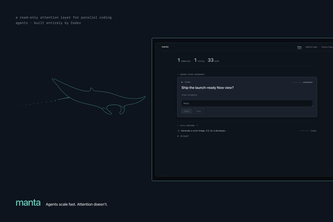
Manta is a self-reported local, read-only attention layer over agent sessions (e.g., Codex and Claude). It claims to guard human judgment by managing attention in the age of parallel agents, allowing users to decide rather than supervise.
What changed
The project was built as part of an OpenAI 2026 hackathon submission. The authors describe it as a tool that watches itself being built using Codex (GPT-5.6), and they claim it is designed to reduce compulsive checking and improve human-agent collaboration through structured attention management.
Single most important open question
Is there any evidence of real-world usage or adoption beyond the hackathon context? The description states no revenue, customers, or traction data are available.
What The Product Actually Is
The description states that Manta is a local, read-only attention layer over agent sessions, specifically targeting tools like Codex and Claude. It processes session logs into explainable state without LLM guessing, identifying what each thread is doing, whether it's waiting on judgment or permission, and whether anything is truly on fire.
It includes:
- A derivation engine turning raw logs into structured claims with evidence (seq + excerpt)
- A metronome that serves interventions at the user’s rhythm
- One write action: send a decision back into parked sessions via
codex exec resume - A freshness check to prevent stale replies from landing on questions already moved past
- A close-out screen that only says “safe to close” when it is literally true
The product is described as being built entirely by Codex (GPT-5.6), with each chaptered session logged in docs/LOG.md. The authors also note that the demo's "send a reply back into the session" moment was first exercised on the very session that built it.
Inference Manta is not a standalone product but rather an interface or middleware for managing attention across multiple agent sessions, designed to reduce human overhead in complex workflows involving AI agents.
Positioning & Claim Evolution
The description states:
- Manta guards human judgment in the age of parallel agents.
- It aims to shift from supervision to decision-making.
- Attention doesn’t scale like agents do — this is the core problem it addresses.
- The name "Manta" reflects calm movement through deep water.
Claim
Manta positions itself as a solution for managing attention overload when working with multiple AI agents simultaneously.
Inference This is a conceptual positioning statement rooted in personal experience and design intent, not validated by usage or market feedback.
Target Customer & ICP
The description does not specify a defined customer segment beyond the author’s own use case — a designer who ships through coding agents. It mentions:
- The user runs 3–5 Codex and Claude Code sessions daily.
- The bottleneck was no longer the models but the human attention.
Inference Based on the author's experience, Manta likely targets individuals working in roles that involve heavy interaction with AI agents — such as developers or designers using agent-based workflows. However, there is no evidence of a broader target market or ICP defined beyond this single user story.
Business Model & Pricing Evidence
Not evidenced.
The description does not contain any information about pricing models, monetization strategies, or business model assumptions. No mention of subscriptions, licensing, or revenue streams.
Technical & Delivery Signals
The project was built using:
- Tools: chokidar, codex, css-modules, express.js, gpt-5.6, node.js, react, server-sent-events, typescript, vite
- Methodology: Each line of code written by Codex (GPT-5.6) across chaptered sessions
- Log handling: Session logs have no format contract; 1.4GB of logs required byte-offset incremental tailing
Inference The technical stack and approach suggest a lightweight, local-first solution built with modern web technologies and AI-assisted development. However, the lack of production-grade infrastructure or scalability details is notable.
Traction & Maturity Signals
Not evidenced.
There is no mention of:
- Customers
- Revenue
- Usage metrics
- Product adoption beyond the hackathon
- Any form of traction or growth data
The project was submitted to a hackathon, and the description explicitly states that no revenue, customer, or traction data are available beyond what the authors state.
Competitive Context
Not evidenced.
There is no discussion of competitors, market positioning relative to existing tools, or competitive landscape. The description focuses entirely on internal design decisions and personal experience rather than external context.
Open Questions & Risks
- No evidence of traction or adoption: The project was built for a hackathon and lacks any indication of real-world usage.
- Unverified claims: All descriptions are self-reported and unverifiable.
- Limited scope: The tool appears to be tailored for a narrow use case (designers/developers using Codex/Claude).
- Self-built with AI tools: While innovative, this raises questions about whether the solution is scalable or generalizable beyond its creator’s specific workflow.
- No pricing or monetization strategy: No indication of how the product would be commercialized.
Questions the description leaves open
- What real-world workflows does Manta support outside of your own use case?
- How do you plan to scale attention management beyond a single user?
- Are there any early adopters or users who have tested this in practice?
- What are the key assumptions behind the product’s design, and how might they evolve?
- Is there a roadmap for integrating with other agent platforms (e.g., Claude, GitHub Copilot)?
- How do you intend to monetize Manta if it becomes a viable product?
Overall Assessment
Not evidenced.
There is no evidence of revenue, customer traction, or financial performance. The project is described as a hackathon submission with no indication of commercial viability or strategic value beyond its conceptual novelty. Any potential investment or partnership opportunity would depend on further validation of the product-market fit and scalability beyond the author’s personal workflow.
User Stories BotA demo video on every pull request
Get a demo video on every new feature
GitHub App that watches your pull requests and records a narrated, captioned demo.
Save time on demo prep and make informed decisions faster with a video walkthrough of every new feature.
Source
Submitted to the OpenAI 2026 hackathon on Devpost. Project home on Devpost. Back to the full gallery on Devpost.
This competitive analysis was produced by top-founders.com (opens in a new tab)
Generated by a language model from this project's public Devpost page — its tagline, the author's own write-up and any built-with tags listed there — as captured in August 2026. Short quotations are the author's words. It is an opinion on the idea as a business, not on the people behind it, and it reflects the description as published then. If the project has moved on, request a correction below. The analysis is not independent research and contains no verified traction, revenue or customer data.
An independent guide by KFG International LLC — not affiliated with, endorsed by, or connected to Devpost or OpenAI.