

Archive position — measured, not model output
0 likes on Devpost
2,263 of the 7,850 archived projects have more likes, and 5,587 share exactly 0 — so this project's #5,127 place in the like-ranked listing is a tie-break inside that group, not a ranking.
Projects (log scale)
Likes on Devpost. ▲ marks this project's group.
Show the figures
| Likes | Projects | Share of archive |
|---|---|---|
| 0 | 5,587 | 71.2% |
| 1 | 1,758 | 22.4% |
| 2 | 284 | 3.6% |
| 3–4 | 132 | 1.7% |
| 5–9 | 75 | 1.0% |
| 10+ | 14 | 0.2% |
 User Stories BotA demo video on every pull request
Get a demo video on every new feature
GitHub App that watches your pull requests and records a narrated, captioned demo.
Save time on demo prep and make informed decisions faster with a video walkthrough of every new feature.
Executive Summary
Project: Make My Circuit
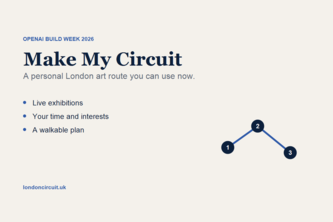
Author's Self-Description: A Next.js app built for the OpenAI 2026 hackathon that helps users plan a walking route through London’s live art exhibitions based on personal preferences and constraints.
Commercial Due-Diligence Read: The project is a self-contained, single-person hackathon product with no evidence of revenue, customers or traction beyond its author’s own account. It appears to be an experimental feature added to an existing product (The Circuit), using AI tools like Codex and GPT-5.6 for development. There is no indication of a scalable business model or commercial viability.
Key Open Question: What is the actual usage or adoption of this feature within The Circuit community, and how does it fit into any broader commercial strategy?
What The Product Actually Is
The description states that Make My Circuit is a planner feature added to an existing product called The Circuit, which already contains a live catalogue of London art exhibitions. The new functionality allows users to:
- Choose a date, starting area, start time, available time, artistic interest, and maximum walking distance.
- Receive a timed walking itinerary that includes:
- Exhibition stops
- Why each stop fits the user’s preferences
- A mapped route
- Integration with Google Maps
The feature recalculates the entire route when a stop is removed, rather than simply hiding it.
Inference: It is a browser-based planner built in React/Next.js and deployed on Vercel. The data model comes from Airtable, and mapping uses MapLibre and OpenStreetMap.
Positioning & Claim Evolution
The author claims that Make My Circuit was inspired by the need to answer a personal question: “if I am in Soho at 2pm, have two hours and want painting, what should I see without crossing London all afternoon?”
This suggests an evolution from a curated route (existing feature) to a personalized itinerary generator, intended for users who want flexibility within a structured experience.
The author also states that the feature works with the live exhibition catalogue and is already deployed in the public product.
Inference: The positioning seems to be that of an enhancement to an existing community platform, not a standalone commercial offering. It is framed as a tool for personalization within a niche audience (London art lovers).
Target Customer & ICP
The description states:
- The author runs a London art community of about 1,000 people.
- The Circuit already helps this group find exhibitions and follow curated gallery routes.
- Make My Circuit is intended for users who want to explore exhibitions based on their own time, location, and interests.
Inference: The target customer appears to be members of a specific community (the London art community) rather than a general public. It’s not clear if the product is open to others beyond this group or whether it has been scaled for broader use.
Business Model & Pricing Evidence
There is no evidence in the description of:
- Revenue streams
- Pricing models
- Monetization strategy
- Customer acquisition costs
- Any commercial relationships or partnerships
The author says that The Circuit already exists and that this feature was added to it, but does not describe how the product is monetized.
Inference: No business model is evident. The project appears to be a non-commercial prototype, possibly part of a hackathon submission.
Technical & Delivery Signals
- Built with: Next.js, React, Vercel, Airtable, MapLibre, OpenStreetMap, Codex, GPT-5.6
- Deployment: Vercel
- Data source: Airtable
- Core functionality: Timed itinerary generation based on user inputs and live exhibition data
- Testing: Automated tests are mentioned; verified on both mobile and desktop
Inference: The technical stack is standard for a modern web app. The use of AI tools like Codex and GPT-5.6 indicates that the author leveraged AI-assisted development, but there is no evidence of scalability or infrastructure beyond this single version.
Traction & Maturity Signals
The description states:
- The feature works with the live London catalogue
- It is already deployed in the public product
- It was tested and verified before submission to the hackathon
- The author plans to test it with Circuit members before expanding features
There is no evidence of:
- User adoption metrics
- Customer feedback or usage data
- Growth trends
- Product iteration history beyond this version
Inference: There is no traction or maturity signal beyond the fact that a prototype was built and deployed. The project does not appear to have moved past the experimental stage.
Competitive Context
The description does not mention:
- Competitors in the space of curated art exhibitions or walking route planners
- How The Circuit differentiates from other platforms
- Whether similar tools exist for city-based cultural exploration
Inference: No competitive context is provided. The project appears to be unique within its own niche, but there is no indication of broader market relevance.
Open Questions & Risks
- No commercial traction or revenue evidence
- Single-person development — no team, no external validation
- Limited scope: Only supports art exhibitions in London
- Unverified usage: No data on how many users actually use the feature
- Hackathon origin: Likely not built for long-term product maturity or scalability
Inference: The project is a proof-of-concept, not a scalable business. It lacks any commercial viability indicators.
Questions the description leaves open
- What is the actual usage of this feature within The Circuit community?
- How many people are actively using The Circuit, and how often do they use this planner?
- Is there a plan to monetize or scale this beyond the current London art community?
- Has the feature been tested with users outside the author’s network?
- What is the long-term vision for this product — is it part of a larger roadmap?
Overall Assessment
Not evidenced: There is no evidence that this project has any commercial traction, revenue, or scalability potential beyond its single-person hackathon prototype.
Inference: This is not a viable investment or partnership opportunity at this stage. It is a personal experiment, not a product with demonstrated market demand or business model.
User Stories BotA demo video on every pull request
Get a demo video on every new feature
GitHub App that watches your pull requests and records a narrated, captioned demo.
Save time on demo prep and make informed decisions faster with a video walkthrough of every new feature.
Source
Submitted to the OpenAI 2026 hackathon on Devpost. Project home on Devpost. Back to the full gallery on Devpost.
This competitive analysis was produced by top-founders.com (opens in a new tab)
Generated by a language model from this project's public Devpost page — its tagline, the author's own write-up and any built-with tags listed there — as captured in August 2026. Short quotations are the author's words. It is an opinion on the idea as a business, not on the people behind it, and it reflects the description as published then. If the project has moved on, request a correction below. The analysis is not independent research and contains no verified traction, revenue or customer data.
An independent guide by KFG International LLC — not affiliated with, endorsed by, or connected to Devpost or OpenAI.