

Archive position — measured, not model output
0 likes on Devpost
2,263 of the 7,850 archived projects have more likes, and 5,587 share exactly 0 — so this project's #5,129 place in the like-ranked listing is a tie-break inside that group, not a ranking.
Projects (log scale)
Likes on Devpost. ▲ marks this project's group.
Show the figures
| Likes | Projects | Share of archive |
|---|---|---|
| 0 | 5,587 | 71.2% |
| 1 | 1,758 | 22.4% |
| 2 | 284 | 3.6% |
| 3–4 | 132 | 1.7% |
| 5–9 | 75 | 1.0% |
| 10+ | 14 | 0.2% |
 User Stories BotA demo video on every pull request
Get a demo video on every new feature
GitHub App that watches your pull requests and records a narrated, captioned demo.
Save time on demo prep and make informed decisions faster with a video walkthrough of every new feature.
Executive Summary
What the company appears to be
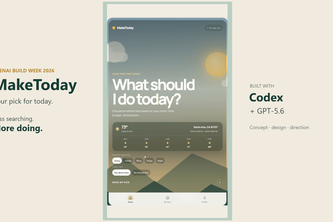
MakeToday is a self-reported personal activity recommendation app built by one person (Conrad Damrau) using AI tools like Codex and GPT-5.6. It offers three personalized activity suggestions based on user inputs such as mood, time, budget, location, and weather. The app includes features like a "My Days" journal for logging activities and optional sharing.
What changed
The project is described as a prototype built during a hackathon (OpenAI 2026), with no evidence of prior development or commercial traction. It currently uses curated data and simulated inputs rather than live services.
Single most important open question
Is there any evidence that users are engaging with the app beyond its prototype stage, or that it has moved beyond a one-person experimental project?
Note: This analysis is based entirely on self-reported information from the author. No independent verification, revenue, customer data, or traction metrics are available.
What The Product Actually Is
The description states that MakeToday is an app that gives users three personalized activity recommendations based on their current situation. It allows customization using factors like mood, time, budget, location, and preferred travel method.
It includes:
- A recommendation engine that evaluates user inputs
- Simulated or curated data (e.g., places, weather, travel times)
- Local browser storage for preferences and usage history
- A "My Days" journal feature to log completed activities
The app is built as a mobile-first web experience using Next.js, TypeScript, Tailwind CSS, and React.
Inference: The product appears to be a lightweight, AI-assisted prototype with no live data integration or user accounts at this stage. It is not described as a commercial service or platform.
Positioning & Claim Evolution
The author positions MakeToday as a solution for people who struggle with decision-making or feeling stuck between wanting to do something and figuring out what to do. The app aims to reduce the burden of choosing by tailoring suggestions to the user's actual situation.
Key claims:
- It removes overwhelm from abundance of options.
- It provides flexibility while avoiding long lists.
- It helps users get started more easily, especially those with anxiety or decision fatigue.
- It offers a simple interface that doesn’t feel like another chore.
Claim vs Fact: These are self-reported intentions and perceived benefits. There is no evidence of user feedback, adoption rates, or behavioral data to confirm these claims.
Target Customer & ICP
The author describes the target audience as:
- People who struggle with decision-making
- Those who find it hard to get started doing something
- Individuals dealing with anxiety or decision fatigue
They note that it may be especially useful for people who "struggle more with decision-making, anxiety, or finding the push to get out and do something."
Inference: The app seems aimed at a broad but underserved segment of users looking for low-effort activity suggestions. No specific persona or segmentation beyond general psychological traits is described.
Business Model & Pricing Evidence
There is no evidence in the description of any business model, pricing strategy, monetization plan, or revenue streams. The project is presented as a prototype built during a hackathon and does not mention subscriptions, ads, partnerships, or paid features.
Not evidenced: No indication of how the product would generate value or income.
Technical & Delivery Signals
The app was built using:
- AI tools (Codex, GPT-5.6)
- Technologies: Next.js, TypeScript, Tailwind CSS, React, Playwright, Vitest, Vercel
- Local storage for data persistence
- Browser-based UI with mobile-first design
It uses deterministic local recommendation logic and simulated inputs rather than live APIs or databases.
Inference: The technical stack suggests a lightweight, frontend-heavy prototype. There is no evidence of backend infrastructure, scalability planning, or integration with external services.
Traction & Maturity Signals
The project has:
- No reported users, customers, or adoption metrics
- No revenue or monetization data
- No mention of growth, retention, or usage statistics
- Is described as a prototype built in a hackathon context
Not evidenced: There is no evidence of traction, user engagement, or product-market fit beyond the author’s own account.
Competitive Context
There are no references to competitors or existing solutions in the description. The author does not compare MakeToday to similar apps or platforms that offer activity recommendations or decision support tools.
Not evidenced: No competitive landscape or differentiation analysis is provided.
Open Questions & Risks
- Single-person development: The entire project was built by one person (Conrad Damrau), raising questions about scalability, long-term maintenance, and team capacity.
- Prototype-only status: The app is described as a curated prototype without live data or real-world integration.
- No commercial viability: No evidence of monetization, business model, or user base.
- AI dependency: Heavy reliance on AI tools (Codex, GPT) raises concerns about reproducibility and control over the product if those tools change or become unavailable.
Inference: The lack of traction, revenue, or team structure suggests a high risk of failure unless significant progress is made post-hackathon.
Questions the description leaves open
- What specific user feedback have you received about the prototype?
- Are there any plans to integrate live data sources (e.g., weather APIs, place databases)?
- How do you plan to scale beyond a single developer?
- Have you tested the app with real users outside of your own testing?
- Is there any intention to monetize or build a sustainable business model?
- What are the key assumptions behind the recommendation logic, and how will they evolve?
Overall Assessment
At this stage, MakeToday is a self-reported prototype built by one individual during a hackathon. There is no evidence of traction, revenue, or commercial viability.
Assessment: Not ready for investment or partnership consideration without further development, user testing, and proof of concept. The project lacks any demonstrated market demand or business model.
User Stories BotA demo video on every pull request
Get a demo video on every new feature
GitHub App that watches your pull requests and records a narrated, captioned demo.
Save time on demo prep and make informed decisions faster with a video walkthrough of every new feature.
Source
Submitted to the OpenAI 2026 hackathon on Devpost. Project home on Devpost. Back to the full gallery on Devpost.
This competitive analysis was produced by top-founders.com (opens in a new tab)
Generated by a language model from this project's public Devpost page — its tagline, the author's own write-up and any built-with tags listed there — as captured in August 2026. Short quotations are the author's words. It is an opinion on the idea as a business, not on the people behind it, and it reflects the description as published then. If the project has moved on, request a correction below. The analysis is not independent research and contains no verified traction, revenue or customer data.
An independent guide by KFG International LLC — not affiliated with, endorsed by, or connected to Devpost or OpenAI.