

Archive position — measured, not model output
0 likes on Devpost
2,263 of the 7,850 archived projects have more likes, and 5,587 share exactly 0 — so this project's #7,090 place in the like-ranked listing is a tie-break inside that group, not a ranking.
Projects (log scale)
Likes on Devpost. ▲ marks this project's group.
Show the figures
| Likes | Projects | Share of archive |
|---|---|---|
| 0 | 5,587 | 71.2% |
| 1 | 1,758 | 22.4% |
| 2 | 284 | 3.6% |
| 3–4 | 132 | 1.7% |
| 5–9 | 75 | 1.0% |
| 10+ | 14 | 0.2% |
 User Stories BotA demo video on every pull request
Get a demo video on every new feature
GitHub App that watches your pull requests and records a narrated, captioned demo.
Save time on demo prep and make informed decisions faster with a video walkthrough of every new feature.
Executive Summary
SynergySplit is a self-reported household coordination platform built for shared living spaces such as roommates, couples, families, and shared homes. The product claims to use game theory principles and AI-assisted tools to promote fair contributions through transparent reward systems, private reminders, and structured conflict resolution.
The project is described as a hackathon submission with no evidence of revenue, customers, or traction beyond its demonstration state. It uses Next.js and OpenAI technologies but does not provide any data on adoption, usage, or monetization.
Key commercial due-diligence read
The description presents a conceptual framework for household coordination using reputation tokens and AI mediation, but lacks evidence that this model has been tested in real-world settings or validated by users. There is no indication of product-market fit, customer feedback loops, or business sustainability beyond the initial prototype.
What The Product Actually Is
The description states that SynergySplit is a game-theoretic coordination platform for shared living environments. It combines:
- Chores management
- Bill tracking and payment
- Contribution history and fairness analysis
- AI-assisted private reminders
- Structured conflict resolution via an AI mediator (Household Council)
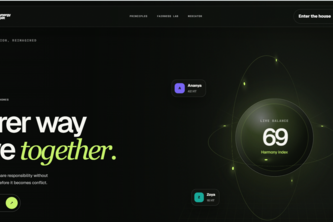
- Reputation-based reward system using Harmony Tokens (HT)
It is built with React 19, TypeScript, Cloudflare Workers, and integrates OpenAI APIs for mediation and council generation.
Inference The product appears to be a prototype or proof-of-concept, not a production-ready service. It includes mechanisms like deterministic accounting logic and bounded AI use, suggesting an intentional design to separate core functionality from probabilistic reasoning.
Positioning & Claim Evolution
The description positions SynergySplit as a solution to repeated-game coordination problems in shared households where fairness is difficult to maintain due to invisible work, unequal bill payments, and confrontational reminders.
It claims to make household coordination fair through:
- Transparent rewards
- AI-assisted agreements
- Respectful private reminders
- Reputation signals that do not become surveillance systems
The author states the platform was inspired by game theory and aims to encourage cooperation without turning homes into surveillance environments.
Inference The positioning reflects a conceptual shift from traditional task management tools toward a more behavioral economics-driven model. However, there is no evidence of prior market testing or user validation of these claims.
Target Customer & ICP
The description identifies the target audience as:
- Roommates
- Couples
- Families
- Shared homes
These are described as users who struggle with coordination issues related to chores, bills, and contributions.
Inference The ICP seems to be household members in shared living arrangements, particularly those seeking structured fairness mechanisms. No specific demographic or psychographic segmentation is provided beyond the shared living context.
Business Model & Pricing Evidence
There is no evidence of pricing, monetization strategy, or business model in the description. The platform uses Harmony Tokens (HT), which are non-transferable and have no monetary value.
The system does not appear to involve any financial transactions or subscription fees. It is described as a demo-only tool, with no indication of how it would scale into a commercial offering.
Inference The business model remains undefined. The platform may be intended for internal use only or as part of a larger ecosystem that has yet to be defined.
Technical & Delivery Signals
The project was built using:
- Frontend: React 19, TypeScript
- Backend: Cloudflare Workers, Vinext/Vite
- Database: Cloudflare D1
- AI Integration: OpenAI GPT-5.6 APIs for mediation and council generation
- Architecture: Separation between deterministic engine (accounting, rewards) and bounded AI layer (reminders, agreements)
It includes features like:
- Structured API surfaces (/api/household, /api/nudge, /api/council)
- Resilient model cascade with fallbacks
- Exportable reports
- 3D visualizations for Harmony Core
Inference The architecture suggests a modular and intentional design, separating core logic from AI components. This indicates awareness of safety and scalability concerns.
Traction & Maturity Signals
There is no evidence of traction, revenue, or customer adoption beyond the demonstration state. The project is described as a hackathon submission (submitted to OpenAI 2026 hackathon), with no mention of user feedback, retention metrics, or product iteration history.
The description mentions:
- Resettable demo mode
- Exportable structured reports
- Structured household activity history
But does not indicate any live deployment, usage statistics, or real-world testing.
Inference The platform is at a very early stage, likely in prototype or MVP phase. No signs of product-market fit or user engagement are evident.
Competitive Context
The description does not mention direct competitors or competitive positioning. It implies that existing tools lack transparency in rewards and do not support fair, game-theoretic coordination.
However, no comparison to other household coordination platforms (e.g., Cozi, OurHome, Roomi) is made.
Inference The competitive landscape is unclear. The product may be unique in its approach, but without market data or competitor analysis, it's impossible to assess whether this innovation addresses a real gap or is merely conceptual.
Open Questions & Risks
- No traction or revenue: The platform is described as a demo-only tool with no evidence of real-world usage.
- Unproven game theory implementation: While the reward system is mathematically defined, there’s no evidence that such a model works in practice.
- AI dependency without clear safeguards: Although AI is used only where it adds value, the reliance on GPT-5.6 raises questions about consistency and control.
- Lack of monetization strategy: No indication of how the platform would generate revenue or sustain operations beyond the prototype stage.
- Self-reported nature: All claims are unverified; no third-party validation or user feedback is provided.
Inference The project presents a conceptual framework with potential, but lacks critical signals of viability, adoption, or scalability.
Questions the description leaves open
- What real-world scenarios were tested during development? Were there any users beyond the team?
- How does the system handle edge cases where members disagree on effort or timeliness?
- Is there a plan to transition from demo mode to a functional, scalable product?
- How is the fairness score calculated and interpreted by users? What feedback has been received?
- What are the long-term plans for AI integration and data privacy compliance?
- Are there any existing partnerships or pilot programs with shared living communities?
Overall Assessment
The description indicates that SynergySplit is a conceptual prototype submitted to a hackathon, with no evidence of traction, revenue, or customer validation.
There is no indication of:
- Product-market fit
- User feedback loops
- Scalable architecture
- Monetization strategy
Assessment Not ready for investment or partnership at this time. The idea shows promise in addressing coordination challenges through game theory and AI, but lacks the foundational signals required to assess commercial viability.
The project is self-reported, unverified, and based on a limited scope of evidence — essentially a proof-of-concept rather than a product in development.
User Stories BotA demo video on every pull request
Get a demo video on every new feature
GitHub App that watches your pull requests and records a narrated, captioned demo.
Save time on demo prep and make informed decisions faster with a video walkthrough of every new feature.
Source
Submitted to the OpenAI 2026 hackathon on Devpost. Project home on Devpost. Back to the full gallery on Devpost.
This competitive analysis was produced by top-founders.com (opens in a new tab)
Generated by a language model from this project's public Devpost page — its tagline, the author's own write-up and any built-with tags listed there — as captured in August 2026. Short quotations are the author's words. It is an opinion on the idea as a business, not on the people behind it, and it reflects the description as published then. If the project has moved on, request a correction below. The analysis is not independent research and contains no verified traction, revenue or customer data.
An independent guide by KFG International LLC — not affiliated with, endorsed by, or connected to Devpost or OpenAI.