

Archive position — measured, not model output
0 likes on Devpost
2,263 of the 7,850 archived projects have more likes, and 5,587 share exactly 0 — so this project's #5,128 place in the like-ranked listing is a tie-break inside that group, not a ranking.
Projects (log scale)
Likes on Devpost. ▲ marks this project's group.
Show the figures
| Likes | Projects | Share of archive |
|---|---|---|
| 0 | 5,587 | 71.2% |
| 1 | 1,758 | 22.4% |
| 2 | 284 | 3.6% |
| 3–4 | 132 | 1.7% |
| 5–9 | 75 | 1.0% |
| 10+ | 14 | 0.2% |
 User Stories BotA demo video on every pull request
Get a demo video on every new feature
GitHub App that watches your pull requests and records a narrated, captioned demo.
Save time on demo prep and make informed decisions faster with a video walkthrough of every new feature.
Executive Summary
What the company appears to be
MakerTA is a self-reported educational tool designed to support open-ended maker classes in classrooms, particularly for robotics education. The author describes it as an AI teaching assistant that helps teachers guide multiple student groups through hands-on building projects using low-cost materials.
What changed
The project description indicates this is a prototype built for the OpenAI 2026 hackathon. It represents a self-reported attempt to address challenges in maker education by integrating AI into a local-first, low-budget system that supports both student experimentation and teacher oversight.
Single most important open question
Does MakerTA actually improve classroom management or learning outcomes in real-world use, or is it a conceptual prototype with no demonstrated traction?
What The Product Actually Is
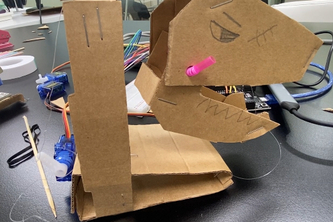
The description states that MakerTA is a local-first prototype with two views: a student workspace and a teacher dashboard. It runs on a four-session maker curriculum where students start with a shared build and then explore open-ended modifications.
- The student side operates through a structured loop: problem, hypothesis, experiment, observation, next step.
- The teacher dashboard summarizes what each group is building, what they've tried, and where human intervention is needed.
- It uses Arduino-based hardware (SG90 servos, ESP32) and runs locally to avoid network restrictions in schools.
The system is described as not treating the conversation as a chat log but instead turning it into structured events grouped by team and ordered for summary.
Inference The product appears to be an early-stage prototype built for demonstration purposes rather than production deployment. It has no evidence of being used beyond the hackathon context.
Positioning & Claim Evolution
The author positions MakerTA as:
- An AI teaching assistant that supports open-ended maker classes.
- A tool that allows one teacher to manage multiple groups without sacrificing student creativity or learning depth.
- A way to make robotics education more accessible by using low-cost materials and avoiding expensive kits.
Claims include:
- AI should help teachers guide students, not do the work for them.
- The system lets kids fail cheaply while still learning from failure.
- It maintains manageability of shared kits while allowing personalization.
Inference This is a conceptual positioning statement, not evidence of adoption or impact. The author frames it as an educational innovation but provides no data on effectiveness, usage, or market traction.
Target Customer & ICP
The description states that MakerTA targets:
- Classroom settings, particularly those involving hands-on robotics education.
- Students aged roughly Grade 5 to first-year middle school.
- Teachers who want to support open-ended maker activities but struggle with managing multiple groups.
There is no mention of specific institutions, districts, or broader customer segments beyond general classroom use.
Inference The ICP seems to be educators in K–12 settings, especially those teaching robotics or maker-based curricula. However, there's no evidence of actual customers or institutional partnerships.
Business Model & Pricing Evidence
There is no evidence provided about pricing, monetization, or business model. The author describes the project as a hackathon submission and does not mention any commercial plans, revenue streams, or customer acquisition strategies.
Inference No business model or pricing data are available from the description — this remains uncharted territory for this analysis.
Technical & Delivery Signals
The system is described as:
- Built with local-first architecture, meaning it runs without internet access.
- Uses Arduino hardware (SG90 servos, ESP32) and software tools like Codex.
- Implements a structured event loop rather than chat-based interaction.
- Designed to handle multiple student teams simultaneously.
The author notes that the physical build was harder than expected and required iterative prototyping. The AI component is said to help with data flow and interface design, but no details on AI model or training are given.
Inference Technical implementation appears experimental and focused on solving classroom-specific constraints (local operation, low-cost hardware). No evidence of scalability, robustness, or deployment beyond prototype stage.
Traction & Maturity Signals
The description states:
- This is a hackathon submission (OpenAI 2026).
- The author built it alone.
- It was tested in their own classroom setting.
- There are no mentions of users, customers, or adoption metrics.
Inference No traction or maturity signals exist. This is clearly an early-stage prototype with no evidence of real-world usage or impact.
Competitive Context
There is no mention of competitors or existing solutions in the maker education space. The author does not reference other platforms, tools, or systems used for classroom robotics or maker learning.
Inference No competitive landscape information is provided — this makes it difficult to assess positioning or differentiation.
Open Questions & Risks
Key risks and open questions include:
- No commercial traction or adoption: The project is described as a hackathon prototype with no evidence of real-world use.
- Unproven educational impact: There’s no data on whether the system improves learning outcomes or classroom efficiency.
- Limited scalability: The author built it alone, using low-cost materials, suggesting limited infrastructure for scaling.
- No pricing or monetization strategy: No indication of how this would be commercialized if developed further.
- Self-reported nature: All claims are unverified and based on the author’s own account.
Inference The lack of any measurable impact, customer base, or business model raises significant concerns about viability beyond the prototype phase.
Questions the description leaves open
- What specific educational outcomes have you observed in your classroom testing?
- How do you plan to scale this beyond a single teacher and small group setting?
- Have you identified any potential institutional partners or schools willing to test this system?
- What are the technical limitations of running locally versus cloud-based solutions?
- Are there any plans for monetization or commercialization beyond the prototype?
- How do you intend to ensure that AI responses remain age-appropriate and pedagogically sound?
Overall Assessment
Not evidenced: There is no evidence of revenue, customers, traction, or financial performance. The project is described as a hackathon submission with no indication of commercial readiness or market validation.
Confidence level: Very low — this is a self-reported prototype with no external verification or data to support claims of impact, scalability, or viability.
Assessment: At this stage, MakerTA appears to be an experimental idea with strong conceptual appeal for educational innovation. However, without evidence of traction, adoption, or business model, it cannot be considered a viable investment or partnership opportunity at present.
User Stories BotA demo video on every pull request
Get a demo video on every new feature
GitHub App that watches your pull requests and records a narrated, captioned demo.
Save time on demo prep and make informed decisions faster with a video walkthrough of every new feature.
Source
Submitted to the OpenAI 2026 hackathon on Devpost. Project home on Devpost. Back to the full gallery on Devpost.
This competitive analysis was produced by top-founders.com (opens in a new tab)
Generated by a language model from this project's public Devpost page — its tagline, the author's own write-up and any built-with tags listed there — as captured in August 2026. Short quotations are the author's words. It is an opinion on the idea as a business, not on the people behind it, and it reflects the description as published then. If the project has moved on, request a correction below. The analysis is not independent research and contains no verified traction, revenue or customer data.
An independent guide by KFG International LLC — not affiliated with, endorsed by, or connected to Devpost or OpenAI.