

Archive position — measured, not model output
1 like on Devpost
505 of the 7,850 archived projects have more likes, and 1,758 share exactly 1 — so this project's #1,204 place in the like-ranked listing is a tie-break inside that group, not a ranking.
Projects (log scale)
Likes on Devpost. ▲ marks this project's group.
Show the figures
| Likes | Projects | Share of archive |
|---|---|---|
| 0 | 5,587 | 71.2% |
| 1 | 1,758 | 22.4% |
| 2 | 284 | 3.6% |
| 3–4 | 132 | 1.7% |
| 5–9 | 75 | 1.0% |
| 10+ | 14 | 0.2% |
 User Stories BotA demo video on every pull request
Get a demo video on every new feature
GitHub App that watches your pull requests and records a narrated, captioned demo.
Save time on demo prep and make informed decisions faster with a video walkthrough of every new feature.
Executive Summary
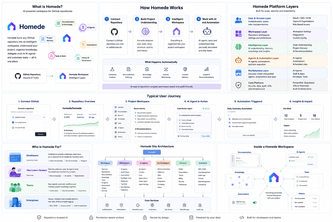
What the company appears to be: Homede is a self-reported platform that transforms GitHub repositories into intelligent workspaces, integrating AI, documentation, tasks, automation, and knowledge management. It positions itself as an extension of GitHub, not a replacement, aiming to help solo developers and “vibe coders” better understand, organize, and monetize their projects.
What changed: The author initially conceived Homede as a marketplace for discovering repositories but evolved it into a repository-centered workspace focused on understanding and organizing projects. This shift reflects a move from discovery to contextualization and tooling around GitHub repositories.
Single most important open question: Is there evidence of real user adoption or traction beyond the single developer who built the platform?
Note: All findings are based on self-reported, unverified information provided by the author. No third-party verification, revenue data, customer names, or usage metrics are available.
What The Product Actually Is
The description states that Homede turns GitHub repositories into intelligent project workspaces. It includes features such as:
- Repository-focused workspaces
- Project and repository discovery
- Documentation and knowledge management
- Repository memory
- Contextual AI assistance
- Specialised AI agents
- Multi-agent workflows
- Tasks and project organisation
- Event-driven automation
- Marketplace publishing and discovery
- GitHub integration
- Enterprise identity and licensing
- Access reviews and governance
- Audit history and evidence generation
The platform is described as not replacing GitHub but adding understanding, organization, and intelligent tools around it.
Claim: Homede builds a workspace on top of GitHub repositories.
Evidence: Author's own write-up.
Inference: The product appears to be a developer tool focused on improving project context and collaboration.
Label: Inferred from feature list and positioning.
Positioning & Claim Evolution
The author describes an evolution in the product’s purpose:
- Started as a marketplace for discovering repositories
- Evolved into an AI workspace that helps understand projects
- Later shifted to helping solo developers monetize their projects
- Eventually became a repository-centered workspace focused on understanding and organizing projects
The final positioning is that Homede is a layer over GitHub that makes repositories easier to discover, understand, and use.
Claim: The product evolved from marketplace to AI workspace to repository-centric workspace.
Evidence: Author’s own write-up.
Inference: This suggests the author iterated based on user needs or perceived value.
Label: Inferred from narrative of development.
Target Customer & ICP
The description states that Homede targets:
- Solo developers
- “Vibe coders”
- Independent developers who create software but struggle to make their projects visible or understandable
It also mentions that the goal is to help these users "monetize their projects" and "show their product in a way GitHub cannot."
Claim: The target customer is solo developers, vibe coders, and independent creators.
Evidence: Author’s own write-up.
Inference: These are likely early-stage or non-enterprise users with limited resources or visibility.
Label: Inferred from positioning.
Business Model & Pricing Evidence
There is no explicit mention of pricing, business model, or monetization strategy in the description. The author mentions that Homede allows developers to "monetize their projects" but does not elaborate on how this would be done.
Claim: Homede enables monetization of projects.
Evidence: Author’s own write-up.
Inference: This could imply a marketplace or SaaS model, but no details are given.
Label: Inferred from claim.
Technical & Delivery Signals
The platform was built incrementally using:
- Frontend: React, TypeScript, Vite
- Backend: Node.js, TypeScript
- Database: PostgreSQL, Supabase
- Infrastructure: Docker, PM2, Nginx
- AI tools used during development: GPT-5.6, Codex, Cursor, Claude, Grok
It integrates with GitHub via REST APIs and uses event-driven automation.
Claim: The platform is built using modern web and backend stacks.
Evidence: Author’s own write-up.
Inference: The use of AI tools like GPT-5.6 and Codex suggests a developer-centric approach to building.
Label: Inferred from tech stack and tooling mentioned.
Traction & Maturity Signals
The description does not contain any evidence of traction, customers, revenue, or usage metrics. It only describes the author’s personal journey in building the product over time.
Claim: No traction data is provided.
Evidence: Author’s own write-up.
Inference: The lack of traction signals suggests this is a prototype or early-stage project.
Label: Inferred from absence of evidence.
Competitive Context
There are no mentions of competitors or competitive positioning in the description. The author does not reference existing tools that solve similar problems, such as GitHub’s own features, GitBook, or other documentation and automation platforms.
Claim: No competitive context is provided.
Evidence: Author’s own write-up.
Inference: This could indicate either lack of awareness or early-stage development.
Label: Inferred from absence of evidence.
Open Questions & Risks
- Single developer team: The platform was built by one person, which raises concerns about scalability and long-term maintenance.
- No revenue or customer data: No evidence of monetization or user adoption.
- Unverified claims: All statements are self-reported without external validation.
- Unclear business model: While monetization is mentioned, no clear path to revenue is described.
- High technical complexity: The platform includes AI agents, multi-agent workflows, and enterprise governance features, which may be difficult to implement or maintain.
Claim: Risks include lack of traction, single developer team, unclear business model.
Evidence: Author’s own write-up.
Questions the description leaves open
- What specific problem are you solving for solo developers, and how do you know it exists?
- How do you plan to monetize the platform, and what is your go-to-market strategy?
- Have you validated your product with real users beyond yourself?
- What are the key technical challenges in scaling this platform?
- How do you intend to compete with existing tools like GitHub, GitBook, or Notion?
Overall Assessment
Not evidenced.
Claim: No investment or partnership assessment is possible without further data.
Evidence: Author’s own write-up.
Inference: The platform appears to be an early-stage idea with no demonstrated traction or business model.
Label: Inferred from lack of evidence.
User Stories BotA demo video on every pull request
Get a demo video on every new feature
GitHub App that watches your pull requests and records a narrated, captioned demo.
Save time on demo prep and make informed decisions faster with a video walkthrough of every new feature.
Source
Submitted to the OpenAI 2026 hackathon on Devpost. Project home on Devpost. Back to the full gallery on Devpost.
This competitive analysis was produced by top-founders.com (opens in a new tab)
Generated by a language model from this project's public Devpost page — its tagline, the author's own write-up and any built-with tags listed there — as captured in August 2026. Short quotations are the author's words. It is an opinion on the idea as a business, not on the people behind it, and it reflects the description as published then. If the project has moved on, request a correction below. The analysis is not independent research and contains no verified traction, revenue or customer data.
An independent guide by KFG International LLC — not affiliated with, endorsed by, or connected to Devpost or OpenAI.