

Archive position — measured, not model output
0 likes on Devpost
2,263 of the 7,850 archived projects have more likes, and 5,587 share exactly 0 — so this project's #5,107 place in the like-ranked listing is a tie-break inside that group, not a ranking.
Projects (log scale)
Likes on Devpost. ▲ marks this project's group.
Show the figures
| Likes | Projects | Share of archive |
|---|---|---|
| 0 | 5,587 | 71.2% |
| 1 | 1,758 | 22.4% |
| 2 | 284 | 3.6% |
| 3–4 | 132 | 1.7% |
| 5–9 | 75 | 1.0% |
| 10+ | 14 | 0.2% |
 User Stories BotA demo video on every pull request
Get a demo video on every new feature
GitHub App that watches your pull requests and records a narrated, captioned demo.
Save time on demo prep and make informed decisions faster with a video walkthrough of every new feature.
Executive Summary
What the company appears to be
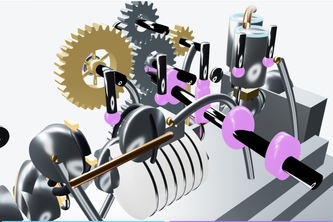
MACHINE DJ is a browser-based interactive experience that visualizes an EDM song as a mechanical system, where each musical stem controls a different mechanical component (e.g., pistons for drums, flywheels for bass). The user can interact with individual mechanisms to mute or re-enable sounds while maintaining synchronization. It was built by one person as part of the OpenAI 2026 hackathon.
What changed
The project is a self-contained prototype demonstrating an experimental interface between audio and mechanical visualization, using AI tools (Codex, GPT-5.6), 3D modeling (Blender), and web technologies (React, Three.js). It does not appear to have evolved into a commercial product or service.
Single most important open question
Is there any evidence of traction, revenue, or customer adoption beyond the author’s personal project? If not, what is the path to monetization or growth?
What The Product Actually Is
The description states that MACHINE DJ transforms one song into a transparent, interconnected machine. Each musical stem controls a different mechanical system:
- Drums drive reciprocating pistons.
- Bass turns a heavy flywheel.
- Chords move a camshaft and its followers.
- Lead travels through a pulley and belt transmission.
Users can press and hold a mechanism to temporarily stop its corresponding sound, or tap to latch it off and bring it back at the current playback position. The system uses synchronized audio stems and a shared timeline so that stopping one layer does not cause desynchronization.
The visual model was procedurally developed in Blender using Python and exported as a GLB file. It is rendered in a browser using React, TypeScript, Three.js, React Three Fiber, and the Web Audio API.
Inference This is an interactive demo or prototype, not a commercial product. The author notes that it was built for a hackathon and does not include any mention of ongoing development or deployment beyond GitHub Pages.
Positioning & Claim Evolution
The author states that MACHINE DJ explores the idea of understanding music not only through sound but also as a visible mechanical system. It is described as an attempt to make traditional DJ equipment more approachable by using AI and a browser-based interface.
Claim
MACHINE DJ aims to bridge the gap between audio and mechanical design, allowing users to "touch" parts of a machine while listening to music.
Inference The positioning appears to be experimental or artistic rather than commercial. There is no evidence of a target market beyond personal interest or educational use.
Target Customer & ICP
Not evidenced.
The description does not identify any specific customer segment, user persona, or ideal customer profile (ICP). The author describes their own background in manufacturing and love for EDM but does not define who would use this tool commercially or at scale.
Business Model & Pricing Evidence
Not evidenced.
There is no mention of pricing, monetization strategy, or business model. The project is presented as a personal prototype with no indication of how it might generate revenue or be sold.
Technical & Delivery Signals
The demo was built using:
- Tools: React, TypeScript, Three.js, React Three Fiber, Web Audio API
- 3D modeling: Blender (Python scripting)
- AI assistance: Codex running on GPT-5.6
- Deployment: GitHub Pages
- Audio stems: Generated with Mureka V9
The author notes challenges in synchronizing audio and visual elements, refining the Blender workflow, and ensuring mechanical coherence across systems.
Inference This is a technical prototype built by one developer using open-source tools and AI assistance. It lacks enterprise-grade infrastructure or scalability features.
Traction & Maturity Signals
Not evidenced.
There is no evidence of users, customers, downloads, or adoption beyond the author’s own description. The project was submitted to a hackathon and deployed via GitHub Pages; there is no indication of ongoing usage or product development.
Competitive Context
Not evidenced.
The description does not reference existing products or competitors in the space of audio-visualization tools or mechanical music interfaces. No market analysis or competitive positioning is provided.
Open Questions & Risks
- Single-person team: The project was built by one individual, raising questions about scalability and long-term maintenance.
- Prototype-only: No evidence of a production-ready version or roadmap beyond the hackathon demo.
- No commercialization path: There is no indication of how the idea might evolve into a product or service with revenue potential.
- Unverified claims: The author’s self-description contains speculative elements (e.g., “the long-term vision is a space where anyone can see, touch, and remix the hidden machinery inside their favorite rhythm”) that are not substantiated by data.
Questions the description leaves open
- What is your plan for transitioning from this prototype to a scalable product or service?
- Have you identified any potential user segments or markets for this type of tool?
- Are there any technical or legal barriers to expanding the scope (e.g., supporting uploaded songs, licensing audio)?
- How do you intend to monetize this concept if at all?
- What are your plans for ongoing development beyond the hackathon?
Overall Assessment
Not evidenced.
There is no evidence of funding rounds, valuation, or investment interest. The project remains a personal prototype with no indication of commercial traction or strategic value to investors or partners. Any potential for growth depends on whether the author intends to develop it further and how they plan to do so.
User Stories BotA demo video on every pull request
Get a demo video on every new feature
GitHub App that watches your pull requests and records a narrated, captioned demo.
Save time on demo prep and make informed decisions faster with a video walkthrough of every new feature.
Source
Submitted to the OpenAI 2026 hackathon on Devpost. Project home on Devpost. Back to the full gallery on Devpost.
This competitive analysis was produced by top-founders.com (opens in a new tab)
Generated by a language model from this project's public Devpost page — its tagline, the author's own write-up and any built-with tags listed there — as captured in August 2026. Short quotations are the author's words. It is an opinion on the idea as a business, not on the people behind it, and it reflects the description as published then. If the project has moved on, request a correction below. The analysis is not independent research and contains no verified traction, revenue or customer data.
An independent guide by KFG International LLC — not affiliated with, endorsed by, or connected to Devpost or OpenAI.