

Archive position — measured, not model output
0 likes on Devpost
2,263 of the 7,850 archived projects have more likes, and 5,587 share exactly 0 — so this project's #5,109 place in the like-ranked listing is a tie-break inside that group, not a ranking.
Projects (log scale)
Likes on Devpost. ▲ marks this project's group.
Show the figures
| Likes | Projects | Share of archive |
|---|---|---|
| 0 | 5,587 | 71.2% |
| 1 | 1,758 | 22.4% |
| 2 | 284 | 3.6% |
| 3–4 | 132 | 1.7% |
| 5–9 | 75 | 1.0% |
| 10+ | 14 | 0.2% |
 User Stories BotA demo video on every pull request
Get a demo video on every new feature
GitHub App that watches your pull requests and records a narrated, captioned demo.
Save time on demo prep and make informed decisions faster with a video walkthrough of every new feature.
Executive Summary
What the company appears to be
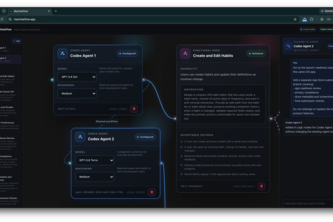
MachineFlow is a self-reported project that claims to coordinate independent Codex agents into one software engineering team using a visual Logic Graph. The author states it is built as a Python multi-agent runtime and a TypeScript visual workbench, designed for use with AI coding agents like Codex and Claude Code.
What changed
The description does not indicate any prior version or evolution of the product — this appears to be a new prototype submitted for a hackathon.
The single most important open question
Does MachineFlow actually enable real coordination between independent AI agents, or is it merely a visualization layer over isolated agent sessions?
Commercial due-diligence read
The description is self-reported and unverified. It contains no evidence of revenue, customers, traction, or adoption. The author states the project was built for a hackathon and includes many technical details about implementation but no demonstration of real-world usage. Claims about coordination between agents are not substantiated by evidence of actual functionality beyond prototype-level demonstration.
What The Product Actually Is
The description states that MachineFlow is:
- A Python multi-agent runtime built with FastAPI and asyncio
- A TypeScript visual workbench built with Next.js, React, React Flow, and Zustand
- Designed to coordinate independent Codex sessions into a software engineering team
- Built around a "Logic Graph" visualization that shows task dependencies and execution states
The author describes it as turning multiple independent Codex windows into one coordinated team through structured messaging between agents.
Evidence The description states the product is built with specific technologies (Python, FastAPI, asyncio, TypeScript, Next.js, React Flow) and has two main components: a backend runtime and a frontend workbench. It claims to support "structured messages" such as task.assigned, artifact.ready, review.requested, etc.
Inference The product appears to be a prototype for coordinating AI coding agents in software development workflows.
Positioning & Claim Evolution
The description states that MachineFlow is positioned to solve the problem of:
- Independent Codex agents being isolated and requiring manual coordination
- Complex multi-agent projects becoming difficult to understand through chat logs alone
- The need for "a coordinated software engineering team" where agents have roles, ownership, dependencies, and communication
The author claims this is inspired by how real engineering teams operate, with concepts like:
- Different roles
- Task ownership
- Artifact handoffs
- Review processes
- Dependency tracking
Evidence The description states the project was inspired by how real engineering teams operate and that it aims to turn independent coding agents into a coordinated team.
Inference This is a positioning statement about solving coordination problems in AI-assisted software development, not evidence of actual product functionality or market traction.
Target Customer & ICP
The description does not clearly identify target customers or ideal customer profiles. It states that the inspiration came from developers who use Codex and Claude Code agents, but does not specify:
- Who specifically uses this tool
- What size organizations might adopt it
- Whether it targets individual developers or teams
- What specific software development workflows it addresses
Evidence The description mentions "developers" as the target audience and that it's inspired by how real engineering teams operate.
Inference The product appears aimed at developers who use AI coding agents, but no specific ICP is defined.
Business Model & Pricing Evidence
The description does not contain any evidence of:
- Revenue model
- Pricing structure
- Monetization approach
- Customer acquisition strategy
- Sales process
Evidence No business model or pricing information is provided in the self-reported description.
Inference The project appears to be a prototype for a hackathon with no commercialization details.
Technical & Delivery Signals
The description states that MachineFlow is built using:
- Python, FastAPI, asyncio
- TypeScript, Next.js, React, React Flow, Zustand
- Specific coordination mechanisms including asyncio.Queue.join(), asyncio.gather(), and asyncio.Event
- Structured messaging system with typed messages (task.assigned, artifact.ready, etc.)
- Project-scoped communication with agent-specific queues
- Separation of shared information into four types: messages, artifacts, decisions, events
Evidence The description provides detailed technical architecture including specific technologies used and coordination mechanisms.
Inference The technical implementation appears sophisticated for a prototype but lacks evidence of production readiness or scalability.
Traction & Maturity Signals
The description states that this is:
- A hackathon project submitted to the OpenAI 2026 hackathon
- A prototype built in a limited timeframe (hackathon timeline)
- Not intended as a final product but as a demonstration of concepts
The author notes they deliberately postponed many features due to time constraints, including:
- Distributed message brokers
- Persistent workflow storage
- Production recovery
- Dynamic agent assignment
- Cross-machine execution
- Complete IDE integration
Evidence The description explicitly states this is a hackathon prototype with many features intentionally left out.
Inference No evidence of traction, customers, or market adoption. This appears to be an experimental prototype.
Competitive Context
The description does not provide any information about:
- Direct competitors
- Market positioning relative to existing tools
- Competitive advantages
- Market size or opportunity
- Industry trends or disruption potential
Evidence No competitive analysis or market context is provided in the self-reported description.
Inference The competitive landscape is unknown from this description alone.
Open Questions & Risks
Key risks and open questions identified from the description:
- Prototype-only status: This is explicitly described as a hackathon prototype with many features intentionally omitted
- No evidence of real functionality: The description shows technical implementation but no demonstration of actual agent coordination
- Unverified claims: All claims about coordination between agents are self-reported without evidence
- Limited scope: The prototype only demonstrates one complete collaboration loop (Implement → Review → Revise → Validate)
- No commercialization plan: No evidence of business model, pricing, or customer acquisition strategy
- Technical limitations: The description notes several technical challenges that remain unsolved in the prototype
Evidence The description explicitly states it's a hackathon prototype with many features postponed and acknowledges technical challenges.
Questions the description leaves open
- What specific coordination problems does MachineFlow actually solve that existing tools don't?
- How do you plan to handle conflicts when multiple agents modify the same code simultaneously?
- What evidence do you have that independent AI agents can be meaningfully coordinated at scale?
- How will you address the challenge of preventing uncontrolled context sharing between agents?
- What is your roadmap for moving from this prototype to a production-ready product?
- How do you plan to monetize this tool, and what market validation do you have for that approach?
- What are the specific technical limitations that would prevent scaling beyond the current prototype?
- How does MachineFlow handle edge cases in agent communication or task dependencies?
- What is your timeline for addressing the technical challenges noted in the description?
- How do you plan to integrate with existing development workflows and tools?
Overall Assessment
Not evidenced
The description provides no evidence of:
- Revenue or financial performance
- Customer adoption or traction
- Market validation
- Product-market fit
- Team experience or track record
- Financial projections or funding history
This appears to be a hackathon prototype with no commercial evidence. The author states it's built for demonstration purposes and that many features were intentionally omitted due to time constraints.
Confidence level Very low - this is a self-reported prototype with no independent verification of functionality, traction, or commercial viability.
Investment recommendation
Not suitable for investment consideration based on the available information. This appears to be an experimental project without demonstrated product-market fit or commercial potential.
User Stories BotA demo video on every pull request
Get a demo video on every new feature
GitHub App that watches your pull requests and records a narrated, captioned demo.
Save time on demo prep and make informed decisions faster with a video walkthrough of every new feature.
Source
Submitted to the OpenAI 2026 hackathon on Devpost. Project home on Devpost. Back to the full gallery on Devpost.
This competitive analysis was produced by top-founders.com (opens in a new tab)
Generated by a language model from this project's public Devpost page — its tagline, the author's own write-up and any built-with tags listed there — as captured in August 2026. Short quotations are the author's words. It is an opinion on the idea as a business, not on the people behind it, and it reflects the description as published then. If the project has moved on, request a correction below. The analysis is not independent research and contains no verified traction, revenue or customer data.
An independent guide by KFG International LLC — not affiliated with, endorsed by, or connected to Devpost or OpenAI.