

Archive position — measured, not model output
0 likes on Devpost
2,263 of the 7,850 archived projects have more likes, and 5,587 share exactly 0 — so this project's #7,070 place in the like-ranked listing is a tie-break inside that group, not a ranking.
Projects (log scale)
Likes on Devpost. ▲ marks this project's group.
Show the figures
| Likes | Projects | Share of archive |
|---|---|---|
| 0 | 5,587 | 71.2% |
| 1 | 1,758 | 22.4% |
| 2 | 284 | 3.6% |
| 3–4 | 132 | 1.7% |
| 5–9 | 75 | 1.0% |
| 10+ | 14 | 0.2% |
 User Stories BotA demo video on every pull request
Get a demo video on every new feature
GitHub App that watches your pull requests and records a narrated, captioned demo.
Save time on demo prep and make informed decisions faster with a video walkthrough of every new feature.
Executive Summary
What the company appears to be
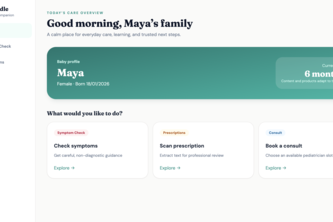
Swaddle is a self-reported AI-powered platform for new parents, built as a hackathon project by one person (Elizabeth Sobiya). It combines an AI baby assistant, prescription extraction, developmental content, and product recommendations — all designed with safety constraints around medical advice. The system uses GPT-5.6 and other tools to generate code via Codex, and is described as a unified platform for baby care.
What changed
The project was submitted to the OpenAI 2026 hackathon. It represents an early-stage prototype built in a short timeframe with no verified traction or revenue.
Single most important open question
Is there any evidence of actual user adoption, customer feedback, or product-market fit beyond the author’s self-reported claims?
What The Product Actually Is
The description states that Swaddle is a unified platform for baby care. It includes:
- An AI Baby Assistant that takes symptoms and age, and returns possible causes, home-care guidance, and open question criteria — but does not suggest specific medicines or dosages.
- A Prescription Extractor using OCR and GPT-5.6 to structure uploaded prescriptions into medicine name, dosage, and frequency (no validation).
- Age-filtered developmental content: rhymes, educational videos, sound activities, color-matching games.
- Age- and context-aware product recommendations for toys, pharmacy supplies, and essentials.
- A pediatrician consultation booking flow (demo/mocked; real-time video not implemented).
All features are described as part of a single platform. The system is built using FastAPI, React/TypeScript, Docker, PostgreSQL, and GPT-5.6.
Evidence
- Self-reported by the author.
- No independent verification or data on actual functionality or usage.
Positioning & Claim Evolution
The project positions itself as a safe, guided AI tool for new parents navigating baby health. The core idea is to avoid the risks of unverified AI medical advice by constraining the assistant to never suggest medicines or dosages — instead directing users to seek professional help when needed.
The author frames this as a design constraint rather than a limitation: “AI that sounds confident” is dangerous, but “AI that knows its own limits” is safer. This reflects an evolution from general AI utility toward responsible AI use in sensitive domains like healthcare.
Evidence
- Self-reported by the author.
- No evidence of prior versions or positioning shifts.
- The claim is based on a single incident (a friend using unverified AI for baby health).
Target Customer & ICP
The target customer is described as new parents, particularly those seeking guidance on baby health, development, and product recommendations. The platform aims to support users through early childhood stages, with content and tools filtered by age.
Evidence
- Self-reported.
- No evidence of segmentation beyond “new parents” or user personas.
- No data on customer acquisition, retention, or feedback.
Business Model & Pricing Evidence
There is no evidence of a business model or pricing strategy in the description. The platform includes features like product recommendations and pediatrician booking (mocked), but no mention of monetization, subscriptions, or sales.
Evidence
- Not evidenced.
- No indication of revenue streams, pricing tiers, or commercial partnerships.
Technical & Delivery Signals
The system is built with:
- Backend: FastAPI, PostgreSQL, GPT-5.6 (via OpenAI API), JWT authentication
- Frontend: React/TypeScript, TailwindCSS, Vite
- Tools used: Codex for code generation, Docker for deployment, OCR via pytesseract and Tesseract OCR
- Architecture: Monorepo scaffolded with Codex; each feature built task-by-task to avoid large-scale debugging
The author notes that backend deployment was deferred due to time constraints.
Evidence
- Self-reported.
- No evidence of production readiness or scalability.
- The system is described as a prototype, not a live product.
Traction & Maturity Signals
There is no evidence of traction or maturity beyond the hackathon submission. The project has:
- One team member (Elizabeth Sobiya)
- No verified customers, users, or adoption metrics
- No revenue data
- No public launch or user feedback
Evidence
- Not evidenced.
- The project is described as a prototype built in a short timeframe.
Competitive Context
The description does not mention any competitors. It focuses on the unique safety constraints of the AI assistant and the lack of verified medical advice, but does not compare Swaddle to existing platforms or tools for baby care or parental support.
Evidence
- Not evidenced.
- No competitive analysis or market positioning beyond self-reporting.
Open Questions & Risks
- Safety vs. Functionality Trade-off: The system is designed to avoid giving medical advice, but this may limit its utility and adoption.
- AI Reliability: GPT-5.6 is used in production, but no validation or error handling is described for AI outputs.
- Prototype Limitations: The platform is a hackathon prototype with no deployment or user testing beyond the author’s own use.
- No Revenue or Traction: No evidence of monetization, users, or market traction.
- Single Developer: A single-person team may limit scalability and product development speed.
Evidence
- Inferred from self-reported claims.
- No external data to support or contradict these risks.
Questions the description leaves open
- What is the actual safety mechanism behind the AI assistant? Is there a human review layer?
- How does the system handle edge cases or ambiguous inputs?
- Are there any plans for user testing or feedback collection?
- What are the long-term goals for monetization and product development?
- Has the platform been tested with real parents, or is it based on assumptions?
Overall Assessment
There is no evidence of a viable business model, traction, or commercial readiness beyond the hackathon prototype. The project is described as a self-contained, unverified experiment by one developer.
Confidence Level Low
Reasoning
The description is entirely self-reported and lacks any verifiable data on users, revenue, product-market fit, or scalability.
Recommendation
Not suitable for investment or partnership at this stage. Further evidence of traction, user feedback, or commercial viability would be required to assess potential.
User Stories BotA demo video on every pull request
Get a demo video on every new feature
GitHub App that watches your pull requests and records a narrated, captioned demo.
Save time on demo prep and make informed decisions faster with a video walkthrough of every new feature.
Source
Submitted to the OpenAI 2026 hackathon on Devpost. Project home on Devpost. Back to the full gallery on Devpost.
This competitive analysis was produced by top-founders.com (opens in a new tab)
Generated by a language model from this project's public Devpost page — its tagline, the author's own write-up and any built-with tags listed there — as captured in August 2026. Short quotations are the author's words. It is an opinion on the idea as a business, not on the people behind it, and it reflects the description as published then. If the project has moved on, request a correction below. The analysis is not independent research and contains no verified traction, revenue or customer data.
An independent guide by KFG International LLC — not affiliated with, endorsed by, or connected to Devpost or OpenAI.