

Archive position — measured, not model output
0 likes on Devpost
2,263 of the 7,850 archived projects have more likes, and 5,587 share exactly 0 — so this project's #7,071 place in the like-ranked listing is a tie-break inside that group, not a ranking.
Projects (log scale)
Likes on Devpost. ▲ marks this project's group.
Show the figures
| Likes | Projects | Share of archive |
|---|---|---|
| 0 | 5,587 | 71.2% |
| 1 | 1,758 | 22.4% |
| 2 | 284 | 3.6% |
| 3–4 | 132 | 1.7% |
| 5–9 | 75 | 1.0% |
| 10+ | 14 | 0.2% |
 User Stories BotA demo video on every pull request
Get a demo video on every new feature
GitHub App that watches your pull requests and records a narrated, captioned demo.
Save time on demo prep and make informed decisions faster with a video walkthrough of every new feature.
Executive Summary
What the company appears to be
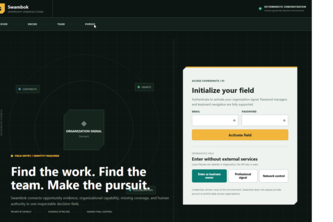
Swambok is a self-reported web application designed to help federal teams organize and pursue opportunities by structuring decision-making around a unified workspace. It claims to support discovery, evaluation, and action on federal opportunities through structured workflows.
What changed
The project was developed during Build Week as part of an OpenAI 2026 hackathon submission. It evolved from an early concept into a more defined product focused on the "Opportunity Field" decision model, with improvements in navigation, integration of decision elements (e.g., Capability Bridge, Decision Structure), and reproducible local deployment via Docker.
Single most important open question
Is there any evidence that Swambok has moved beyond demonstration or prototype stage — particularly around live data ingestion from federal systems like SAM.gov or Simpler.Grants.gov?
Note: This analysis is based entirely on the self-reported project description provided by the author. No external verification, revenue data, customer names, or traction metrics are available.
What The Product Actually Is
The description states that Swambok is a web application built with Python backend and browser interfaces, packaged for local deployment using Docker.
It organizes federal opportunity pursuit through a structured workspace that includes:
- Discover
- Opportunity Field
- Decision Structure
- Capability Bridge
- Field Events
- Pursuit Space
The product uses tools such as Git, Codex, GPT-5.6, and various web technologies (HTML5, CSS3, JavaScript, SQL). It is described as a decision-support workspace, not an automated system replacing human judgment.
Claim: Swambok is a structured decision environment for federal opportunity management.
Evidence: Author's own write-up.
Inference: The product appears to be a prototype or demonstration-level tool based on the lack of production integrations and validated data sources.
Positioning & Claim Evolution
The author positions Swambok as a structured workspace that helps teams move from “we found something” to “we understand whether and how we should pursue it.”
It is framed as an alternative to fragmented approaches (spreadsheets, email, calendars) where information about opportunities is scattered across multiple tools.
Key claims:
- It turns scattered federal opportunity information into a structured pursuit workspace.
- It supports a unified decision journey rather than isolated features.
- It does not claim to replace human judgment but to make it more organized and actionable.
Claim: Swambok aims to improve organizational clarity in pursuing federal opportunities.
Evidence: Author's own write-up.
Inference: The positioning reflects a shift from generic search tools toward structured decision-making environments — though no evidence of prior usage or adoption exists.
Target Customer & ICP
The description states that Swambok is intended for teams evaluating and pursuing federal opportunities, particularly those working with systems like SAM.gov and Simpler.Grants.gov.
It targets organizations managing complex, multi-step pursuit processes involving:
- Opportunity discovery
- Capability alignment
- Evidence gathering
- Deadline tracking
- Decision planning
Claim: Swambok serves federal teams engaged in opportunity evaluation and pursuit.
Evidence: Author's own write-up.
Inference: No specific segment or persona details are provided beyond general federal team use cases.
Business Model & Pricing Evidence
There is no evidence presented regarding a business model, pricing strategy, monetization approach, or revenue streams.
The project description does not mention any paid features, subscriptions, licensing models, or customer acquisition strategies.
Claim: No information on business model or pricing.
Evidence: Not evidenced.
Inference: Since this is a hackathon submission and no commercial traction is reported, it likely lacks a defined monetization path at this stage.
Technical & Delivery Signals
The product is built as a web application using:
- Python backend
- Browser-based UI
- Docker packaging for local deployment
- Git-based version control with clear milestones distinguishing pre-existing work from Build Week additions
- Automated testing (76 tests passing)
- Schema migrations up to version 5
- Clean clone and fresh database validation
- Accessibility audit covering twelve routes
AI collaboration involved:
- Codex for code inspection, implementation, testing, migration, documentation
- GPT-5.6 for narrative refinement, strategic planning, and editorial support
Claim: Swambok is technically robust with reproducible builds and automated tests.
Evidence: Author's own write-up.
Inference: The technical setup suggests a mature development process, but lacks evidence of production-grade infrastructure or scalability.
Traction & Maturity Signals
There is no evidence of:
- Revenue
- Customers
- Users
- Adoption
- Live integrations with federal systems (e.g., SAM.gov, Simpler.Grants.gov)
- Production usage or live data ingestion
The demonstration uses controlled demo data and explicitly states that live acceptance testing was not completed.
Claim: No traction or maturity beyond prototype/demonstration stage.
Evidence: Author's own write-up.
Inference: The project is at a very early stage of development, likely pre-product-market fit.
Competitive Context
No mention of competitors or competitive landscape in the description.
The author does not reference existing tools for federal opportunity management or decision support systems.
Claim: No competitive context provided.
Evidence: Not evidenced.
Inference: Without external references or market positioning, it is unclear how Swambok compares to other solutions in this space.
Open Questions & Risks
- Unvalidated integrations: The product does not claim live connectivity with federal systems; this remains future work.
- Prototype-only status: No evidence of real-world usage or validated workflows beyond demo data.
- No commercialization path: No indication of pricing, monetization, or customer acquisition strategy.
- Single founder team: Only one member listed (Alexander Dahl), which may limit execution capacity.
- AI dependency without validation: While AI was used for development and documentation, no production API validation is claimed.
Claim: Risks include unproven integrations, lack of traction, and unclear commercial viability.
Evidence: Author's own write-up.
Inference: These are inherent to a hackathon submission with no prior market presence or validated use cases.
Questions the description leaves open
- What specific federal agencies or teams have expressed interest in using Swambok?
- Are there any plans for live integration with SAM.gov or Simpler.Grants.gov, and what timeline is expected?
- How does the team plan to monetize or scale this product beyond the prototype phase?
- Has the current demo been tested by actual users from federal teams?
- What are the key assumptions underlying the "Opportunity Field" decision model, and how were they validated?
- Can you provide evidence of any internal testing or user feedback loops beyond the Build Week submission?
- How does Swambok handle data privacy and compliance in federal environments?
Note: These questions aim to uncover gaps in the self-reported narrative and assess whether the team has moved beyond concept into early traction or validation.
Overall Assessment
Not evidenced.
There is no evidence of:
- Revenue
- Customers
- Product-market fit
- Market traction
- Commercial viability
The project is described as a hackathon prototype, with no indication of progress toward productization, market entry, or commercial adoption.
Claim: No investment or partnership readiness.
Evidence: Not evidenced.
Inference: Based on the lack of any commercial signals, revenue, or validated user feedback, Swambok is not positioned for investment or strategic partnership at this time.
User Stories BotA demo video on every pull request
Get a demo video on every new feature
GitHub App that watches your pull requests and records a narrated, captioned demo.
Save time on demo prep and make informed decisions faster with a video walkthrough of every new feature.
Source
Submitted to the OpenAI 2026 hackathon on Devpost. Project home on Devpost. Back to the full gallery on Devpost.
This competitive analysis was produced by top-founders.com (opens in a new tab)
Generated by a language model from this project's public Devpost page — its tagline, the author's own write-up and any built-with tags listed there — as captured in August 2026. Short quotations are the author's words. It is an opinion on the idea as a business, not on the people behind it, and it reflects the description as published then. If the project has moved on, request a correction below. The analysis is not independent research and contains no verified traction, revenue or customer data.
An independent guide by KFG International LLC — not affiliated with, endorsed by, or connected to Devpost or OpenAI.