

Archive position — measured, not model output
0 likes on Devpost
2,263 of the 7,850 archived projects have more likes, and 5,587 share exactly 0 — so this project's #3,147 place in the like-ranked listing is a tie-break inside that group, not a ranking.
Projects (log scale)
Likes on Devpost. ▲ marks this project's group.
Show the figures
| Likes | Projects | Share of archive |
|---|---|---|
| 0 | 5,587 | 71.2% |
| 1 | 1,758 | 22.4% |
| 2 | 284 | 3.6% |
| 3–4 | 132 | 1.7% |
| 5–9 | 75 | 1.0% |
| 10+ | 14 | 0.2% |
 User Stories BotA demo video on every pull request
Get a demo video on every new feature
GitHub App that watches your pull requests and records a narrated, captioned demo.
Save time on demo prep and make informed decisions faster with a video walkthrough of every new feature.
Executive Summary
What the company appears to be
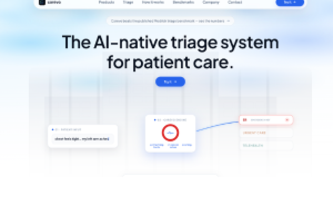
Carevo is an AI-powered care navigation platform for health insurers, designed to help patients determine where to seek medical care based on their symptoms. It uses a layered system combining emergency detection, natural language understanding, and deterministic routing rules to recommend appropriate care levels (e.g., ER, urgent care, telehealth) while maintaining auditability.
What changed
The project was submitted as part of the OpenAI 2026 hackathon. It represents an early-stage prototype built by a team of three developers with no evidence of prior traction or commercial deployment.
Single most important open question
Is there sufficient evidence that Carevo's architecture can scale safely and effectively in real-world healthcare environments, particularly around handling vague or incomplete patient input without compromising safety?
What The Product Actually Is
The description states that Carevo is an AI care navigation platform for health insurers. It builds a triage system with three layers:
- Emergency safety net: Detects life-threatening language and routes users to 911.
- AI extractor layer: Translates natural language into structured clinical features (does not make routing decisions).
- Deterministic rules engine: Applies safety floors, open question logic, and care-routing rules.
It also includes a "Recursive Experience Engine" (REE) for evaluation and learning purposes.
The product is built using:
- Frontend: Next.js, React, TypeScript, Tailwind CSS
- Backend: Node.js, OpenAI GPT-4o-mini, Google Maps Platform, Vercel, Upstash Redis
- Data sources: Healthcare.gov API
Not evidenced: No mention of actual deployment, production usage, or integration with real insurers.
Positioning & Claim Evolution
The description states that Carevo aims to solve the problem of patient confusion around care options — specifically targeting those who do not know where to go when they feel sick or injured. It positions itself as a tool for health insurers to guide members toward the right first step without making AI the final clinical decision-maker.
Claims made:
- Published benchmarks show 90.2% accuracy on Semigran/MedAsk vs. 87.6% for incumbent.
- Zero dangerous under-triage across 500+ scored trials.
- System is built to be auditable, with every recommendation tied back to extracted features and safety logic.
Inference: These claims suggest a focus on safety over speed or convenience, but the description does not confirm whether these benchmarks reflect real-world performance or synthetic testing only.
Not evidenced: No evidence of market positioning beyond the hackathon submission; no mention of target insurer partnerships or commercialization strategy.
Target Customer & ICP
The description states that Carevo is built for health insurers. Its stated purpose is to help insurers guide members to the right first step in care, reducing guesswork and improving safety.
It also mentions that it's designed for "risk-bearing healthcare organizations."
Inference: The target customer appears to be health insurers or large employer groups with insurance plans who want to reduce costs and improve outcomes by directing patients to appropriate levels of care.
Not evidenced: No specific customer segments beyond insurers, no evidence of existing customers or pilot programs.
Business Model & Pricing Evidence
The description does not provide any information about pricing models, revenue streams, or monetization strategies. It only describes the platform's functionality and architecture.
Inference: Since this is a hackathon project, it’s likely not yet monetized, but the authors imply that insurers would be paying for access to the system.
Not evidenced: No evidence of pricing structure, subscription tiers, or commercial agreements.
Technical & Delivery Signals
The system uses:
- AI extractor layer: GPT-4o-mini for natural language understanding.
- Deterministic rules engine: For routing decisions and safety checks.
- Emergency detection: Prioritizes life-threatening signals before AI processing.
- Evaluation pipeline (REE): For reviewing sessions, identifying over/under-routing patterns, and generating training examples.
The frontend is built with Next.js, React, TypeScript, Tailwind CSS; backend uses Node.js, Vercel, Redis, OpenAI APIs, Google Maps Platform, and Healthcare.gov API.
Not evidenced: No evidence of scalability, performance metrics, or production-grade infrastructure beyond the prototype.
Traction & Maturity Signals
The project is described as a prototype submitted to a hackathon. The authors mention internal synthetic benchmark results (90.2% accuracy), but no real-world usage data or customer feedback is provided.
Inference: This indicates early-stage development, likely with limited real-world testing and no commercial traction.
Not evidenced: No evidence of user adoption, customer base, ARR, revenue, or product-market fit beyond the hackathon submission.
Competitive Context
The description does not mention competitors directly. However, it implies that there is an incumbent system (referred to as "the incumbent") against which Carevo's performance was benchmarked — showing 90.2% vs. 87.6%.
Inference: There are existing solutions in the healthcare triage space, but the exact nature of these competitors is unknown.
Not evidenced: No competitive landscape analysis, no mention of direct or indirect competitors, no evidence of market share or differentiation strategy.
Open Questions & Risks
- Safety concerns: The system relies heavily on deterministic rules and AI extraction, but no evidence of how it handles ambiguous or incomplete patient input.
- Scalability risk: Built as a prototype for a hackathon; unclear if architecture supports real-world deployment at scale.
- Lack of real-world validation: Benchmarks are synthetic; no evidence of performance in actual patient interactions.
- No commercialization strategy: No mention of monetization, partnerships, or go-to-market plans.
- Limited team size: Only 3 members, which may limit execution capacity for a complex healthcare product.
Not evidenced: No evidence of regulatory compliance, data privacy measures, or clinical validation.
Questions the description leaves open
- What are the specific safety checks and thresholds used in the deterministic rules engine?
- How does the system handle vague or incomplete patient input without over-triaging or under-triaging?
- Can you provide more details on how the REE pipeline works and how it integrates into product updates?
- Have you tested the platform with actual patients or clinicians outside of synthetic benchmarks?
- What is your plan for regulatory compliance, especially in relation to healthcare data handling and AI use?
- How do you intend to scale this system beyond a hackathon prototype?
Overall Assessment
This is an early-stage prototype submitted as part of a hackathon. The authors describe a structured approach to building a safe, auditable triage system, but there is no evidence of commercial traction, real-world testing, or product-market fit.
The project shows technical sophistication and a clear understanding of healthcare AI challenges, but lacks key signals of maturity or readiness for investment or partnership.
Confidence level: Low
Not evidenced: No revenue, customers, ARR, funding rounds, or market validation. The entire analysis rests on self-reported claims from a hackathon submission.
User Stories BotA demo video on every pull request
Get a demo video on every new feature
GitHub App that watches your pull requests and records a narrated, captioned demo.
Save time on demo prep and make informed decisions faster with a video walkthrough of every new feature.
Source
Submitted to the OpenAI 2026 hackathon on Devpost. Project home on Devpost. Back to the full gallery on Devpost.
This competitive analysis was produced by top-founders.com (opens in a new tab)
Generated by a language model from this project's public Devpost page — its tagline, the author's own write-up and any built-with tags listed there — as captured in August 2026. Short quotations are the author's words. It is an opinion on the idea as a business, not on the people behind it, and it reflects the description as published then. If the project has moved on, request a correction below. The analysis is not independent research and contains no verified traction, revenue or customer data.
An independent guide by KFG International LLC — not affiliated with, endorsed by, or connected to Devpost or OpenAI.