

Archive position — measured, not model output
0 likes on Devpost
2,263 of the 7,850 archived projects have more likes, and 5,587 share exactly 0 — so this project's #3,149 place in the like-ranked listing is a tie-break inside that group, not a ranking.
Projects (log scale)
Likes on Devpost. ▲ marks this project's group.
Show the figures
| Likes | Projects | Share of archive |
|---|---|---|
| 0 | 5,587 | 71.2% |
| 1 | 1,758 | 22.4% |
| 2 | 284 | 3.6% |
| 3–4 | 132 | 1.7% |
| 5–9 | 75 | 1.0% |
| 10+ | 14 | 0.2% |
 User Stories BotA demo video on every pull request
Get a demo video on every new feature
GitHub App that watches your pull requests and records a narrated, captioned demo.
Save time on demo prep and make informed decisions faster with a video walkthrough of every new feature.
Executive Summary
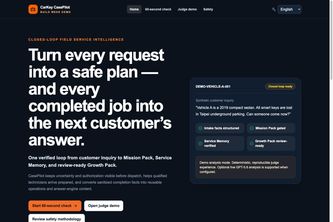
The company appears to be a single-person project (Otto Yeh) developing an AI-powered field-service workflow system called CarKey CasePilot. The author describes it as a closed-loop system that handles incomplete inquiries, verifies service readiness, creates technician mission packs, and turns completed work into privacy-safe growth content.
What changed
The project is presented as a hackathon submission (Devpost entry for OpenAI 2026 hackathon), indicating it's in early development or prototype stage. It was built using Next.js, React, TypeScript, Tailwind CSS, Zod, Vitest, and Vercel, with optional integration of OpenAI APIs.
The single most important open question
Is there a viable commercial market need for this specific closed-loop field-service workflow system, or is it primarily a technical demonstration?
What The Product Actually Is
- The description states that CarKey CasePilot is "a closed-loop AI field-service system"
- It claims to recover incomplete inquiries from channels like LINE, website visits, and chat
- It separates anonymous visits from recoverable inquiries and owner-review-ready leads
- It creates three typed artifacts: Mission Pack, Service Memory, and Growth Pack
- The system requires human approval before generating any content or dispatching work orders
- It uses deterministic providers for stable experience and optional OpenAI providers for live analysis
- No API key is required for the public demo, automated tests, production build, or judge flow
Inference Based on the author's own write-up, this appears to be a workflow management system that bridges incomplete customer interactions with formal service operations in field-service environments.
Positioning & Claim Evolution
- The project positions itself as solving problems in field-service workflows where incomplete inquiries are lost or mismanaged
- It claims to address "authorization, safety, and operational risk" from treating incomplete information as dispatch-ready
- The author states that the opportunity extends beyond service completion — it also captures verified knowledge for future reuse
- It presents a "human-controlled loop" approach rather than automated decision-making
- The system is described as connecting disconnected stages of field-service work into one workflow
Inference This is positioned as a privacy-conscious, consent-aware, human-gated field-service workflow tool that aims to improve customer retention and knowledge capture.
Target Customer & ICP
- Not evidenced. The description does not identify specific target customers or personas.
- The author mentions "field-service work" but does not specify which industries or types of businesses this applies to.
- No mention of typical business sizes, roles (e.g., owner, dispatcher, technician), or geographic scope.
Business Model & Pricing Evidence
- Not evidenced. There is no information provided about pricing, monetization strategy, or revenue model.
- The description does not state whether the system will be sold as SaaS, a one-time license, or offered for free.
- No mention of customer acquisition costs, lifetime value, or any commercial metrics.
Technical & Delivery Signals
- Built with Next.js App Router, React, strict TypeScript, Tailwind CSS, Zod, Vitest, and Vercel
- Uses typed schemas (LeadRecord and CaseRecord) to separate incomplete commercial intent from formal service operations
- Includes deterministic providers for stable experience and optional server-side OpenAI providers
- Implements structured-output pattern with Zod schemas, responses.parse(), zodTextFormat(), store: false, timeout handling, PII masking, response validation, and safe deterministic fallback
- Has a 73-check reproducible evaluation harness covering multiple aspects of functionality
- Public demo uses synthetic data and sends no external messages
- Interface clearly identifies when deterministic demo analysis is shown instead of live GPT runtime
Inference The system shows technical sophistication with typed schemas, structured outputs, privacy controls, and reproducibility features. However, it's presented as a prototype or proof-of-concept.
Traction & Maturity Signals
- Not evidenced. No data on users, customers, revenue, adoption rates, or usage metrics are provided.
- The project is described as a hackathon submission (Devpost entry for OpenAI 2026)
- The public demo uses synthetic data and publishes nothing automatically
- No mention of pilot programs, beta testing, or real-world deployment
Competitive Context
- Not evidenced. There is no information about existing competitors or market landscape.
- The author does not reference similar tools or platforms in the field-service space
- No mention of how this solution compares to current industry practices or offerings
Open Questions & Risks
- Single-person development team: Only one member listed (Otto Yeh), which may limit scalability and long-term maintenance
- Prototype nature: Described as a hackathon submission with synthetic data, suggesting it's not yet production-ready
- No commercial traction or revenue evidence: No customers, users, or monetization strategy mentioned
- Limited target market definition: No clear indication of who would use this system or how it fits into existing workflows
- Privacy and consent complexity: While privacy controls are emphasized, managing these in practice could be challenging
- AI dependency risk: Reliance on optional OpenAI providers introduces potential integration risks if those services change
Questions the description leaves open
- What specific field-service industries or use cases does this system target?
- How do you plan to monetize this product, and what is your go-to-market strategy?
- What are the key assumptions about user behavior that underpin this workflow design?
- Can you describe any potential regulatory or compliance issues in deploying this system at scale?
- How will you ensure consistent quality of AI-generated content when using optional OpenAI providers?
- What metrics do you track to measure success beyond the current demo?
- How do you intend to onboard and train users on this workflow system?
- Are there any known limitations or edge cases that haven't been addressed in the prototype?
Overall Assessment
- Not evidenced. No information is provided about funding rounds, valuations, or investment interest.
- The project is described as a hackathon submission with no indication of commercial viability or traction
- While technically impressive, there's no evidence of market demand, customer validation, or business model maturity
- The single-person team and prototype nature suggest this is early-stage development
Confidence level Low. This analysis is based entirely on self-reported information without any external corroboration or evidence of traction, revenue, customers, or commercial viability.
User Stories BotA demo video on every pull request
Get a demo video on every new feature
GitHub App that watches your pull requests and records a narrated, captioned demo.
Save time on demo prep and make informed decisions faster with a video walkthrough of every new feature.
Source
Submitted to the OpenAI 2026 hackathon on Devpost. Project home on Devpost. Back to the full gallery on Devpost.
This competitive analysis was produced by top-founders.com (opens in a new tab)
Generated by a language model from this project's public Devpost page — its tagline, the author's own write-up and any built-with tags listed there — as captured in August 2026. Short quotations are the author's words. It is an opinion on the idea as a business, not on the people behind it, and it reflects the description as published then. If the project has moved on, request a correction below. The analysis is not independent research and contains no verified traction, revenue or customer data.
An independent guide by KFG International LLC — not affiliated with, endorsed by, or connected to Devpost or OpenAI.