

Archive position — measured, not model output
0 likes on Devpost
2,263 of the 7,850 archived projects have more likes, and 5,587 share exactly 0 — so this project's #3,150 place in the like-ranked listing is a tie-break inside that group, not a ranking.
Projects (log scale)
Likes on Devpost. ▲ marks this project's group.
Show the figures
| Likes | Projects | Share of archive |
|---|---|---|
| 0 | 5,587 | 71.2% |
| 1 | 1,758 | 22.4% |
| 2 | 284 | 3.6% |
| 3–4 | 132 | 1.7% |
| 5–9 | 75 | 1.0% |
| 10+ | 14 | 0.2% |
 User Stories BotA demo video on every pull request
Get a demo video on every new feature
GitHub App that watches your pull requests and records a narrated, captioned demo.
Save time on demo prep and make informed decisions faster with a video walkthrough of every new feature.
Executive Summary
What the company appears to be
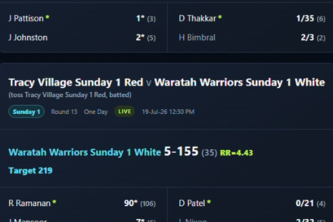
Carnival Live (Cricket) is a self-reported web application that aggregates live cricket match data from multiple games into a single dashboard for display. It was built as part of a hackathon project and is described as being designed for cricket carnivals, competitions, and club rounds where multiple matches occur simultaneously.
What changed
The author states the project evolved from a personal need to manage scores during carnival events into a broader tool for administrators and clubs wanting to monitor multiple games at once. The application retrieves data from PlayCricket and displays it in a simplified format using Python, Flask, HTML, CSS, and JavaScript.
Single most important open question
Is there evidence of real-world usage or traction beyond the author's own testing during a hackathon?
What The Product Actually Is
The description states that Carnival Live (Cricket) is a web application that collects live cricket match data and displays multiple games together on one screen. It shows:
- Teams and match status
- Current score and overs
- Run rate
- Batters at the crease
- Current bowlers
- Toss information
- Leading performers
- Completed and live matches together
It was built using Python, Flask, HTML, CSS, JavaScript, and retrieves data from PlayCricket. The author notes that GPT-5.6 and Codex were used to assist in building and improving the code.
Evidence
- Author's own write-up
- Technology stack listed (Python, Flask, HTML, CSS, JavaScript)
- Data source identified (PlayCricket)
Inference The product is a dashboard-style web tool for viewing live cricket scores across multiple matches. It is not a full-fledged SaaS offering or platform.
Positioning & Claim Evolution
The author states that the project was initially conceived to solve a problem in cricket carnivals where there are 4–5 games happening at once, and scores are scattered across separate pages. The idea evolved into a tool for administrators and clubs wanting to monitor other grades of play.
Evidence
- Inspiration: “Cricket carnivals and competition rounds have several matches being played at the same time”
- Use case: “Designed for cricket carnivals, representative competitions, club rounds”
Inference The positioning appears to be a niche tool for event organizers or clubs managing multiple simultaneous games. It does not claim to be a general-purpose cricket score aggregator or platform.
Target Customer & ICP
The description states that the product is designed for:
- Cricket carnivals
- Representative competitions
- Club rounds
It is intended for selectors, players, officials, and spectators who want to follow multiple matches at once. The author also mentions it was tested with live cricket competitions.
Evidence
- “Designed for cricket carnivals, representative competitions, club rounds”
- “Tested with live cricket competitions”
Inference The target customer is likely event organizers or club administrators who manage or follow multiple simultaneous matches. No specific buyer persona or segment beyond this is described.
Business Model & Pricing Evidence
Not evidenced.
Evidence No mention of pricing, monetization, or business model in the description.
Inference There is no indication that the project has a business model or pricing structure. It was built as a hackathon submission and not described as a commercial product.
Technical & Delivery Signals
The application was built with:
- Python (Flask)
- HTML, CSS, JavaScript
- Data from PlayCricket via REST API
- Deployment on Render
It uses AI tools like GPT-5.6 and Codex for development assistance.
Evidence
- Technology stack listed
- Deployment platform mentioned
- Use of AI coding tools noted
Inference The tool is a basic web application with backend logic in Python and frontend display in HTML/CSS/JS. It is not described as scalable or enterprise-grade.
Traction & Maturity Signals
Not evidenced.
Evidence No data on users, customers, adoption, or usage beyond the author’s own testing during a hackathon.
Inference There is no evidence of traction, revenue, or customer base. The project was not described as deployed in production or used by others beyond the author.
Competitive Context
Not evidenced.
Evidence No mention of competitors or similar tools in the description.
Inference It is unclear whether there are existing tools for aggregating live cricket scores across multiple matches, as no competitive landscape is described.
Open Questions & Risks
- No traction or commercialization: The project was built for a hackathon and lacks evidence of real-world usage.
- Limited scope: It appears to be a proof-of-concept with no indication of scalability or enterprise features.
- Unverified data source: The tool depends on PlayCricket’s public pages, which may not be stable or reliable.
- No business model: No evidence of monetization or revenue streams.
- Self-reported only: All claims are from the author and unverified.
Questions the description leaves open
- What is the actual usage or adoption rate beyond the hackathon?
- Are there any real users or customers who have tested this tool in production?
- How does it handle data inconsistencies or outages from PlayCricket?
- Is there a plan to monetize or scale this beyond a hobby project?
- What are the technical limitations of relying on public APIs for live data?
Overall Assessment
Not evidenced.
Evidence No information on funding, valuation, or investment interest is provided.
Inference This is a self-reported hackathon project with no evidence of commercial viability or traction. It does not appear to be a serious business opportunity at this stage.
User Stories BotA demo video on every pull request
Get a demo video on every new feature
GitHub App that watches your pull requests and records a narrated, captioned demo.
Save time on demo prep and make informed decisions faster with a video walkthrough of every new feature.
Source
Submitted to the OpenAI 2026 hackathon on Devpost. Project home on Devpost. Back to the full gallery on Devpost.
This competitive analysis was produced by top-founders.com (opens in a new tab)
Generated by a language model from this project's public Devpost page — its tagline, the author's own write-up and any built-with tags listed there — as captured in August 2026. Short quotations are the author's words. It is an opinion on the idea as a business, not on the people behind it, and it reflects the description as published then. If the project has moved on, request a correction below. The analysis is not independent research and contains no verified traction, revenue or customer data.
An independent guide by KFG International LLC — not affiliated with, endorsed by, or connected to Devpost or OpenAI.