

Archive position — measured, not model output
0 likes on Devpost
2,263 of the 7,850 archived projects have more likes, and 5,587 share exactly 0 — so this project's #5,113 place in the like-ranked listing is a tie-break inside that group, not a ranking.
Projects (log scale)
Likes on Devpost. ▲ marks this project's group.
Show the figures
| Likes | Projects | Share of archive |
|---|---|---|
| 0 | 5,587 | 71.2% |
| 1 | 1,758 | 22.4% |
| 2 | 284 | 3.6% |
| 3–4 | 132 | 1.7% |
| 5–9 | 75 | 1.0% |
| 10+ | 14 | 0.2% |
 User Stories BotA demo video on every pull request
Get a demo video on every new feature
GitHub App that watches your pull requests and records a narrated, captioned demo.
Save time on demo prep and make informed decisions faster with a video walkthrough of every new feature.
Executive Summary
Company: Magent
Self-reported basis: The analysis is based entirely on the author-supplied project description from Devpost, which is self-reported and unverified. No external corroboration, revenue, customer or traction data is available.
What it appears to be: A prototype AI-native workforce operating system that routes tasks between humans and AI agents, with a focus on collaboration and human control.
Key change: The project is presented as an experiment in human-AI workflow design, not a commercial product.
Single most important open question: Is there evidence of user adoption or feedback that would suggest a viable market need beyond the hackathon context?
What The Product Actually Is
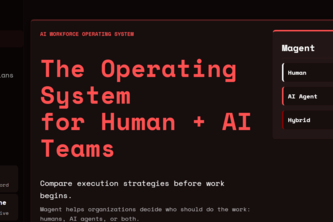
The description states that Magent is “an AI-native workforce operating system.” It allows users to create tasks, assign them to AI agents or human teammates, monitor progress, and manage collaboration from a single workspace. It supports hybrid workflows where both humans and AI work together.
- Claimed functionality: Task creation, assignment, monitoring, and collaboration between humans and AI.
- Inferred purpose: To streamline task execution by intelligently routing work based on capability or preference.
- Not evidenced: Specific features beyond general workflow management, integrations, or performance metrics.
Positioning & Claim Evolution
The author positions Magent as an “AI-native workforce operating system” that helps teams complete tasks faster while keeping people in control. It is described as a shift from competing AI and humans to collaborating AI and humans.
- Claim: The product supports natural collaboration between humans and AI.
- Inferred evolution: From standalone chatbots or tools to integrated workflow orchestration.
- Not evidenced: Market positioning, competitive differentiation, or prior versions of the product.
Target Customer & ICP
The description does not specify a target customer segment. It mentions “teams” but does not define team size, industry, or use case.
- Claim: The system is for teams that want to automate repetitive tasks while retaining human oversight.
- Inferred audience: Teams using AI agents or looking to integrate AI into their workflows.
- Not evidenced: Specific customer personas, verticals, or adoption patterns.
Business Model & Pricing Evidence
There is no mention of pricing, monetization strategy, or business model in the description.
- Claim: None provided.
- Inferred: If commercialized, it might be a SaaS or platform-based offering.
- Not evidenced: Revenue streams, pricing tiers, or customer acquisition costs.
Technical & Delivery Signals
The project was built using GPT-5.6 and Codex, with a modern web interface and backend services for coordination.
- Claimed tech stack: Cloudflare, GPT-5.6, Codex.
- Inferred delivery approach: Prototype or MVP built in a hackathon context.
- Not evidenced: Scalability, infrastructure robustness, or deployment details beyond the hackathon build.
Traction & Maturity Signals
The project is described as a hackathon submission and has no evidence of traction, users, or commercial adoption.
- Claim: It’s a prototype submitted to an OpenAI 2026 hackathon.
- Inferred maturity level: Early-stage concept or proof-of-concept.
- Not evidenced: Customers, usage data, or product iteration history.
Competitive Context
No mention of competitors or market context is provided in the description.
- Claim: None.
- Inferred: The space likely includes AI workflow tools and task management platforms.
- Not evidenced: Competitive landscape, market size, or differentiation from existing solutions.
Open Questions & Risks
The project is a hackathon submission with no evidence of traction or commercial viability. It lacks clarity on how it would scale beyond the prototype stage.
- Risk: No demonstrated user feedback or adoption.
- Open question: Lack of business model, pricing, or customer data.
- Not evidenced: Risk of technical failure, market misalignment, or scalability issues beyond the prototype phase.
Questions the description leaves open
- What specific tasks or workflows are you targeting with Magent?
- How do you plan to validate demand for this product outside of a hackathon context?
- Have you conducted any user research or interviews with potential customers?
- What is your roadmap for moving from prototype to a scalable product?
- Are there any existing partnerships or integrations that support the vision?
Overall Assessment
The project is a self-reported hackathon submission with no evidence of traction, revenue, or customer validation. It is not ready for investment or partnership consideration at this stage.
- Assessment: Not evidenced as a viable commercial opportunity.
- Inference: If the founders iterate and validate market need, it may have potential.
- Not evidenced: Financials, team experience, or product-market fit beyond the prototype phase.
User Stories BotA demo video on every pull request
Get a demo video on every new feature
GitHub App that watches your pull requests and records a narrated, captioned demo.
Save time on demo prep and make informed decisions faster with a video walkthrough of every new feature.
Source
Submitted to the OpenAI 2026 hackathon on Devpost. Project home on Devpost. Back to the full gallery on Devpost.
This competitive analysis was produced by top-founders.com (opens in a new tab)
Generated by a language model from this project's public Devpost page — its tagline, the author's own write-up and any built-with tags listed there — as captured in August 2026. Short quotations are the author's words. It is an opinion on the idea as a business, not on the people behind it, and it reflects the description as published then. If the project has moved on, request a correction below. The analysis is not independent research and contains no verified traction, revenue or customer data.
An independent guide by KFG International LLC — not affiliated with, endorsed by, or connected to Devpost or OpenAI.