

Archive position — measured, not model output
1 like on Devpost
505 of the 7,850 archived projects have more likes, and 1,758 share exactly 1 — so this project's #1,183 place in the like-ranked listing is a tie-break inside that group, not a ranking.
Projects (log scale)
Likes on Devpost. ▲ marks this project's group.
Show the figures
| Likes | Projects | Share of archive |
|---|---|---|
| 0 | 5,587 | 71.2% |
| 1 | 1,758 | 22.4% |
| 2 | 284 | 3.6% |
| 3–4 | 132 | 1.7% |
| 5–9 | 75 | 1.0% |
| 10+ | 14 | 0.2% |
 User Stories BotA demo video on every pull request
Get a demo video on every new feature
GitHub App that watches your pull requests and records a narrated, captioned demo.
Save time on demo prep and make informed decisions faster with a video walkthrough of every new feature.
Executive Summary
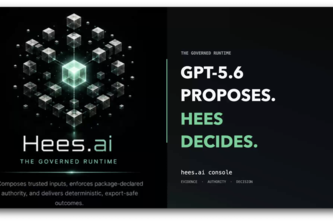
The description states that hees.ai console is a keyboard-first development environment for building, testing, and inspecting governed AI profiles. The author describes it as a tool that changes the unit of AI development from a prompt to a governance profile, where GPT-5.6 proposes and Hees decides. It is presented as a native terminal application built in Incan, with support for replay and live modes, and includes features like Training by Committee and Content DNA construction.
The key commercial due-diligence question is whether this represents a viable product or concept that could attract paying customers, given the lack of any evidence of revenue, customers, or adoption beyond the author's own development work.
What The Product Actually Is
The description states that hees.ai console is:
- A native, keyboard-first development environment for building, testing, and inspecting governed AI profiles
- A "governed AI profile studio" that operates as a bounded workflow
- A terminal application built in Incan, with support for macOS Apple Silicon, macOS Intel, and Linux x86-64 platforms
- A tool that separates model proposing from authority decision-making
- A system where GPT-5.6 proposes and Hees decides
The product is described as a "native Developer Tool" with:
- A working evidence-first Profile Studio
- Real session-local candidate state
- Deterministic profile validation
- Governed Training by Committee
- Visible proposal, finding, policy, and decision boundaries
- Admitted and adversarial scenarios
- Selected-memory attribution through Content DNA
- Inspectable receipts
- Credential-free offline replay
- A successfully tested optional live GPT-5.6 path
Positioning & Claim Evolution
The description states that:
- Most AI development begins with a prompt and ends with model output, but governance is usually added afterwards as moderation or filtering
- The company positions itself as changing the unit of AI development from a prompt to a governance profile
- GPT-5.6 proposes; Hees decides
- The product aims to make authority visible - judges can see what the model proposed, what the profile permitted, what evaluators observed, what Hees classified, which memory was selected, and why the interaction was admitted or rejected
The claim evolution appears to be from a general problem (late-stage governance) to a specific solution (governance profiles as the development unit) with emphasis on visibility and safety.
Target Customer & ICP
The description states:
- The target is developers working with AI systems
- It's positioned as a "native Developer Tool"
- The system includes features like "Training by Committee" which suggests it targets teams or individuals who need to evaluate AI proposals through multiple evaluators
- The tool is described as having "seven destinations" following the governed-development lifecycle: Profiles, Evidence, Memory, Committee, Interactions, Decisions, Help
No specific customer segments or personas are named. The positioning appears to be toward developers who want to build and test AI systems with governance controls.
Business Model & Pricing Evidence
Not evidenced. The description does not contain any information about pricing, revenue models, monetization strategies, or business model details beyond the self-description of the product itself.
Technical & Delivery Signals
The description states:
- Built with Incan (a programming language and toolchain developed by the author)
- Uses codex and GPT-5.6 for development assistance
- The runtime separates three responsibilities: model proposes, profile declares, Hees decides
- Includes native Incan terminal application
- Direct invocation of public Incan-authored Hees profile
- Strict typed contracts for package, proposal, observation, decision, Content DNA, and receipt
- SHA-256 identities across governed artifacts
- Explicit Incan interop with crossterm for terminal primitives
- Explicit Incan interop with ureq for optional HTTPS boundary
- Bounded OpenAI Responses API adapter pinned to gpt-5.6-sol
- Deterministic offline replay through real authority path
- Responsive wide and compact terminal layouts
- Three self-contained release builds requiring no Incan compiler or source checkout
- Native, profile, provider, compatibility, packaging, and extracted-archive tests
The technical approach appears to be a self-contained terminal application built in Incan that interfaces with GPT-5.6 while maintaining its own authority boundary.
Traction & Maturity Signals
Not evidenced. The description does not contain any information about:
- Revenue or customers
- Adoption metrics
- Usage statistics
- Market traction
- Product maturity beyond the initial release
- Any evidence of real-world usage or impact
The only signal is that it's a "Build Week" release, suggesting it's an early-stage product.
Competitive Context
Not evidenced. The description does not contain any information about:
- Competitors in the AI governance space
- Market positioning relative to existing solutions
- Competitive advantages or disadvantages
- Industry landscape or market size
Open Questions & Risks
The description states several potential risks and open questions:
- The product is described as a "Build Week" release, suggesting it's early-stage
- The author states that the hardest problem was preserving one honest authority boundary across multiple components (profile editing, offline replay, live provider calls, terminal presentation, and release artifacts)
- The system requires solving several distinct challenges including making candidate-profile changes real without pretending safe activation exists
- The product is described as being built by a single person (team size: 1)
- The macOS binaries are unsigned and not notarized
- The author notes that the release process exposed cross-platform inspection problems
- The description states that "GPT-5.6 has a deliberately narrower role" - suggesting it's not a general-purpose AI tool but rather a specific governance framework
Questions the description leaves open
- What is the actual market need for this type of governance system, and how do you know?
- How does this product differ from existing AI governance tools or frameworks?
- What are your plans for scaling beyond a single developer's use case?
- How do you plan to monetize this tool, given that it appears to be a developer tool?
- What specific problems in current AI development workflows are you solving, and how do you validate these problems exist?
- How do you plan to handle the complexity of maintaining the authority boundary across different environments and platforms?
- What is your roadmap for expanding beyond the current "Build Week" release?
- How do you plan to attract users beyond just the developer community?
- What are the key technical challenges that remain before this could be a production-ready solution?
- How does this product fit into the broader AI ecosystem and what partnerships might be needed?
Overall Assessment
Not evidenced. The description does not contain any information about:
- Financial performance or projections
- Valuation or funding history
- Strategic fit for potential investors or partners
- Market opportunity size
- Competitive positioning in terms of investment appeal
The product appears to be an early-stage developer tool with a specific focus on AI governance, but there is no evidence of commercial traction, revenue, or customer adoption. The author's own account suggests it's a proof-of-concept built during a hackathon rather than a commercial product.
User Stories BotA demo video on every pull request
Get a demo video on every new feature
GitHub App that watches your pull requests and records a narrated, captioned demo.
Save time on demo prep and make informed decisions faster with a video walkthrough of every new feature.
Source
Submitted to the OpenAI 2026 hackathon on Devpost. Project home on Devpost. Back to the full gallery on Devpost.
This competitive analysis was produced by top-founders.com (opens in a new tab)
Generated by a language model from this project's public Devpost page — its tagline, the author's own write-up and any built-with tags listed there — as captured in August 2026. Short quotations are the author's words. It is an opinion on the idea as a business, not on the people behind it, and it reflects the description as published then. If the project has moved on, request a correction below. The analysis is not independent research and contains no verified traction, revenue or customer data.
An independent guide by KFG International LLC — not affiliated with, endorsed by, or connected to Devpost or OpenAI.